Internet use, social media, and wellbeing: the role of trust, social connections, and emotional bonds
Acknowledgments
The work in this chapter has benefited greatly from helpful comments and suggestions from John Helliwell, Lara Aknin, Richard Layard, and Barry Grimes.

Key insights
Previous studies from the World Happiness Report highlight the importance of trust and social connections for wellbeing. This chapter explores how the rise of internet and social media use has affected wellbeing directly, and also indirectly by altering trust, social connections, and emotional bonds.
We use four rounds of the European Social Survey (ESS), covering 30 countries over the years 2016 to 2024, to investigate the impact of internet use upon wellbeing. In order to measure the total impact of internet use, we instrument it by M-Lab data on local internet speed. The instrumental variable results reveal a significant negative coefficient on internet use that is not visible in standard OLS estimations.
The estimated relationship between internet use and wellbeing varies sharply across generations, genders, and regions. It is strongly negative for Gen Z, moderately negative for Millennials, near zero for Gen X, and slightly positive for Baby Boomers. The generational gradient reflects both greater increases in internet use among younger cohorts (exposure) and more negative estimated coefficients for those same cohorts (susceptibility).
The social and emotional foundations of wellbeing have deteriorated most for younger Europeans, especially in Western Europe. Declines in interpersonal trust, institutional trust, perceived social activity, and social meeting frequency are largest for Gen Z and Millennial women. In contrast, older cohorts show more resilience, supported by rising attachment to country and, in many Central and Eastern European countries, improved feelings of safety.
Perceived social activity (“compared to others your age”) has fallen everywhere and is among the strongest predictors of wellbeing losses.
Internet use is associated with several drivers of wellbeing, including trust, perceived social activity, and social connection. Interaction terms reveal that internet use can be positive for individuals with high interpersonal trust or strong attachments to their countries. However, those who report being highly socially active experience more negative effects, consistent with substitution or displacement of offline connections.
The digital environment matters: the effect of internet use on wellbeing depends on how common social media use is within an individual’s demographic peer group. Internet use is beneficial when peer-group exposure is low, but becomes increasingly harmful as social media use becomes more widespread among one’s peers.
Generational differences in wellbeing are widening over time. Older adults benefit from stable trust, rising attachment, improved safety, and moderate digital use, while younger adults face the erosion of these foundations in highly saturated digital ecosystems.
Introduction
Over the past 25 years, numerous studies have investigated the relationship between social media use and subjective wellbeing using cross-sectional, experimental, or longitudinal data. One group of studies finds social media use to be negatively associated with wellbeing, largely due to factors such as social comparison, fear of missing out, social isolation, excessive screen time, smartphone addiction, and being a potential source of misinformation.[1] Conversely, other research finds social media use to be positively associated with wellbeing through increased opportunities for social interaction and connections, creation of social capital, self-expression, and social support.[2]
One consistent finding across studies in this field is the variation across age groups. Recent evidence suggests that younger individuals – especially in North America, Western Europe, Australia, and New Zealand – are experiencing declining levels of wellbeing and mental health. Potentially, this is a result of increased social media use among young people, with the effect often found to be more pronounced among girls.[3]
A possible reason for this decline is that increased social media use can reduce social circle size, alienate individuals from communities, and decrease the quality of interactions, altering the nature and frequency of face-to-face communications.[4] This, in turn, can lead to increases in depression and loneliness.[5] It is well-established that social connections have important implications for health and wellbeing through their ability to reduce stress, depression, and loneliness.[6] In 2023, US Surgeon General Vivek Murthy released an advisory on social media and youth mental health, identifying that reduced social connections can have significant ramifications on academic achievement, workplace performance, and health. This includes increased risk of disease and premature death, not only for individuals, but for communities-at-large.[7] There is growing concern that the emergence of social media has hastened a shift from quality of connections to quantity of connections, deteriorating relationships across populations, and increasing levels of social isolation, primarily in industrialised societies.[8]
There is growing concern that the emergence of social media has hastened a shift from quality of connections to quantity of connections.
Stronger social connections are also associated with higher levels of trust among individuals, stronger faith in institutions, and higher levels of prosocial giving and volunteering, as well as increased political engagement and higher levels of attachment to communities.[9] Various studies have shown that social trust, institutional trust, and trust in the police and legal system are all significant factors that positively influence wellbeing.[10] In this regard, social media use has been found to have a negative influence on wellbeing through its deterioration of trust.[11] Results from Europe demonstrate that higher social media use is associated with lower trust in neighbours, strangers, the police, and the EU, with these effects being more pronounced in regions with wider internet coverage and faster internet connections.[12] Conversely, social media can also allow individuals to share information more rapidly and efficiently, offering opportunities to create social ties that were previously unavailable from face-to-face interactions.[13] With many competing influences on trust and social connections, there remains considerable divide on the net effect of social media use, making it difficult to draw decisive, generalisable conclusions, particularly across countries.[14]
In this chapter, we analyse the effect of internet and social media use on subjective wellbeing through two distinct channels: 1) individuals’ self-reported levels of trust, and 2) individuals’ perceived levels of social connections and emotional bonds. Specifically, we ask: do internet and social media use affect subjective wellbeing not only directly, but also indirectly by altering levels of societal trust and social connection?
To answer this question, we use individual-level data from the European Social Survey (ESS), which include multiple measures of subjective wellbeing, as well as self-reported levels of generalised trust and perceived social connectedness, in addition to measures of health, socio-economic and demographic factors like employment status and levels of income. This dataset is particularly useful, as it includes survey responses from 30 European nations, between 2016 and 2024, allowing a consistent resource to investigate national-, regional-, and time-varying effects of internet use on individuals’ wellbeing.[15]
One persistent challenge in studies of this nature is the issue of potential endogeneity. Specifically, does increased internet and social media use lead to changes in individuals’ subjective wellbeing, or rather, do individuals change their online engagement in response to their happiness or life satisfaction? To address this issue, we compiled a novel dataset that exploits variation in internet access speeds at the regional level over time to use as an instrumental variable for internet use.[16] Our hypothesis is that higher internet access speeds will result in increased internet use for individuals in those regions, which, in turn, may affect wellbeing through changes in trust and social connections.[17] We use this instrumental variable approach to achieve two important goals: 1) to isolate the effect of internet use on individuals’ level of subjective wellbeing while controlling for possible reverse causality, and 2) to quantify how internet and social media use affects wellbeing through channels of social trust and social connections.
Our findings highlight three broad patterns:
Internet use has a negative effect on wellbeing, especially for younger cohorts.
Declines in trust, social connections, and perceived social activity account for a substantial portion of wellbeing losses.
The digital environment matters: what peers do online strongly shapes individual outcomes.
The remainder of this chapter proceeds as follows. First, we introduce our data and describe the evolution of internet and social media use in Europe, as well as describing the patterns of trust and social connections over the span of our dataset. We construct a simple regression model to investigate the direct effects of internet use on self-reported wellbeing. We then address the issue of potential reverse causality between internet use and wellbeing by incorporating our instrumental variable approach, using exogenous regional internet speeds to instrument for internet use.
A central contribution of this chapter is showing that the wellbeing impact of internet use depends heavily on the level of social media saturation within an individual’s demographic peer group.
To investigate the links between trust, social connections, and wellbeing, we augment our regression analysis with a series of interaction terms to determine the differential effects of internet use on happiness for varying levels of trust and social connections across individuals. We then decompose our results across time (pre-2020 and post-2020) and geographic areas (Western vs. Central and Eastern Europe), as well as by generational cohorts (from Baby Boomers to Gen Z). To capture individuals’ digital environment, we supplement the ESS sample with Eurostat data on social media use by age, gender, and country. A central contribution of this chapter is showing that the wellbeing impact of internet use depends heavily on the level of social media saturation within an individual’s demographic peer group.
Overall, this chapter shows that the interaction between rising internet use, social media saturation, and declining social foundations has produced a distinctly generational pattern of wellbeing changes across Europe. We conclude with a discussion of our findings, their policy implications, and future research opportunities.

Internet use and subjective wellbeing
The evolution of internet and communication technologies has played a tremendous role in the rise of social media. With an increasing number of countries introducing high-speed internet, studies have shown positive effects of internet use on life satisfaction across countries.[18] However, these results are often nonlinear – there are diminishing returns to wellbeing that differ across income and age brackets, both within and across countries.[19]
To investigate this relationship between internet use and subjective wellbeing, we use data from the European Social Survey (ESS), which amasses responses from individuals across a large selection of European countries since 2001.[20] The ESS is particularly advantageous as it comprises over 1,500 respondents from each country, conducted every two years, with questions covering a wide range of social, economic, and political perspectives.[21] We compile responses from nearly 200,000 individual respondents from 30 countries between 2016 and 2024, including information on demographics, interpersonal and institutional trust, and social connections, along with their internet use habits.
For our measures of subjective wellbeing, we use two questions from the ESS:
1) Happiness: Taking all things together, how happy would you say you are?
From 0 (extremely unhappy) to 10 (extremely happy)
2) Life Satisfaction: All things considered, how satisfied are you with your life as a whole nowadays?
From 0 (extremely dissatisfied) to 10 (extremely satisfied)
While these questions might seem similar at first glance, the correlation among respondents is less than 0.70. Therefore, we create a third variable, HapSat – a composite measure which calculates the arithmetic mean of Happiness and Life Satisfaction.
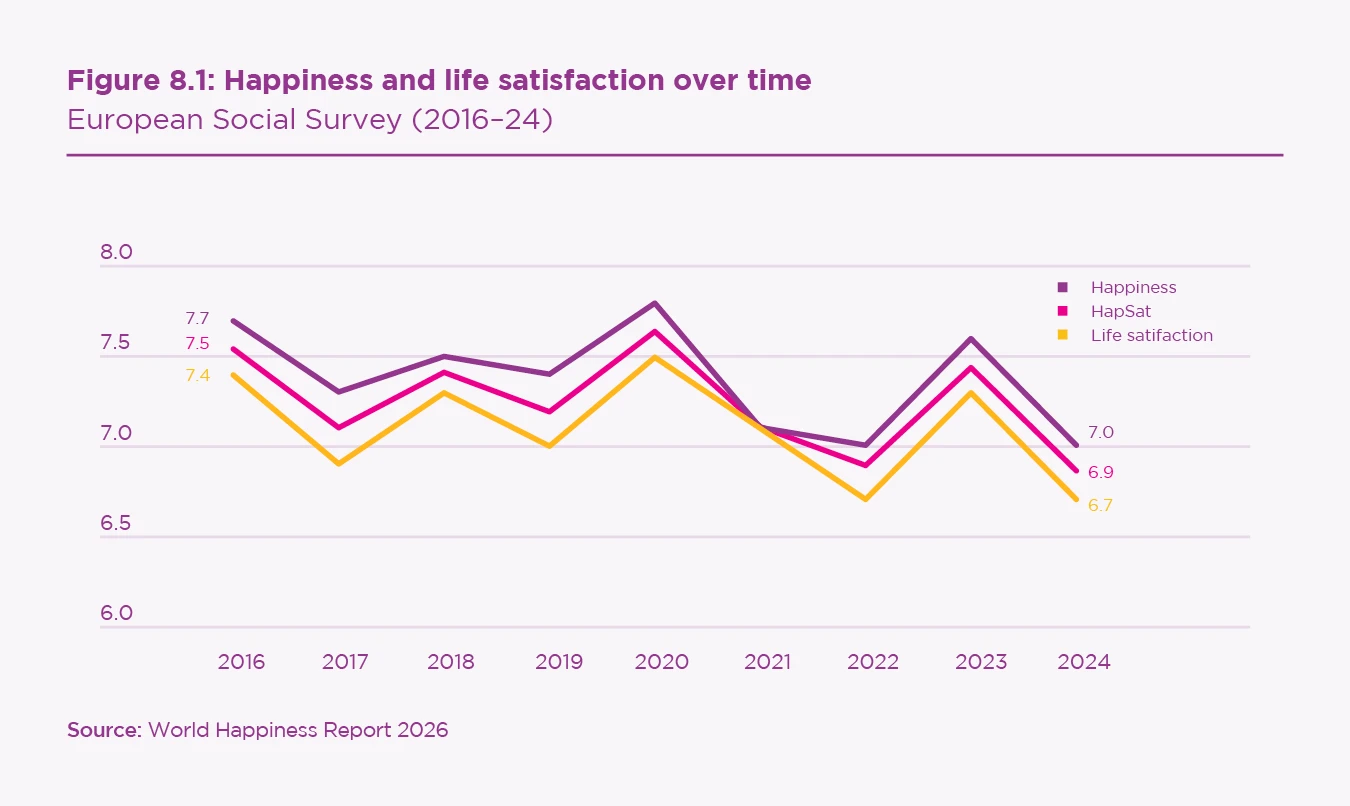
Figure 8.1 shows the similar trends across these three indicators over time.[22] Happiness is typically highest, with the dips and rises across indicators consistent throughout. We see a decrease in wellbeing across countries following the 2020 COVID-19 pandemic, with wellbeing rebounding in 2022, followed by a decline after 2023.
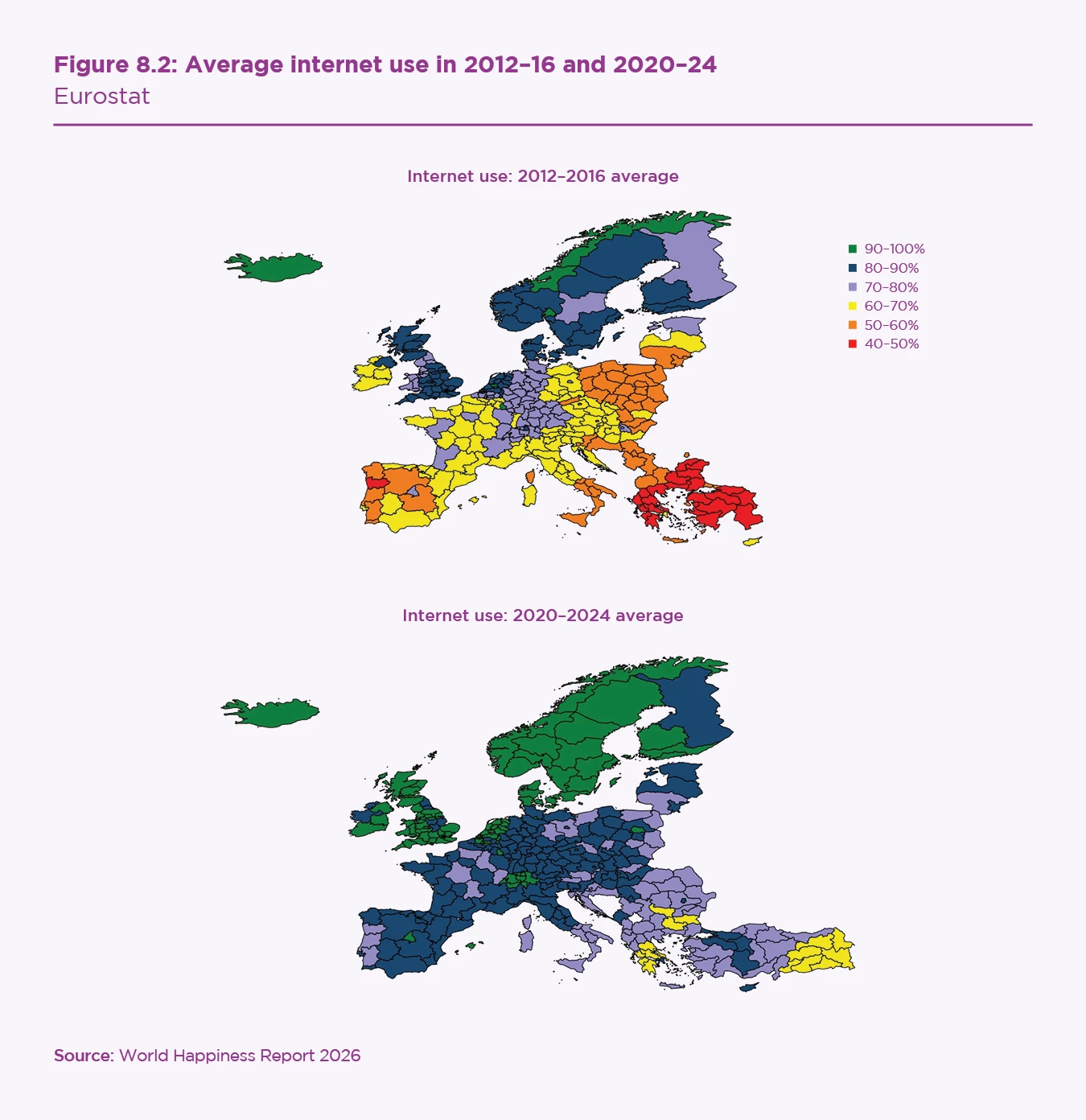
The ESS asks respondents about their daily use of the internet in minutes.[23] Furthermore, we add data from Eurostat on average internet use across the 30 countries covered by our ESS data, to compare individuals’ level of internet use relative to others in their respective regions. Figure 8.2 depicts the prevalence of internet use among residents of each NUTS2 region across Europe, in percentage terms, comparing the average level of coverage from 2012–16 to 2020–24.[24] This visual representation conveys the sizeable and ubiquitous growth in internet use over the time span, with initial levels for many regions reflecting less than 70% adoption in the early 2010s, contrasted with the preponderance of regions attaining levels above 70% by the early part of the following decade, with the majority of regions obtaining at least 80% internet use among their residents.
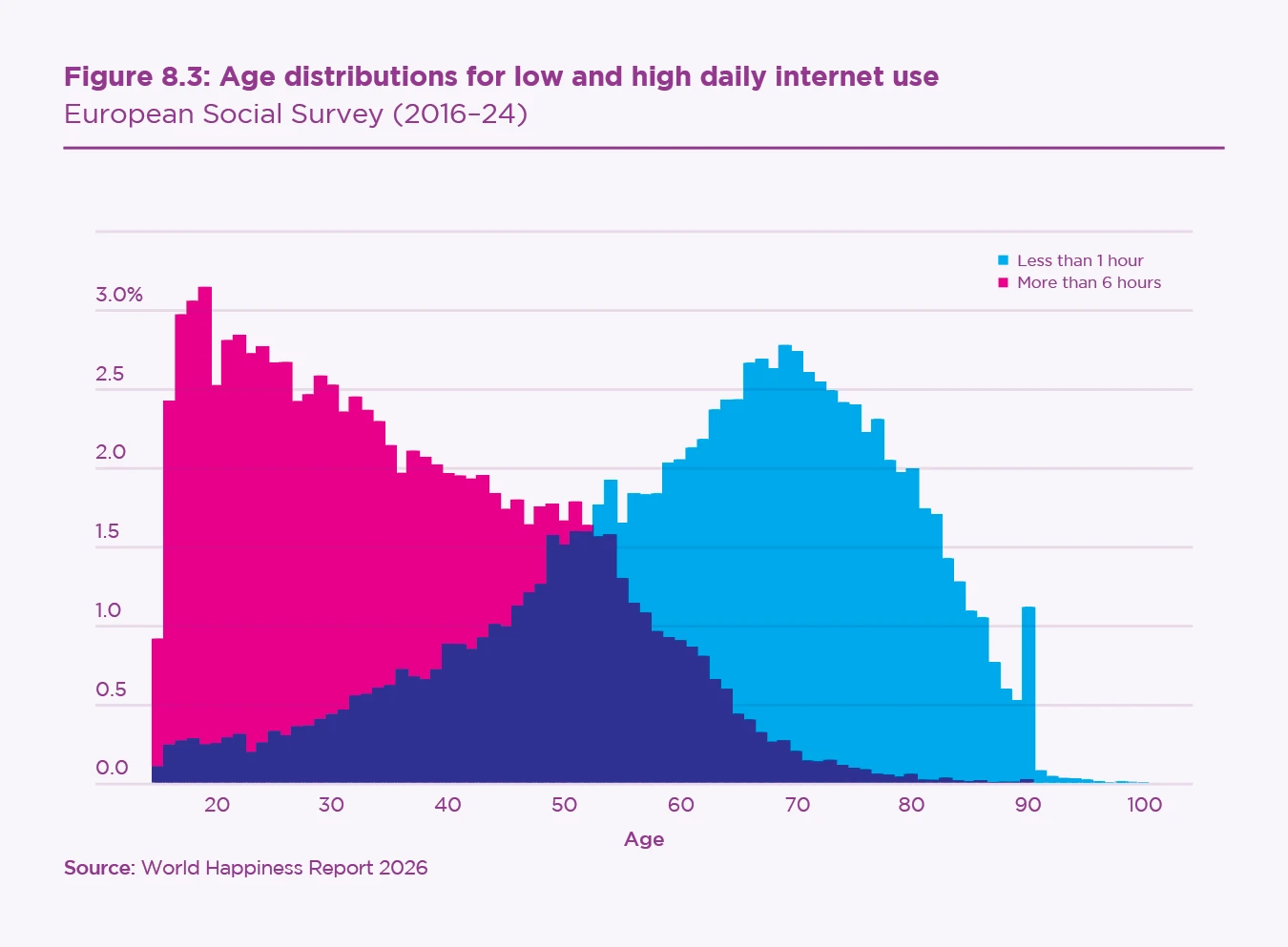
One notable feature in our data, established in previous studies, is the relationship between internet use and age. In Figure 8.3, we plot responses to the ESS question, “On a typical day, about how much time do you spend using the internet?”. The figure shows the distribution of ages among two subsets of individual respondents: those who report using the internet less than one hour per day and those who report total use of more than six hours per day. Overall, we find that heavy users (6+ hours) are much younger on average – with the majority representing users in their late teens through thirties and tapering quickly after 50 years of age. Conversely, light users (<1 hour) skew older, predominantly among those in their late sixties and seventies, with relatively little mass below those in their forties.[25]
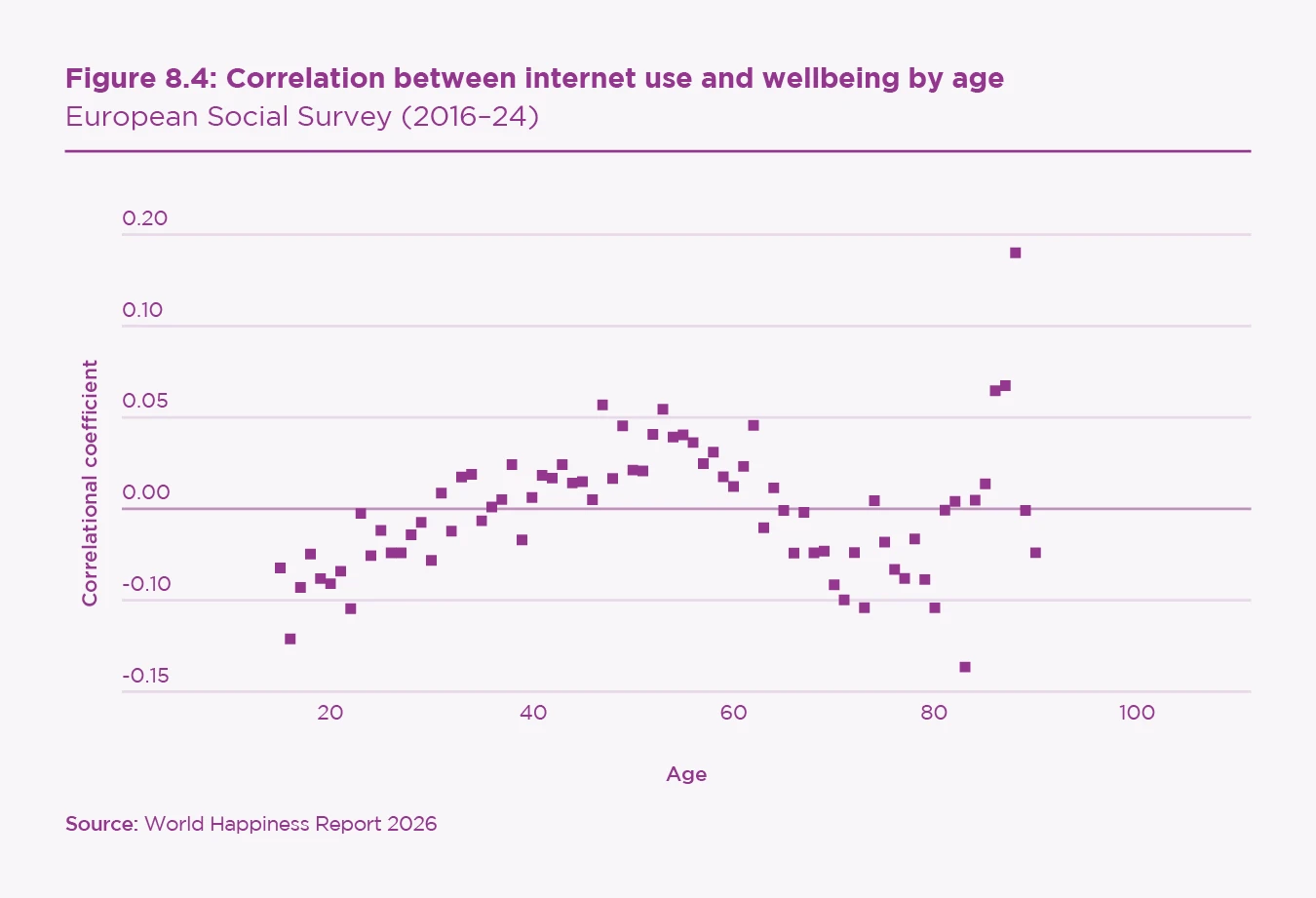
To link the relationship between age and internet use to subjective wellbeing, we plot the correlation coefficients between internet use (in minutes per day) and HapSat, across age groups. Figure 8.4 suggests a quadratic, or possibly cubic, relationship, with a generally positive correlation between internet use and wellbeing for those between 35 and 60, and a generally negative relationship for those below 35 and over 60.[26]
To understand the relationship between internet use and wellbeing, we use pooled linear regressions.[27] Our regressions include our main variables of interest: trust, social connections, and emotional attachments. For measuring trust, we consider two variables that focus on trust in people (generalised trust) and feeling safe after dark. To account for individuals’ trust in institutions, we generate a variable that is the average of three ESS questions on trust in the parliament, legal system, and politicians of the respondent’s country. For social connections, we use variables that ask individuals about their frequency of meeting friends, relatives, and colleagues, as well as the frequency they take part in social activities, compared to others of the same age. This latter variable provides information on the social comparison perspective, offering an interesting aspect of individuals’ social connections. Lastly, we include measures for individuals’ attachment to their countries and to Europe.
Table 8.1 describes our various measures of trust, social connections, and attachment. Additionally, we control for gender, age, political leaning, education, physical health, income, employment and marital status, living in urban areas, and being born in the country. We add an indicator specifically for Gen Z (individuals born after 1997). The ESS also includes a question on whether respondents have posted or shared anything about politics in the last 12 months. We use this variable to account for posting or sharing political views online. We also include country fixed effects.[28]
| Variable | ESS question(s) | Notes |
|---|---|---|
| Trust in system | On a scale of 0 (no trust) to 10 (complete trust), how much do you trust:
| Generated as mean of three ESS questions listed |
| Trust in people | Generally speaking, would you say that most people can be trusted, or that you can’t be too careful in dealing with people? | Where 0 means you can’t be too careful and 10 means that most people can be trusted |
| Safety after dark | How safe do you – or would you – feel walking alone in [area] after dark? |
|
| Social activity comparison | Compared to other people of your age, how often would you say you take part in social activities? |
|
| Social meeting frequency | How often do you meet socially with friends, relatives or work colleagues? |
|
| Attachment to country | How emotionally attached do you feel to [country]? | Where 0 means not at all attached and 10 means very attached |
| Attachment to Europe | And how emotionally attached do you feel to Europe? | Where 0 means not at all attached and 10 means very attached |
Table 8.2 presents results using our three different measures of wellbeing as dependent variables. Internet use is not a statistically significant predictor of any of the three wellbeing measures. We find that individuals who report posting or sharing political views online have lower levels of happiness and wellbeing regardless of the dependent variable used. Our main variables of interest (three measures of trust, two social connections variables, and two attachment variables) all display strong, positive, and robust relationships with our wellbeing measures. Trust in the system and trust in people, as well as social interactions with friends and the frequency of these interactions matter greatly for happiness. Individuals’ perceived levels of safety within their communities are positively related to their levels of happiness. Similarly, those who report stronger attachment to one’s country, as well as to Europe, show increased levels of happiness.
We also find that political views are associated with wellbeing. Individuals that align more with right-wing views report higher levels of happiness and wellbeing. Females and married individuals also report significantly higher happiness and wellbeing. Consistent with previous literature, we find that age has a U-shaped effect, with happiness declining initially and picking up after mid-age. Individuals living in rural areas report higher levels of happiness. Income, employment status, and physical health all have positive associations with happiness and wellbeing.
| Dependent variables | |||
|---|---|---|---|
| Variables | Happiness | Life satisfaction | HapSat |
| Internet use (in hours) | 0.00189 | 0.00178 | 0.00178 |
| Posting about politics | −0.0827*** | −0.123*** | −0.103*** |
| Trust in system | 0.0531*** | 0.103*** | 0.0779*** |
| Trust in people | 0.0438*** | 0.0578*** | 0.0508*** |
| Safety after dark | 0.140*** | 0.155*** | 0.147*** |
| Social activity comparison | 0.134*** | 0.124*** | 0.128*** |
| Social meeting frequency | 0.112*** | 0.110*** | 0.111*** |
| Attachment to country | 0.103*** | 0.0904*** | 0.0964*** |
| Attachment to Europe | 0.0308*** | 0.0264*** | 0.0286*** |
| Age | −0.0408*** | −0.0545*** | −0.0477*** |
| Age squared/100 | 0.0422*** | 0.0609*** | 0.0516*** |
| Gen Z | −0.158*** | −0.0645* | −0.111*** |
| Female | 0.179*** | 0.139*** | 0.159*** |
| University | −0.0340*** | −0.00763 | −0.0209* |
| Urban | −0.0774*** | −0.0856*** | −0.0814*** |
| Married | 0.425*** | 0.313*** | 0.369*** |
| Left wing | −0.0562*** | −0.148*** | −0.102*** |
| Right wing | 0.0430*** | 0.176*** | 0.110*** |
| Born in country | −0.0393* | 0.0484** | 0.00464 |
| Health | 0.443*** | 0.468*** | 0.455*** |
| Household net income (decile) | 0.0511*** | 0.0770*** | 0.0641*** |
| Paid work (last 7 days) | 0.0486*** | 0.106*** | 0.0773*** |
| Constant | 3.983*** | 3.715*** | 3.852*** |
| Country fixed effects | YES | YES | YES |
| Observations | 84,290 | 84,284 | 84,350 |
| R-squared | 0.234 | 0.255 | 0.286 |
Note: The pooled OLS regression results reported above use happiness, life satisfaction and HapSat (the mean of happiness and life satisfaction) as dependent variables. Each regression is run using robust standard errors which are not reported here for brevity. The regressions also include country fixed effects. The asterisks display statistical significances as follows: *** p<0.01, ** p<0.05, * p<0.1. Regressions use individual-level post-stratification survey weights.
Taken together, our results suggest the significance of the direct positive effects of trust, social connections, and emotional bonds on happiness and wellbeing.[29] However, our pooled regression results do not resolve the problem of endogeneity and reverse causality between internet use and wellbeing. We turn to this issue next.
Do people who use the internet more frequently report higher life satisfaction and happiness, or are people who are happy more likely to use the internet?
The problem of reverse causality
The relationship between internet use and wellbeing raises an important issue of causality: do people who use the internet more frequently report higher life satisfaction and happiness, or are people who are happy more likely to use the internet? Some studies that have accounted for the reverse causality between social media use and happiness have found that social media use does affect wellbeing.[30] But differences in results within the literature, particularly across disciplines, can often be attributed to a lack of longitudinal data or difficulties in identifying and controlling for causality and finding reliable indicators to address this concern.[31]
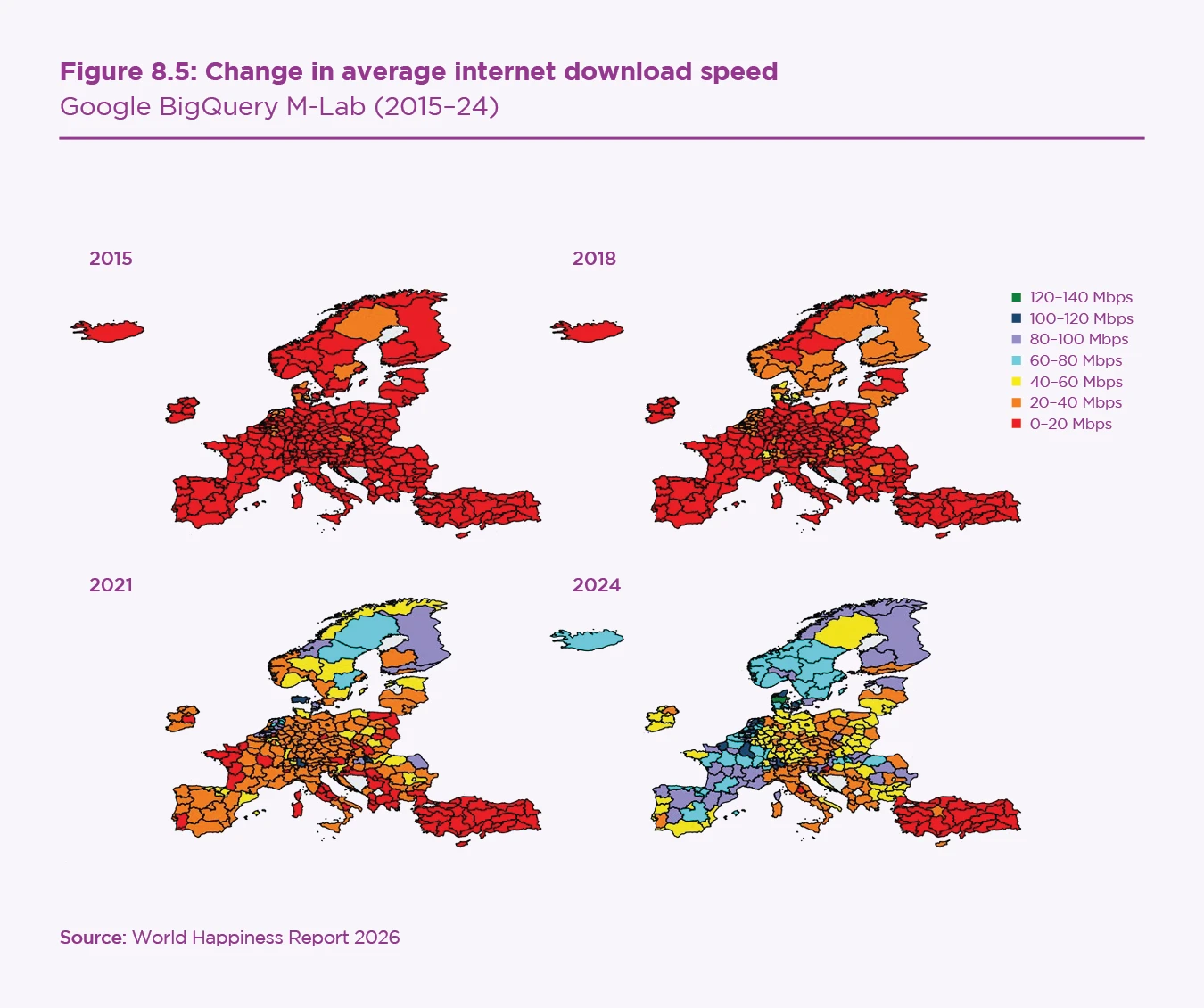
In our analysis, we account for reverse causality by using an instrumental variable approach, employing data on the evolution of internet download speeds as an instrument for internet use. We construct a panel of regional internet speeds using Measurement Lab (M-Lab) data hosted in Google BigQuery. M-Lab is a nonprofit open platform that runs standardised internet speed tests worldwide and publishes the anonymised measurements (including timestamps, download throughput, and approximate latitude/longitude) for public use. BigQuery is Google’s cloud data warehouse that allows efficient SQL queries over very large datasets without local storage or specialised infrastructure. Using M-Lab’s public tables in BigQuery, we extract tests from 2015–24 and transform each test’s coordinates into a point that we map to a Eurostat NUTS2 region.
Within each region, we compute the quarterly mean download speed (Mbps) and the number of contributing tests. Since speed distributions could be skewed, we also report the median as a robustness measure. The procedure yields a consistent quarterly time series for every NUTS2 region. We then merge this internet speed data to the ESS data at the individual level, with each respondent matched to the quarterly average download speed in their corresponding NUTS2 region in the quarter that their survey interview took place. This approach offers transparent, replicable indicators of regional internet performance suitable for descriptive analysis and as instruments or controls in econometric applications.

Figure 8.5 shows changes in average download speeds across NUTS2 regions from 2015 to 2024. We see that while internet speeds rose everywhere, there is significant variation in the levels and rates of growth across countries. For example, countries like Iceland, Norway, and Sweden, as well as regions in France and Germany, experienced the most drastic improvements, while regions of Southern and Eastern Europe tend to lag further behind. We exploit this variation across regions and time to instrument for internet use, under the assumption that internet infrastructure development is not a function of self-reported wellbeing of residents in that area.
Next, we reconsider our linear regressions to address the issue of potential endogeneity between internet use and wellbeing. Our goal is to isolate the effect of internet use on happiness and wellbeing while controlling for reverse causality, and then to quantify how the effect of internet use moves through the channels of trust and social connections.
Using an instrumental variable (IV) approach changes our estimates considerably. Table 8.3 compares our original OLS results with our IV results. While the coefficient estimates for our other controls remain mostly consistent, the effect of internet use on wellbeing, after correcting for reverse causality, is now negative and significant.[32]
| Dependent variable: HapSat | ||
|---|---|---|
| Variables | OLS | IV |
| Internet use (in hours) | 0.00178 | −0.0915*** |
| Posting about politics | −0.103*** | −0.0589*** |
| Trust in system | 0.0779*** | 0.0750*** |
| Trust in people | 0.0508*** | 0.0525*** |
| Safety after dark | 0.147*** | 0.147*** |
| Social activity comparison | 0.128*** | 0.122*** |
| Social meeting frequency | 0.111*** | 0.114*** |
| Attachment to country | 0.0964*** | 0.0929*** |
| Attachment to Europe | 0.0286*** | 0.0303*** |
| Age | −0.0477*** | −0.0525*** |
| Age squared/100 | 0.0516*** | 0.0523*** |
| Gen Z | −0.111*** | −0.0839*** |
| Female | 0.159*** | 0.148*** |
| University | −0.0209* | 0.0507** |
| Urban | −0.0814*** | −0.0407** |
| Married | 0.369*** | 0.328*** |
| Left wing | −0.102*** | −0.0974*** |
| Right wing | 0.110*** | 0.117*** |
| Born in country | 0.00464 | −0.000206 |
| Health | 0.455*** | 0.445*** |
| Household net income (decile) | 0.0641*** | 0.0719*** |
| Paid work (last 7 days) | 0.0773*** | 0.121*** |
| Constant | 3.852*** | 4.251*** |
| Country fixed effects | YES | YES |
| Observations | 84,350 | 77,058 |
| R-squared | 0.286 | 0.266 |
Note: The regression results reported above use HapSat (the mean of happiness and life satisfaction) as the dependent variable. Each regression is run using robust standard errors which are not reported here for brevity. The asterisks display statistical significances as follows: *** p < 0.01, ** p < 0.05, * p < 0.1. Regressions use individual-level post-stratification survey weights. The regression in the second column is an instrumental variable 2SLS type with median internet download speed reported quarterly used as the instrument for internet use.
The implementation of the IV strategy does reduce our effective sample size slightly, due to missing or incomplete location data for some survey respondents. However, there does not appear to be any systematic effect on our variables of interest as a result. Summary statistics for both estimation samples are provided in Table 8B.3 in the online appendix. With the endogeneity concerns addressed through our IV strategy, the next step is to unpack the mechanisms behind the estimated effects by analysing how trust, social connections, and emotional bonds contribute to changes in wellbeing.

Trust, social connections, and emotional bonds
In this section, we examine how a set of social, emotional, and institutional channels contribute to changes in subjective wellbeing across demographic groups and over time. While our instrumental variable (IV) estimates established a generalised effect of internet use on wellbeing, individuals experience the broader social environment through multiple pathways that interact with or reinforce this relationship. Therefore, we focus on several key determinants highlighted in the wellbeing literature: social interactions, trust in people and institutions, attachments, and feelings of safety. We assess how changes in these variables, combined with their coefficients from our IV model, shape the wellbeing landscape from earlier rounds of the ESS (Rounds 8 and 9, 2016–19) to later rounds (Rounds 10 and 11, 2020–24). By decomposing changes in each channel across generations, genders, and regions, we provide a detailed account of how internet use, social connections, and emotional bonds have shifted during this period and the extent to which these shifts contribute to overall trends in wellbeing.
Before analysing how social and emotional channels contribute to changes in wellbeing, we divide our sample into meaningful demographic and regional groups. Generational cohorts are defined using standard birth-year cutoffs: Gen Z (born 1997 or later), Millennials (1981–1996), Gen X (1965–1980), and Baby Boomers (born 1964 or earlier). We also distinguish between Central and Eastern Europe and Western Europe to reflect the persistent social, institutional, and economic differences across these regions. Table 8.4 summarises the countries assigned to each region. These groupings are used throughout the section to examine heterogeneity in mean changes, causal coefficients, and implied wellbeing effects.
| Central and Eastern Europe | Bulgaria, Croatia, Cyprus, Czechia, Estonia, Hungary, Latvia, Lithuania, North Macedonia, Montenegro, Poland, Serbia, Slovakia, Slovenia |
|---|---|
| Western Europe | Austria, Belgium, Denmark, Finland, France, Germany, Greece, Iceland, Ireland, Italy, Netherlands, Norway, Portugal, Spain, Sweden, Switzerland, United Kingdom |
Across all demographic groups, average daily internet use increased substantially between 2016–19 and 2020–24. Figure 8.6 (left panel) shows that the growth gradient is steeply age-dependent. The largest increases occurred among younger cohorts, especially Gen Z, with the most pronounced growth observed among Gen Z females in Central and Eastern Europe. Even among Millennials, average use rose by roughly one hour per day over this period. In contrast, older cohorts (Gen X and Baby Boomers) display much smaller increases, remaining below three hours per day on average. These patterns illustrate a widening generational gap in digital engagement. Not only do younger individuals spend more time online, but their usage appears to be accelerating more rapidly than that of older groups. The divergence is especially marked in regions of Central and Eastern Europe.
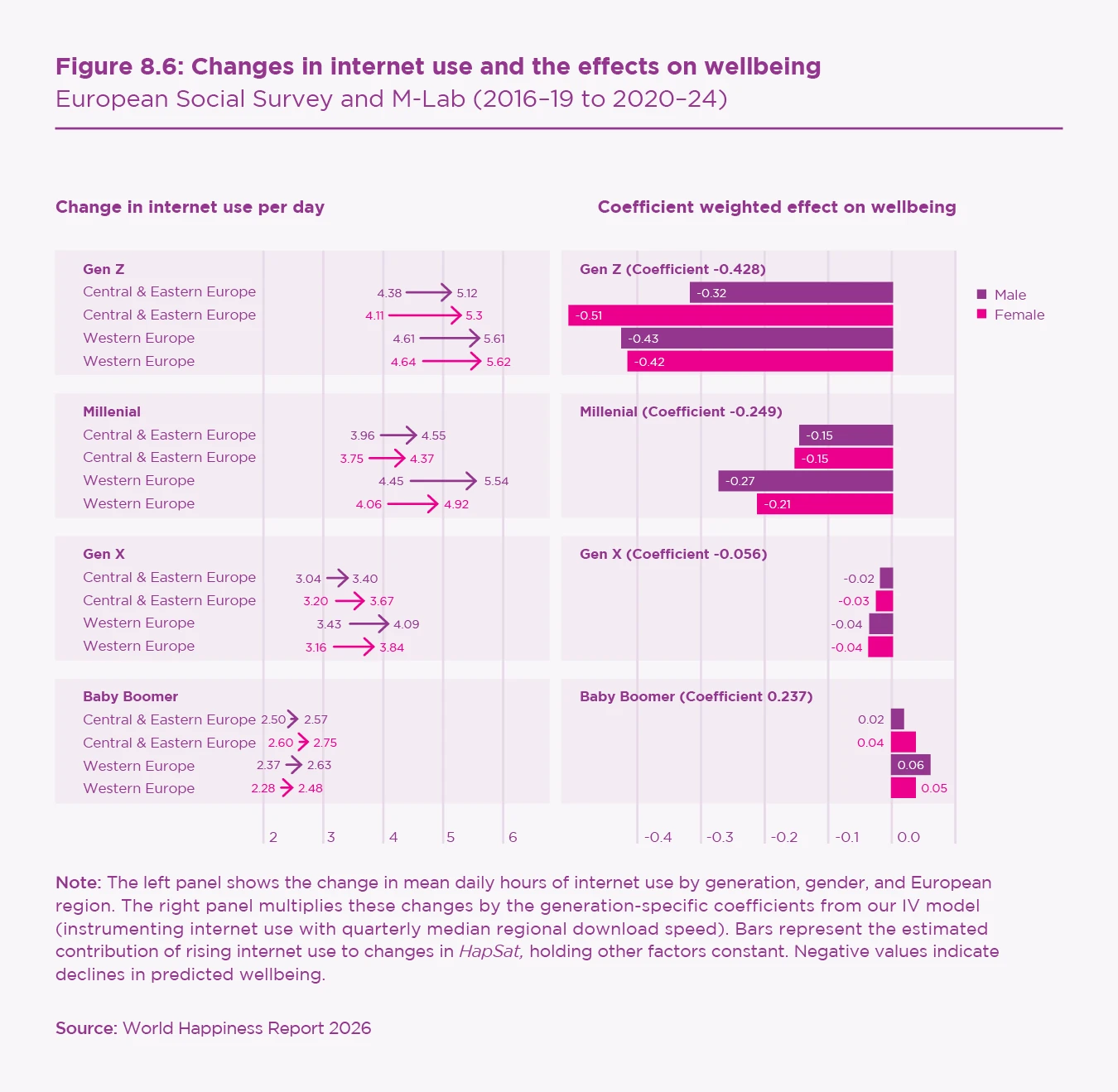
The right panel of Figure 8.6 translates these behavioural changes into implied wellbeing effects by multiplying the observed changes in mean internet use by the generation-specific IV coefficients from our preferred causal model. Because we estimate the model separately for each generation, each cohort has its own causal coefficient, allowing us to quantify how rising internet use affects wellbeing within each generation while holding other factors constant. The results reveal substantial heterogeneity. For Gen Z, who exhibit the largest predicted negative effect of internet use on wellbeing, the sharp increase in daily online time translates into the largest predicted decline in wellbeing, representing a 0.3–0.5 point decline on the 10-point wellbeing scale. Millennials experience a more moderate implied decrease, due to their smaller predicted negative coefficients and smaller mean internet use increase. For Gen X, where the causal effect is near zero, increases in usage have very little predicted impact on wellbeing. Finally, among Baby Boomers, the causal coefficient is positive, so rising internet use yields a small predicted improvement in wellbeing. This pattern underscores that wellbeing consequences depend not only on how much individuals increase their internet use, but also on how sensitive each cohort is to that exposure.
Wellbeing losses and gains across Europe are shaped not by a single factor but by a combination of shifting social and emotional conditions.
Taken together, these results highlight a key insight: rising internet use has very different wellbeing implications across generations. For younger cohorts, the combination of rapid growth in online engagement and a strongly negative causal effect suggests that the digital environment may fundamentally be a different experience than it is for older generations. Millennials exhibit similar but less pronounced dynamics. For older adults, however, moderate increases in internet use appear to complement rather than displace social connections – perhaps by reducing isolation, improving access to information, or facilitating communication with family. The net effect is a nuanced generational divide: the same expansion in digital engagement that harms the wellbeing of younger groups may modestly benefit older ones. These findings highlight the importance of considering both exposure and susceptibility when evaluating the broader social consequences of digital technologies.
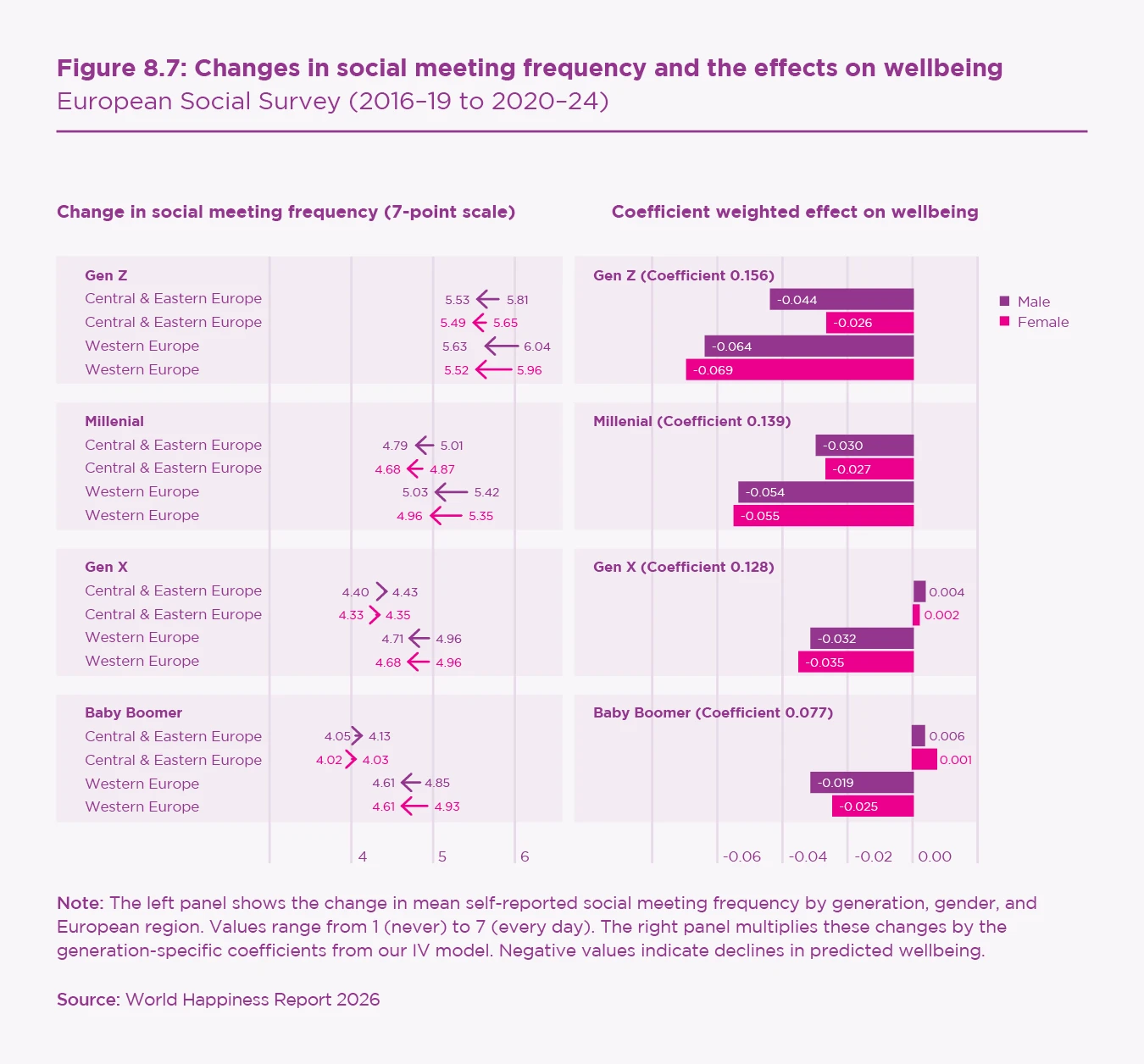
Figure 8.7 shows clear changes in social meeting frequency from 2016–19 to 2020–24. Western Europe consistently reports higher levels of social meetings, but it also experienced the largest declines, particularly among Gen Z and Millennials. In Central and Eastern Europe, changes were more muted, and older cohorts even show slight increases. As a result, the East-West gap in social interactions narrowed over time, not because Central and Eastern Europe increased markedly, but because Western Europe’s social activity fell sharply. Overall, the data suggest a continent-wide contraction of in-person social engagement, with the most pronounced reductions occurring among younger generations in Western Europe.
These behavioural shifts have important wellbeing implications. The effect of social meeting frequency on wellbeing is strongest among younger cohorts, and these are the same groups that experienced the largest declines in social interactions. Gen Z and Millennials show the largest predicted declines in wellbeing, especially in Western Europe. In contrast, Gen X and Baby Boomers exhibit much smaller changes in social meetings and weaker causal coefficients, resulting in near-zero or slightly positive implied effects. Taken together, the findings suggest that reduced social interactions have disproportionately affected younger Europeans, amplifying the wellbeing consequences of the post-2020 social environment.
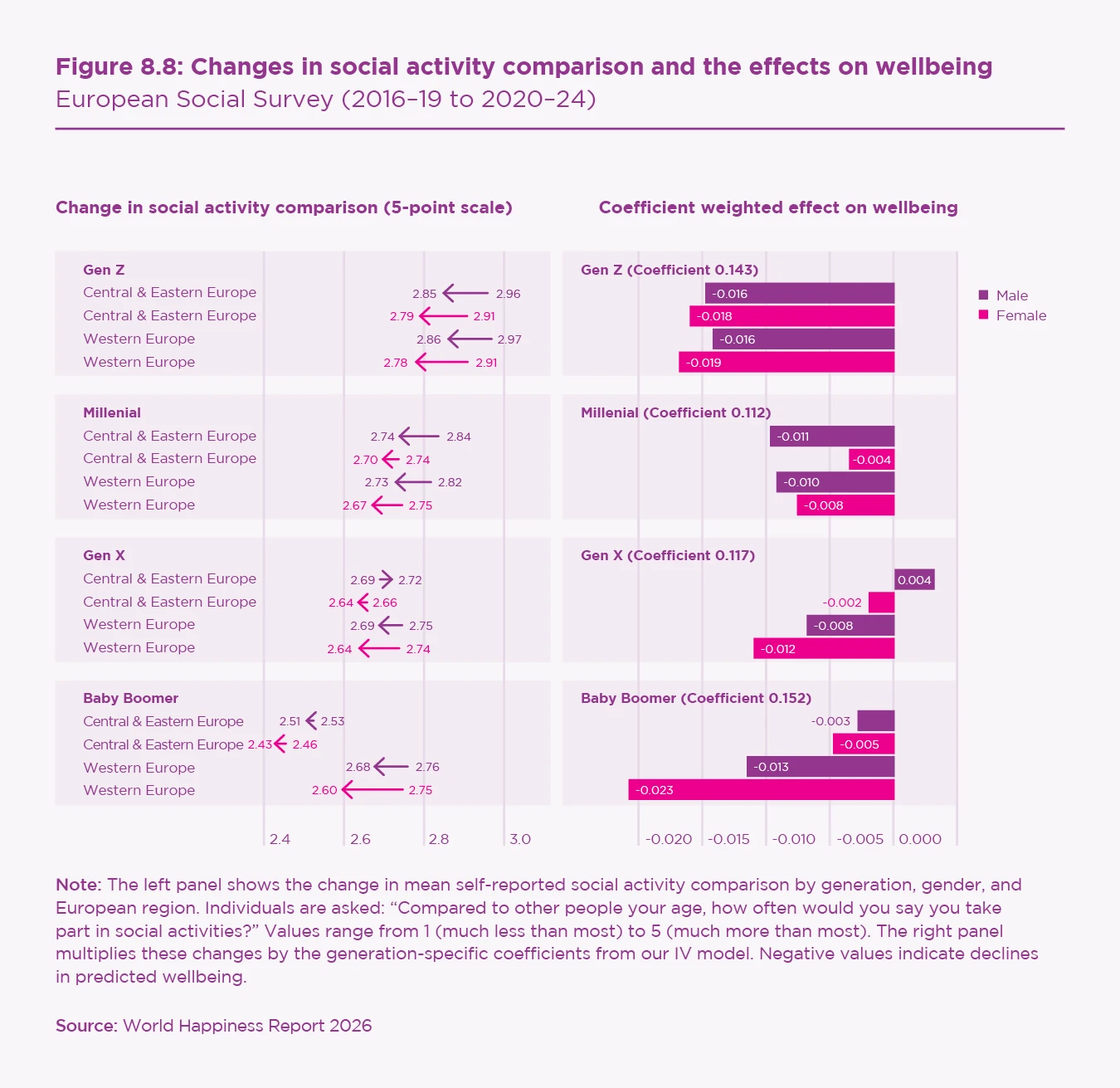
Figure 8.8 presents changes in how frequently individuals report socialising relative to others their age, making this a measure of perceived social engagement rather than objective social behaviour. Across nearly all regions, genders, and generations, perceived social activity declined between 2016–19 and 2020–24. A consistent gender pattern emerges: women generally rate themselves as less socially active than their peers, a gap that persists across all cohorts. Older generations also tend to perceive themselves as less socially active than others their age, and this pattern continued through the post-2020 period. Although declines are visible in almost every group, they are most pronounced in Western Europe, producing a nearly universal downward shift in perceptions of relative social engagement.
Because the coefficients linking perceived social activity to wellbeing are similar across generations, declines in this perception affect both young and old in broadly comparable ways. However, the largest combined effects arise among younger cohorts and older women in Western Europe, who experienced the greatest falls in perceived social activity. Importantly, this variable reflects how individuals evaluate their own social lives, which may increasingly be shaped by digital environments. The fact that these groups show the largest coefficient-weighted wellbeing losses lends support to a social-comparison interpretation: even modest behavioural declines can translate into meaningful drops in subjective wellbeing when perceptions shift more sharply than actions. Together, the evidence suggests that digital comparison pressures may be reshaping how individuals see themselves in relation to their peers, with measurable consequences for wellbeing.
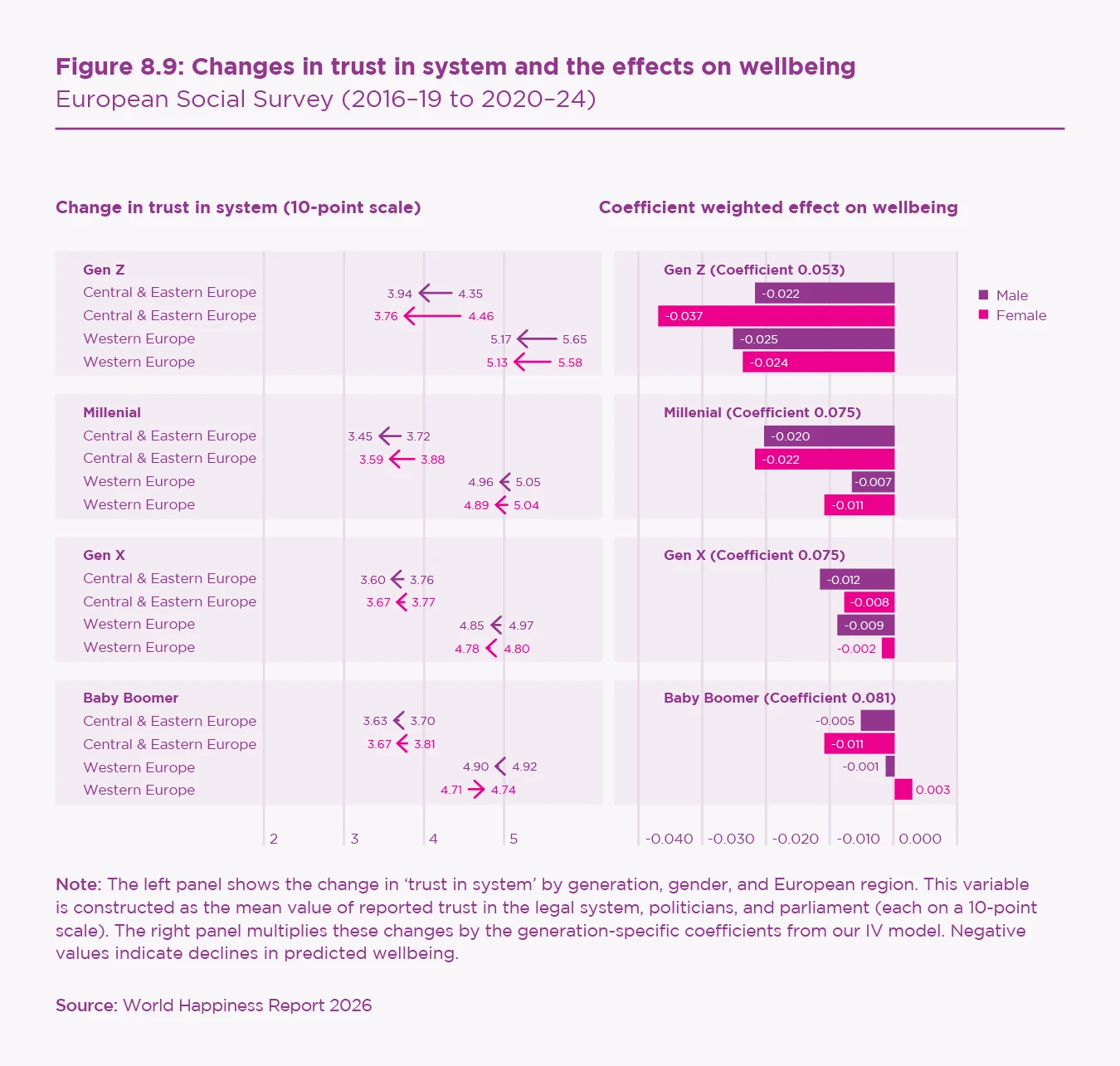
Figure 8.9 presents changes in ‘trust in system’, measured as the average of trust in the legal system, politicians, and parliament. Across all generations, genders, and regions, there is a clear downward shift in system trust from 2016–19 to 2020–24. The longstanding East-West divide remains large: individuals in Eastern and Central Europe consistently report substantially lower system trust than their counterparts in Western Europe, regardless of gender or age. Yet, the most striking feature of the figure is the steep decline among Gen Z, whose trust in political and legal institutions fell more sharply than that of any other cohort. Millennials and Gen X also show declines, though more modest, while Baby Boomers experience the smallest shifts. Overall, the data portray a widespread erosion of institutional trust, most pronounced among younger Europeans.
Although system trust has a weaker causal association with wellbeing for younger cohorts – reflected in their smaller IV coefficients – their large declines in trust levels produce the largest negative predicted effects on wellbeing. In other words, even though system trust “matters” less for Gen Z in marginal terms, the sheer size of this drop in trust yields the most substantial wellbeing losses. Millennials and Gen X experience smaller combined effects, reflecting both moderate declines in trust and moderately sized coefficients. Baby Boomers show only minimal predicted impacts. Taken together, these results imply that the erosion of institutional trust has had its greatest wellbeing consequences for the youngest generation, reinforcing the broader picture that post-2020 changes in the social and political environment have disproportionately affected younger Europeans.
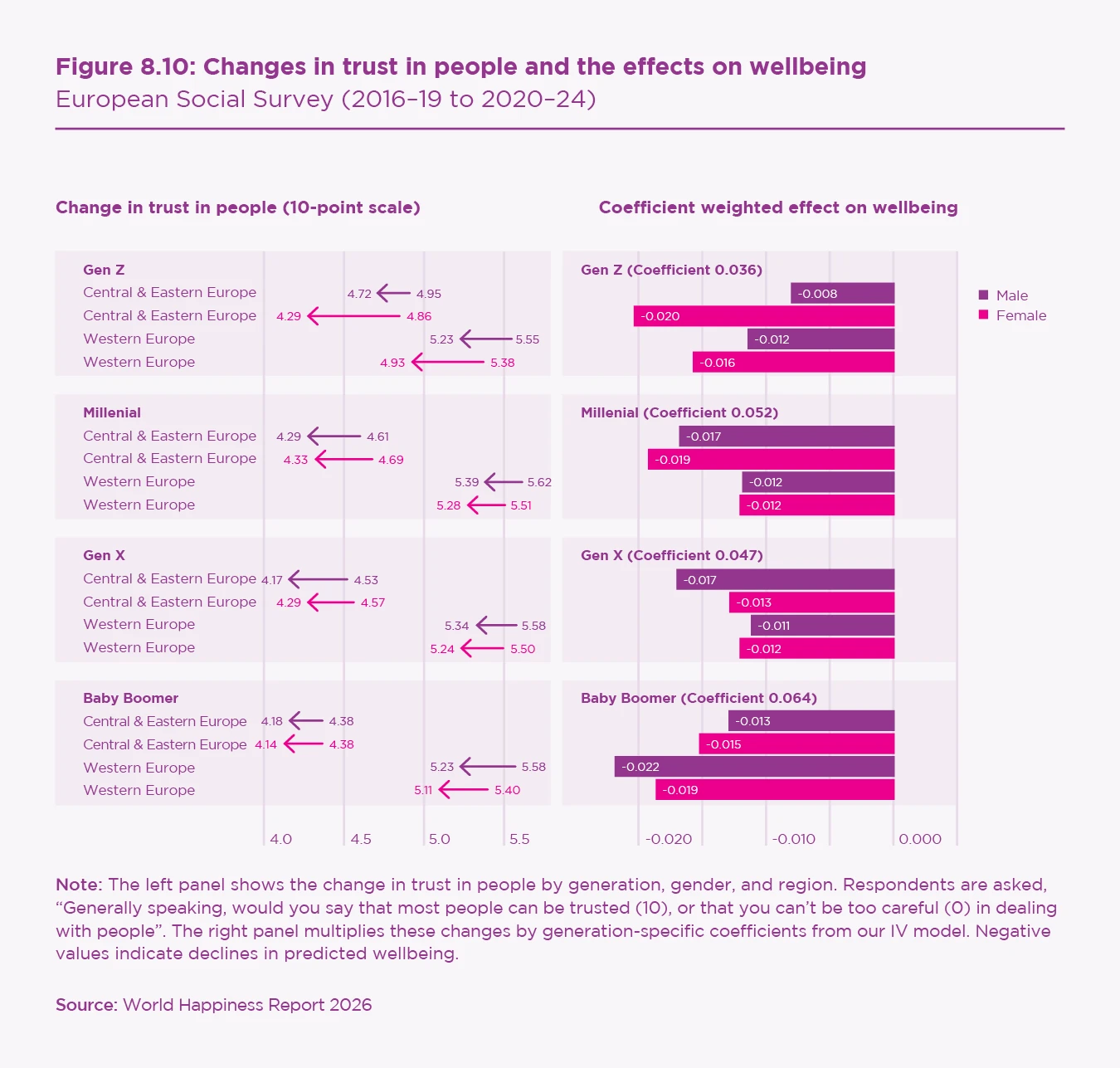
Figure 8.10 shows substantial declines in trust in people across all age groups, genders, and regions from 2016–19 to 2020–24. The drop is universal, with no demographic subgroup showing an increase in interpersonal trust. As with system trust, there remains a pronounced East-West divide: respondents in Central and Eastern Europe consistently report significantly lower interpersonal trust than those in Western Europe, and this holds across generations and genders. The steepest declines occur among Gen Z, especially Gen Z females, who show some of the largest downward shifts in interpersonal trust across the entire sample. Although trust in other people is already relatively low in Central and Eastern Europe, Western Europe also experienced meaningful declines, contributing to a broad European-wide erosion of interpersonal trust.
Although declines in interpersonal trust reduce wellbeing across all generations, the underlying mechanism appears to differ between younger and older cohorts. Among Gen Z, the coefficient linking trust to wellbeing is relatively small, but the drop in trust levels is so pronounced that the implied wellbeing losses are substantial. For Baby Boomers, the pattern is reversed: their trust levels fell only slightly, yet interpersonal trust carries a much larger causal weight in their wellbeing equation, so even modest declines generate meaningful (though still smaller) predicted effects. This contrast highlights that the wellbeing consequences of trust erosion operate through different channels across age groups: the magnitude of the decline for the young, and the importance of trust in people for the old.
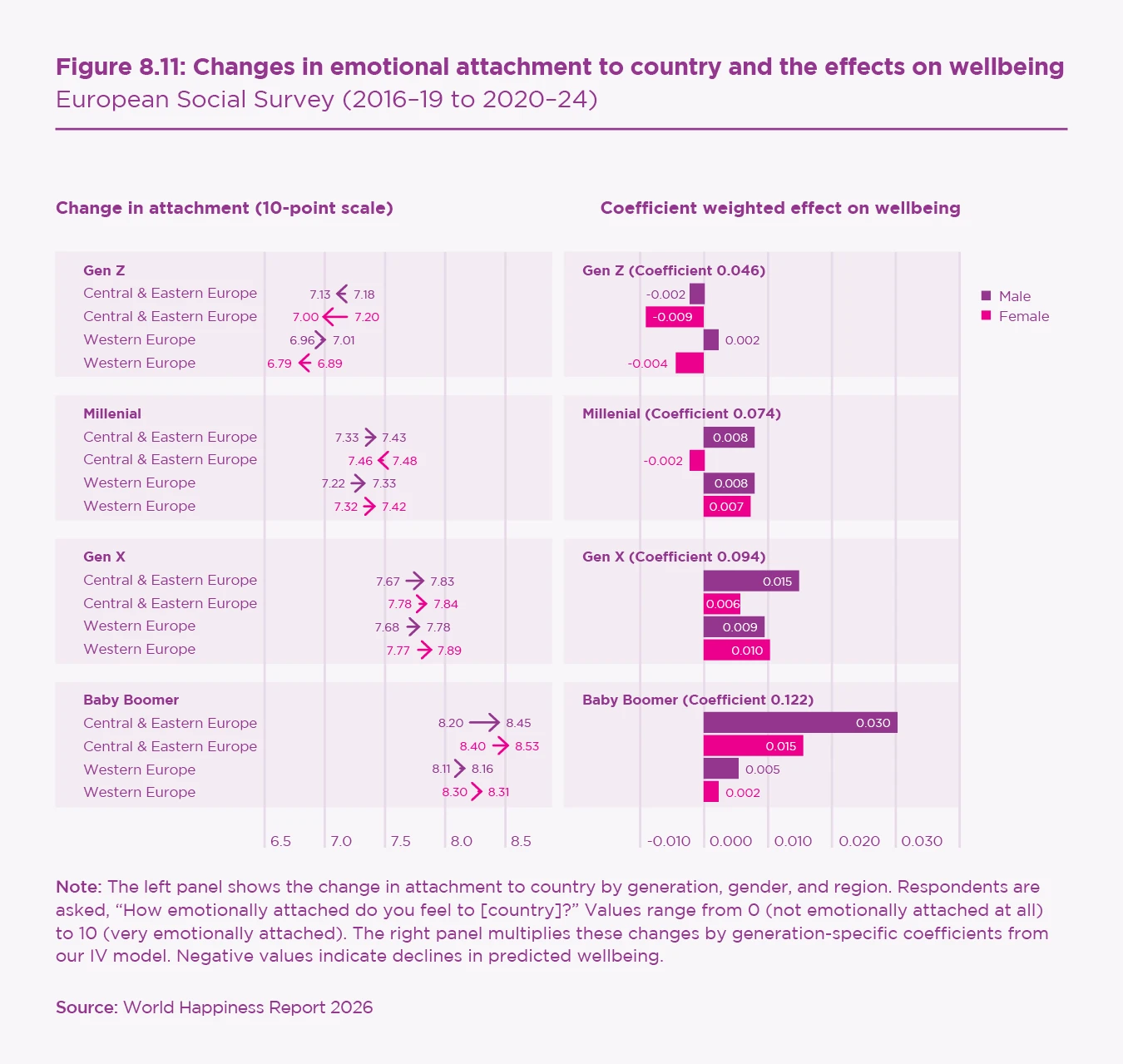
Figure 8.11 shows how individuals’ emotional attachment to their country has changed from 2016–19 to 2020–24. A clear generational divide emerges: older cohorts consistently report stronger attachment to their country, with Baby Boomers scoring highest across regions and genders. Younger generations (particularly Gen Z) show the lowest levels of attachment, and among younger females there is even a slight decline over time, especially in Western Europe. In contrast, attachment appears to increase modestly among older groups, with Baby Boomers in both regions reporting higher attachment in the later period. The overall picture is one in which emotional connection to one’s country is highest (and increasing) among older adults, while younger Europeans show weaker and, in some cases, declining attachment.
The coefficient-weighted results indicate that attachment to country has a positive association with wellbeing, with the effect strengthening with age. Baby Boomers exhibit the largest coefficients, meaning attachment carries substantial wellbeing significance for this generation. Combined with their rising attachment levels, this produces the largest positive predicted wellbeing effects, especially among male Baby Boomers in Central and Eastern Europe. Millennials and Gen X show smaller gains, reflecting moderate increases in attachment paired with moderate coefficients. For Gen Z, whose coefficients are smaller and whose means change little (or even decline slightly for some subgroups), the implied wellbeing effects are minimal or near zero. Overall, these results suggest that emotional bonds to one’s country have become an increasingly important wellbeing resource for older Europeans, while playing a more limited role for younger cohorts.
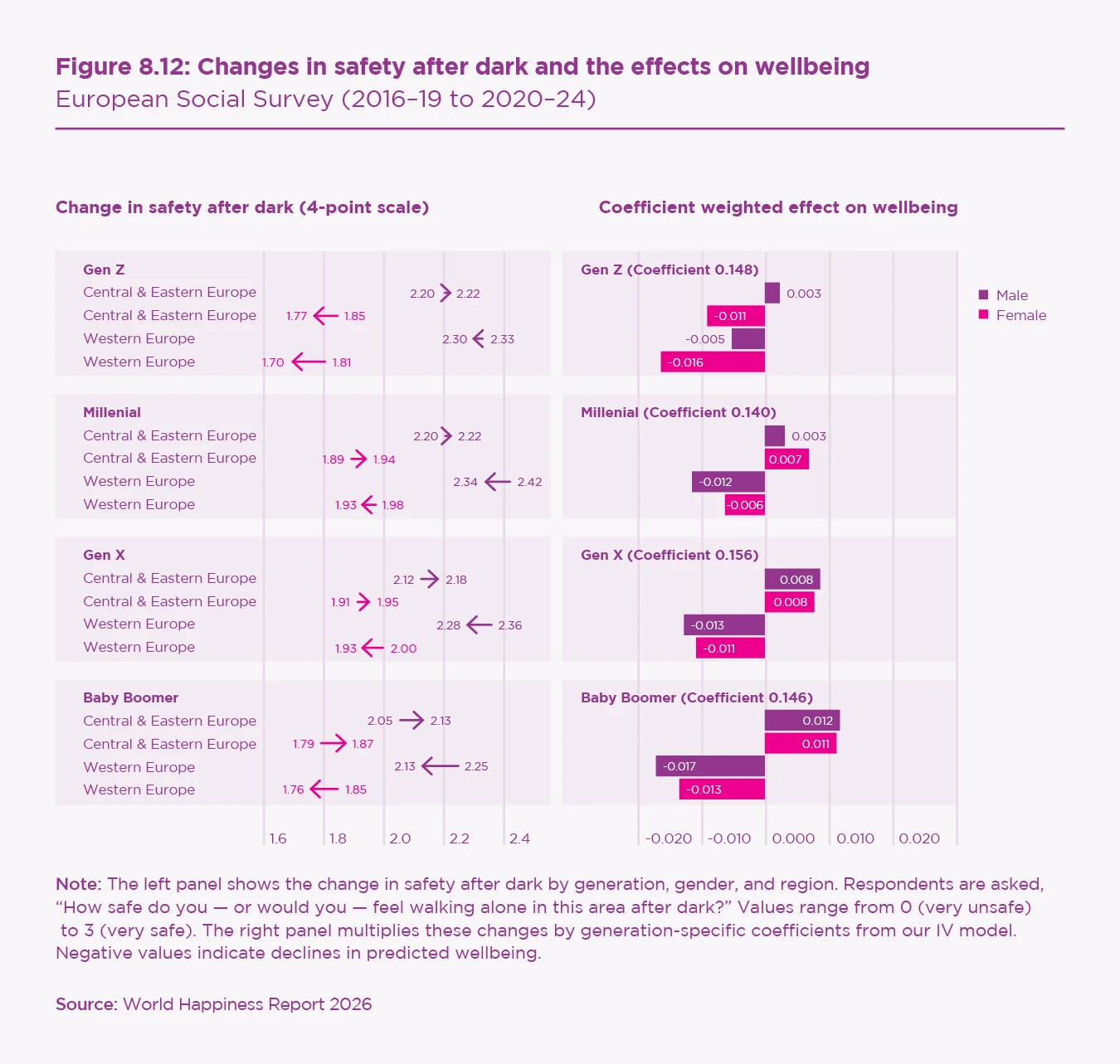
Figure 8.12 shows changes in perceived safety when walking alone after dark between 2016–19 and 2020–24. Across every region and generation, there is a clear and persistent gender divide: women consistently feel less safe than men, and this pattern holds even within narrowly defined demographic groups. The geographic split is also notable. In Western Europe, feelings of safety declined universally, with both men and women reporting lower perceived safety across all generations. In contrast, Central and Eastern Europe show the opposite pattern: most groups report improved feelings of safety over time, with the main exception being Gen Z females, whose safety perceptions remain low and are decreasing.
The coefficient-weighted effects indicate that feelings of safety have a consistently positive association with subjective wellbeing, with coefficients similar across generations. Because these coefficients do not vary much by age group, the implied wellbeing effects are driven almost entirely by changes in the means, rather than by differences in sensitivity. As a result, the largest negative effects appear among groups in Western Europe, where declines in perceived safety were largest. Conversely, groups in Central and Eastern Europe, who experienced modest but widespread improvements in safety perceptions, show small positive predicted impacts on wellbeing. The gender divide remains visible: women generally experience larger negative implied effects in Western Europe, reflecting both lower baseline safety perceptions and steeper declines. Overall, the findings suggest that trends in perceived public safety contribute meaningfully, albeit unevenly, to the broader pattern of wellbeing change, reinforcing how local environments and personal security shape subjective wellbeing across Europe.

Indirect effects of internet use on wellbeing
Next, we examine whether the effect of internet use carries through our channels of trust, social connections, and attachments across individuals. The question we ask is whether increased use of the internet changes individuals’ wellbeing levels above and beyond what we have seen through our estimations in the previous section.
In order to assess whether internet use has indirect effects on wellbeing, we first construct categorical versions of high versus low levels of trust, social connections, and emotional attachments to allow for the differences among individuals.[33] The “high” group are those that report higher levels of system trust, trust in people, and safety after dark, respectively.[34] This group also encompasses those individuals who report higher social meeting frequency and being more socially active in comparison to their peers. Additionally, this group has greater ties to their country as well as to Europe. Individuals who fall in the “low” group for system and people trust, on average, have wellbeing levels that are 1.35 to 1.29 points lower respectively, on the 0 to 10 scale, compared to those who report high levels of trust. For social connections, those in the “low” group have about a point lower wellbeing levels than those who report “high” levels of social connections. For emotional attachments, being in the “low” category amounts to 0.88 to 1.02 points of a decrease in wellbeing in comparison to those in the “high” category.
To analyse the pass-through effect of internet use on these channels, we include interaction terms in our instrumental variable regression model. In constructing the interaction terms, we multiply the internet use variable with all newly created categorical versions (high/low) of our trust, social connections, and emotional attachment variables. The regression also includes all of our channel variables (in their original scales), control variables from our earlier regressions, as well as country fixed effects. We use the median quarterly download speed as our instrument for internet use.[35] Figure 8.13 shows the estimates for our interaction terms for individuals falling under “high” or “low” categories of trust, social connections, and emotional attachments.
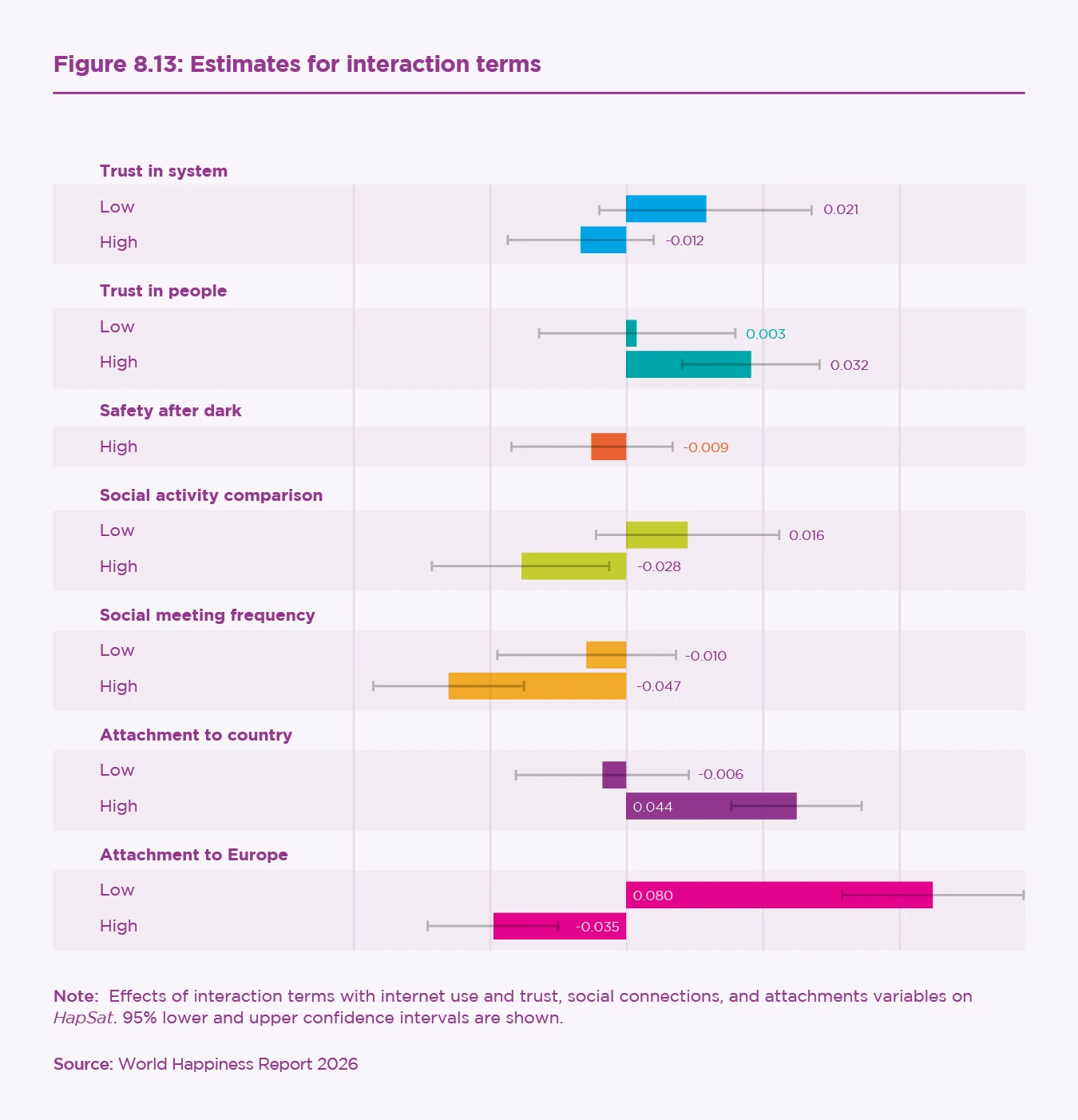
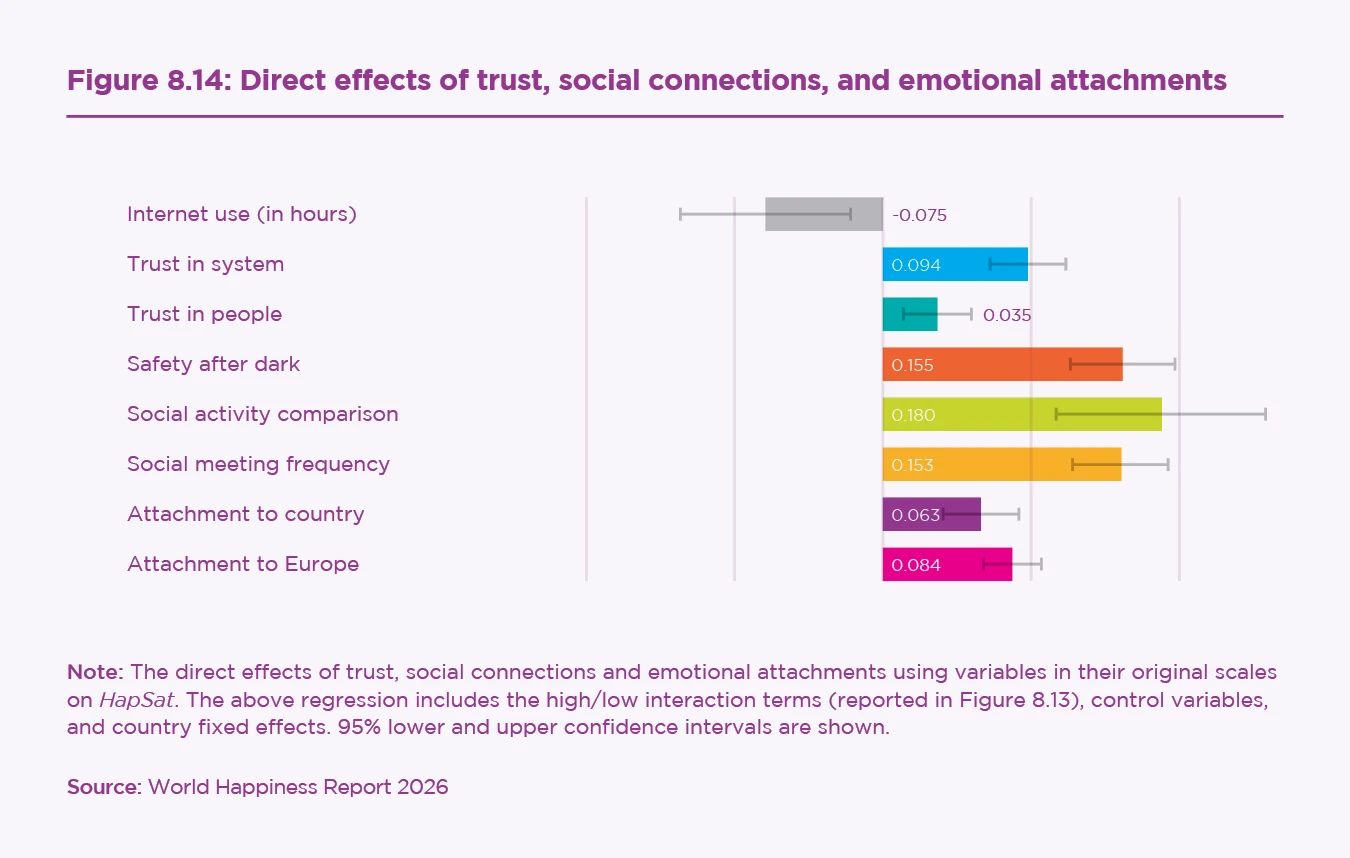
Figure 8.14 demonstrates the large direct effects (from the same regression) on wellbeing from the corresponding main variables of trust, social connections, and emotional attachments. The interaction effects are statistically significant for those with high interpersonal trust, high social activity comparison with peers, high social meeting frequency, high attachments to country, and for those in both low and high categories of attachment to Europe. Internet use has a positive effect for those reporting higher people trust and higher attachment to country. However, when examining social connections, our interaction terms show that individuals who report being more socially active suffer more in terms of their wellbeing from higher use of the internet. These negative interactions indicate that the wellbeing costs of internet use are larger for individuals who are more socially active, which is consistent with a displacement story: people with rich offline social lives have more to lose when time shifts from in-person to online interaction. While this does not prove displacement, the pattern from Figure 8.13 aligns with the idea that additional internet use may crowd out high-value offline social connections.
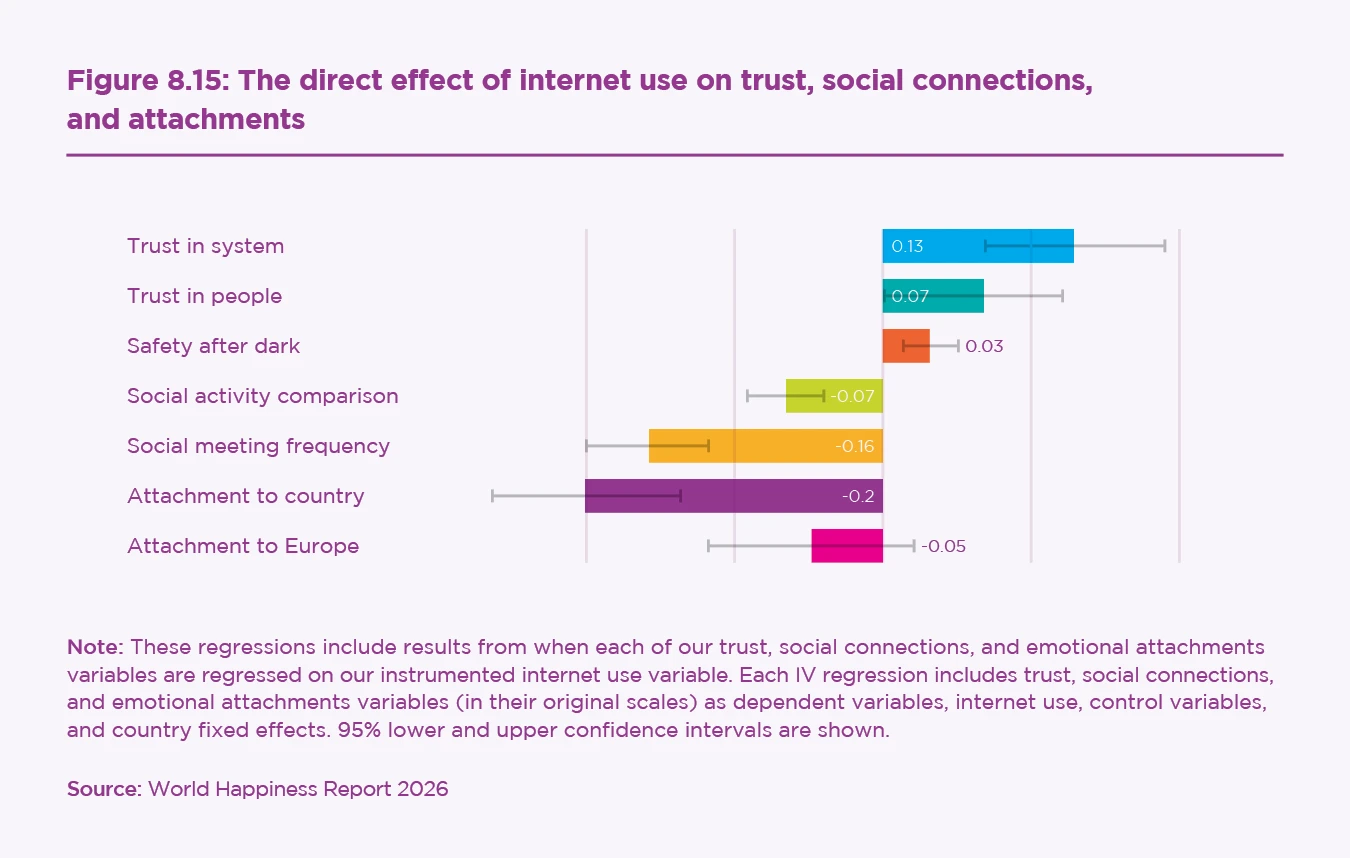
Given the negative interaction coefficients, we consider whether internet use has a direct effect on our channel variables that passes through to wellbeing. To examine whether internet use affects our channel variables directly, we run a series of instrumental variable regressions, with each of our trust, social connections, and emotional attachment variables as the dependent variable (in their original scales), with internet use as our primary variable of interest.[36] The results, reported in Figure 8.15, show that internet use has a significantly positive effect on trust in system and people, as well as safety after dark. However, it has a significantly negative effect for social connections (both social meeting frequency and social activity comparison) as well as attachment to country.
Taken together with our earlier findings, the evidence paints a consistent picture: wellbeing losses and gains across Europe are shaped not by a single factor but by a combination of shifting social and emotional conditions. Younger generations have faced large declines in interpersonal trust, perceived social activity, system trust, and feelings of safety, leading to sizable predicted declines in wellbeing. Older generations, by contrast, show greater resilience. Improvements in attachment to country and, in some regions, increases in feelings of safety help offset declines in trust, and the stronger causal weight these channels carry for older adults moderates the overall impact. The generational contrast is therefore not only one of exposure but also one of sensitivity – the young experience large changes in key social variables, while the old are more affected by how strongly those variables matter for their wellbeing. Internet use also affects our social connections more strongly. Generational differences are widely visible in terms of the happiness gains or losses achieved from heavier use of the internet.

Social media environment and the effects of internet use on wellbeing
One limitation of the ESS is that it does not directly measure social media use in its core modules. Respondents are asked how many minutes per day they use the internet, but no ESS variable captures whether that time is spent on platforms such as Facebook, Instagram, or TikTok. To address this gap, we supplement the ESS with external data from Eurostat, which provides the percentage of individuals using social media in each country, disaggregated by age cohort, gender, and year. These data allow us to construct a measure that approximates not an individual’s own social media use, but the digital environment they are embedded in.
To incorporate these data, we construct a ‘peer group’ for each ESS respondent, consisting of individuals in their country, age cohort, and gender each year. This process, for each interview year (2016–2024), over 30 countries and age-gender cohorts (from ages 16–24 up to 55–64), yields 2,700 unique ‘peer groups’. We then merge data from Eurostat on the percentage of individuals in each peer group that use social media. For example, a 20-year-old female in Spain in 2018 is assigned the 89.7% social media usage rate for her demographic group, while a 45-year-old male in Poland in 2023 receives 55.4%. This peer-group construction reflects the fact that online environments are shaped far more by demographic proximity than by geographic proximity. While our instrument for internet use (average download speed) is necessarily constructed at the NUTS2 regional level, social media interactions may not be geographically localised in the same way.[37] Individuals interact disproportionately with people of similar age and gender within their own cultural and national context, not with others who merely live nearby. Thus, the peer-group measure more accurately captures the social media saturation of the environment that individuals experience online.
Figure 8.16 presents Eurostat social media adoption rates for two broad age groups: 16–24 and a combined average for all individuals 25 and older. Among youth, social media use is near-universal, with rates typically between 90% to 98% across Europe and very little cross-country variation. This implies that, for young people, meaningful differences in exposure do not come from their own adoption (which is almost uniform) but from the broader digital environment surrounding them. Adults aged 25–64, by contrast, display substantial heterogeneity, with usage rates ranging from the low 40s in countries such as France and Italy to the mid-80s in the Nordic countries. Thus, cross-country variation in overall social media exposure is driven largely by differences among older adults, where institutional and cultural differences appear to matter more.
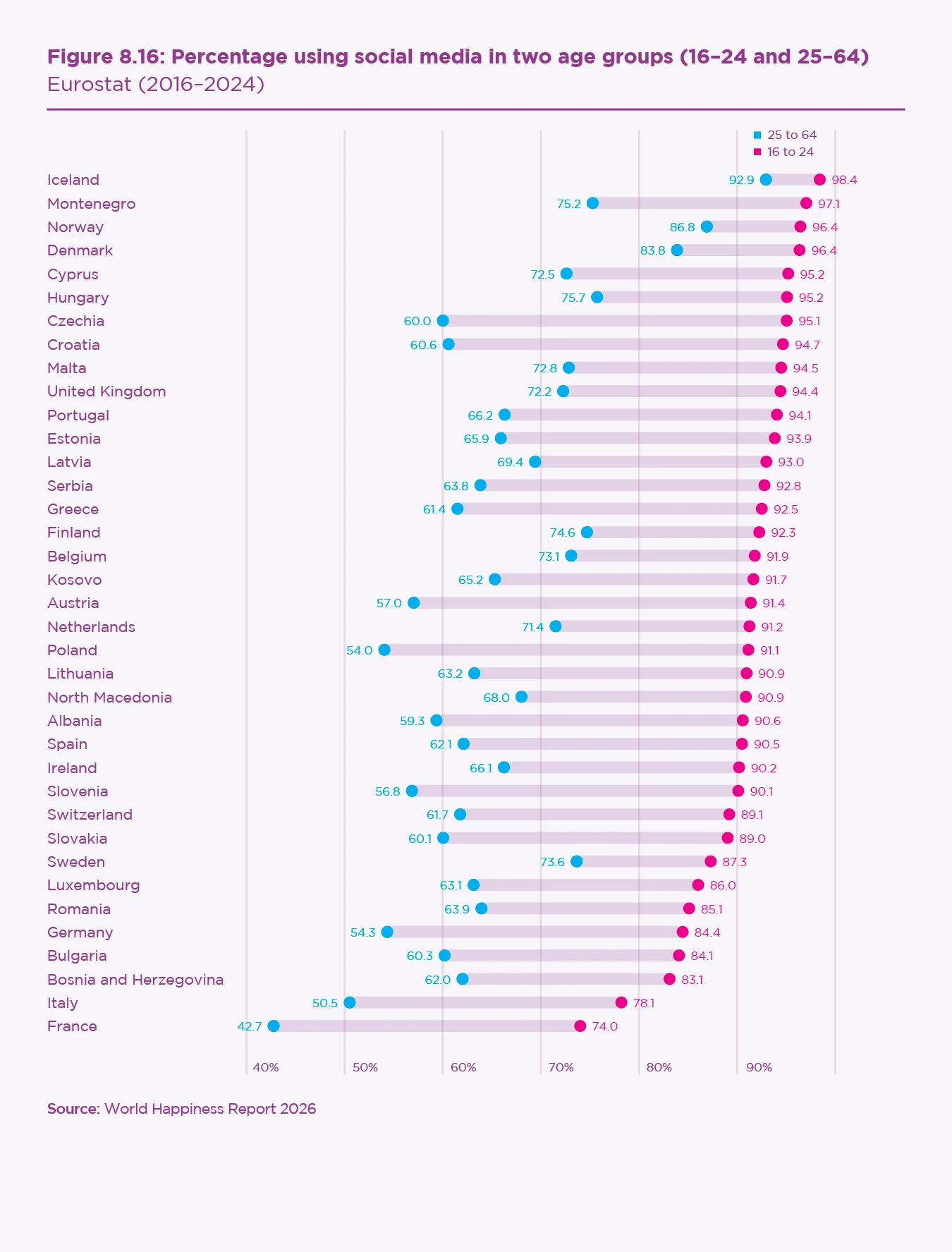
Figure 8.17 shows our instrumental-variable estimates of the effect of internet use (in hours) on wellbeing, HapSat (the average of happiness and life satisfaction), stratified by peer-group social media concentration. The pattern that emerges is highly consistent: when an individual’s demographic environment has low social media penetration (<50%), the estimated causal effect of additional internet use is positive. However, as exposure increases, the effect becomes progressively more negative. In the highest saturation category (>90%), the IV coefficient is strongly negative and statistically significant. This gradient implies that the wellbeing impact of internet use is conditional on the social media intensity of the surrounding environment.
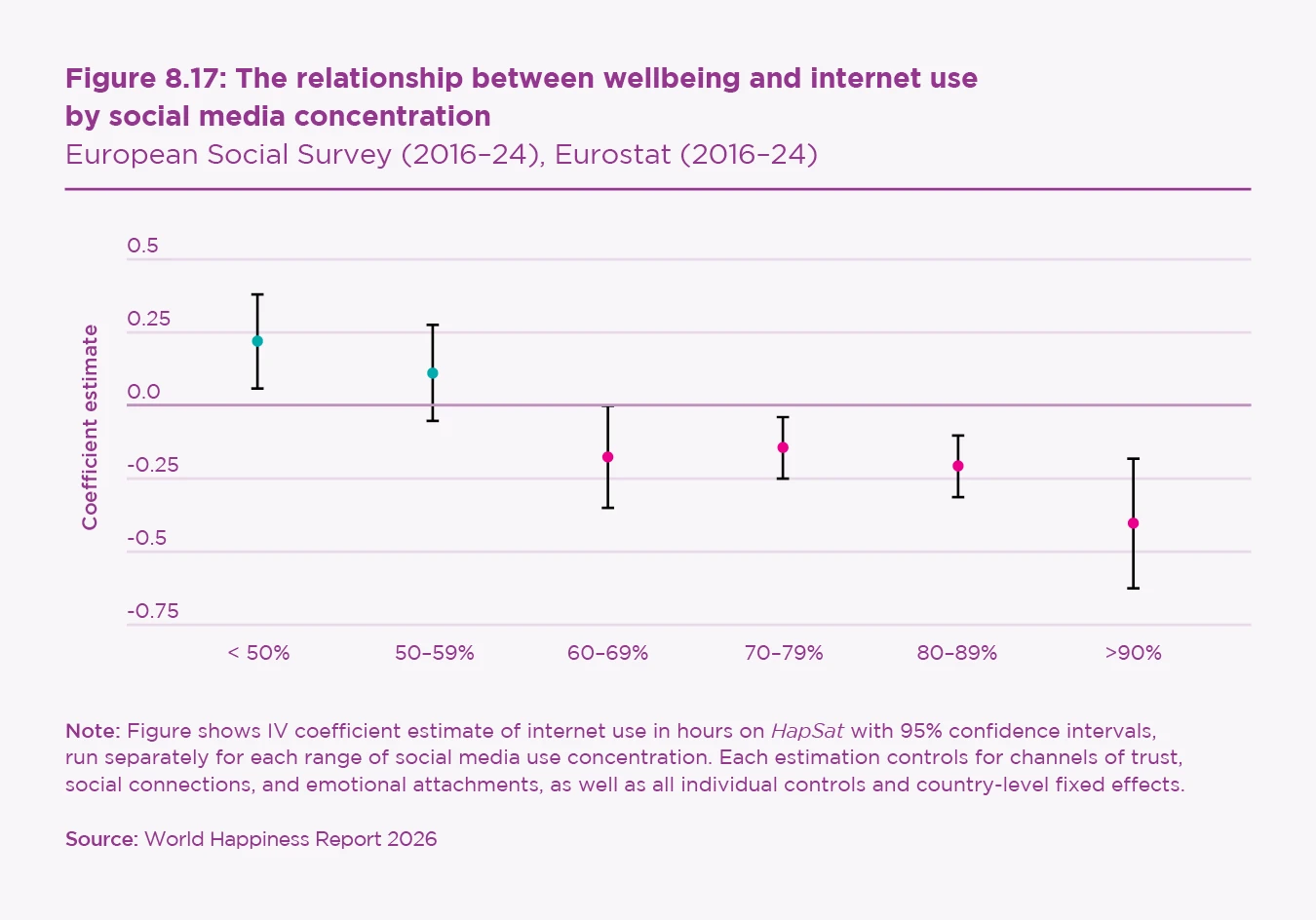
Although we control for age and gender in these estimations, some of the observed gradient may still be shaped by generational dynamics, since younger cohorts tend to live in more saturated digital environments. Yet the monotonic decline in the IV coefficients, even after conditioning on demographic controls, shows that peer-group social media concentration may exert an independent, meaningful influence. Taken together, these findings suggest that internet use is not uniformly beneficial or harmful. Instead, its effect appears to depend, critically, on what the online world around an individual looks like. In low-exposure settings, internet use may enhance wellbeing through communication, access to information, and support networks. In highly saturated digital environments, where social media dominates online activity, the same additional hour of internet use is more likely to intensify social comparison, displacement of offline interactions, or other mechanisms associated with lower wellbeing.
Internet use is most harmful for Gen Z, moderately harmful for Millennials, close to zero for Gen X, and slightly beneficial for Baby Boomers.
Conclusions
This chapter has examined how changes in internet use, social media exposure, and key social and emotional factors have shaped the wellbeing landscape in Europe from 2016 to 2024. Using an instrumental-variable strategy based on regional internet speeds to correct for issues of reverse-causality, we established a clear relationship between internet use and subjective wellbeing. The IV estimates reveal that higher daily internet use reduces wellbeing on average, reversing the positive or near-zero correlations found in conventional OLS models. Importantly, the magnitude and even the direction of this effect differs substantially across generations: internet use is most harmful for Gen Z, moderately harmful for Millennials, close to zero for Gen X, and slightly beneficial for Baby Boomers. These findings provide evidence that the role of the internet in daily life is deeply shaped by age-specific social contexts and needs. Not all online engagement is inherently detrimental.
To understand the mechanisms behind these generational patterns, we analysed changes in several foundational social and emotional channels: interpersonal trust, institutional trust, social meeting frequency, perceived social activity relative to peers, attachments to country and Europe, and feelings of safety. Across nearly all indicators, we observe a substantial deterioration among younger Europeans, particularly among Gen Z in Western Europe. Trust in people and in institutions declined sharply, social meeting frequency fell, and perceptions of one’s own social activity declined even more dramatically, suggesting heightened pressures of online comparison. At the same time, attachments to country rose mainly among older cohorts, while feelings of safety diverged with improvements in many Central and Eastern European countries and declines in the West. These changes contribute meaningfully to wellbeing trends. When multiplied by generation-specific coefficients, the channel shifts imply large wellbeing losses for younger cohorts and small gains or muted declines for older adults.
Our auxiliary IV regressions, using these channels of trust and social connections as outcomes, reinforce this interpretation by demonstrating that increased internet use lowers interpersonal trust, institutional trust, and social activity comparison, while modestly reducing social interaction. These results are consistent with mechanisms involving social comparison, displacement of offline engagement, and erosion of social capital. Importantly, the largest estimated effects appear on variables tied to relationships and social connections rather than structural or civic indicators; a pattern that aligns closely with the rise of algorithmically curated digital environments.
Finally, our analysis of the peer-group social media environment shows that the wellbeing effect of internet use depends critically on the social media saturation of an individual’s demographic context. When individuals belong to age/gender/country groups with low social media adoption, additional internet use has a positive effect on wellbeing. As saturation rises, the effect becomes progressively more negative, reaching its strongest magnitude for peer groups where over 90% of individuals regularly use social media. This gradient reveals that wellbeing is shaped not only by how much time people spend online, but also by what others around them are doing online. The digital environment is ecological: individuals are affected not only by their own online habits, but by the online habits of their peers.
Taken together, the evidence points to a widening generational divergence across Europe in factors affecting wellbeing. Older adults increasingly benefit from stable trust levels, improved feelings of safety, stronger attachments to country, and perhaps more purposeful digital use. Younger adults, by contrast, face eroding social capital, shrinking offline social networks, and intensified comparison pressures within highly saturated digital environments. Internet use interacts with these shifts, amplifying vulnerabilities among younger cohorts while offering modest support to older ones.
Despite the richness of our multi-source dataset, several limitations point to opportunities for future research. The ESS provides detailed measures of trust and social connections, but it does not measure how individuals use their time on different social media platforms, how time online displaces other activities, or the quality and depth of their relationships – factors that may be more consequential for wellbeing than the sheer quantity of online engagement. We measure the frequency of meeting friends, relatives, and colleagues, but we cannot observe the balance between online versus offline ties. Upcoming ESS rounds are expected to include more detailed items on social media behaviour and on social disconnectedness, offering valuable data that can help disentangle these mechanisms more precisely. Future research should examine whether all social connections sustain wellbeing equally, whether those with fewer offline friends or weaker in-person networks are more vulnerable to heavy online engagement, and whether increases in online activity substitute for beneficial offline routines. More broadly, understanding not only how much time people spend online but what they do, who they interact with, and how these interactions shape feelings of belonging, comparison, and support will be essential for mapping the complex relationship between digital life and wellbeing.

From a policy perspective, these findings suggest that interventions aimed at improving wellbeing cannot focus solely on individual screen time. Rather, they must address the broader social ecosystem: the decline in trust, the weakening of community bonds, and the highly comparative nature of online environments, especially for young people. Strengthening civic institutions, fostering offline community engagement, and improving digital literacy may help reverse some of these trends. At the same time, thoughtful regulation of social media environments (particularly those that algorithmically amplify comparison and visibility) could play a role in mitigating harmful effects. As we discussed at the beginning of this chapter, evidence suggests that online interactions do not substitute for in-person social contact, that digital relationships may fail to form strong or durable ties, and that social media encourages a shift from quality to quantity in social connections.
Ultimately, this chapter shows that the digital age is reshaping the social and emotional foundations of wellbeing in Europe. The effects are neither uniform nor inevitable: they depend on who you are, the social world you inhabit, and the digital environment surrounding you. Understanding these interactions is essential for developing policies that support wellbeing in an increasingly online society.
References
Allen, M. S., & Vella, S. A. (2015). Screen-based sedentary behaviour and psychosocial well-being in childhood: Cross-sectional and longitudinal associations. Mental Health and Physical Activity, 9, 41–47. https://doi.org/10.1016/j.mhpa.2015.10.002
Antoci, A., Sabatini, F., & Sodini, M. (2014). Bowling alone but tweeting together: The evolution of human interaction in the social networking era. Quality & Quantity, 48, 1911–1927. https://doi.org/10.1007/s11135-013-9863-z
Arampatzi, E., Burger, M. J., & Novik, N. (2018). Social network sites, individual social capital and happiness. Journal of Happiness Studies, 19, 99–122. https://doi.org/10.1007/s10902-016-9808-z
Arenas-Arroyo, E., Fernandez-Kranz, D., & Nollenberger, N. (2025). High speed internet and the widening gender gap in adolescent mental health: Evidence from Spanish hospital records. Journal of Health Economics, 102, 103014. https://doi.org/10.1016/j.jhealeco.2025.103014
Avom, D., & Malah, F. Y. (2022). Social media and happiness nexus in the millennial generation. Telecommunications Policy, 46(8), 102368. https://doi.org/10.1016/j.telpol.2022.102368
Bessière, K., Kiesler, S., Kraut, R., & Boneva, B. S. (2008). Effects of internet use and social resources on changes in depression. Information, Community & Society, 11(1), 47–70. https://doi.org/10.1080/13691180701858851
Best, P., Manktelow, R., & Taylor, B. (2014). Online communication, social media and adolescent wellbeing: A systematic narrative review. Children and Youth Services Review, 41, 27–36. https://doi.org/10.1016/j.childyouth.2014.03.001
Blanchflower, D. G., Bryson, A., & Xu, X. (2025). The declining mental health of the young and the global disappearance of the unhappiness hump shape in age. PLoS One, 20(8), e0327858. https://doi.org/10.1371/journal.pone.0327858
Booker, C. L., Skew, A. J., Kelly, Y. J., & Sacker, A. (2015). Media use, sports participation, and wellbeing in adolescence: cross-sectional findings from the UK Household Longitudinal Study. Am J Public Health, 105(1), 173–179. https://doi.org/10.2105/AJPH.2013.301783
Booker, C. L., Kelly, Y. J., & Sacker, A. (2018). Gender differences in the associations between age trends of social media interaction and wellbeing among 10–15 year olds in the UK. BMC Public Health, 18, 321, 1–12. https://doi.org/10.1186/s12889-018-5220-4
Braghieri, L., Levy, R., & Makarin, A. (2022). Social media and mental health. American Economic Review, 112(11), 3660–3693. https://doi.org/10.1257/aer.20211218
Bruni, L., & Stanca, L. (2008). Watching alone: Relational goods, television and happiness. Journal of Economic Behaviour & Organization, 65(3–4), 506–528. https://doi.org/10.1016/j.jebo.2005.12.005
Burke, M., Marlow, C., & Lento, T. (2010). Social network activity and social wellbeing. In: Proceedings of the SIGCHI Conference on Human Factors in Computing Systems, New York, NY: ACM, 1909–1912. https://doi.org/10.1145/1753326.1753613
Burke, M., Kraut, R., & Marlow, C. (2011). Social capital on Facebook: Differentiating uses and users. In Proceedings of the 2011 Annual Conference on Human Factors in Computing Systems, New York, NY: ACM, 571–580. https://doi.org/10.1145/1978942.1979023
Castellacci, F., & Tveito, V. (2018). Internet use and wellbeing: A survey and a theoretical framework. Research Policy, 47(1), 308–325. https://doi.org/10.1016/j.respol.2017.11.007
Castellacci, F., & Schwabe, H. (2018). Internet use and the U-shaped relationship between age and wellbeing. TIK Working Paper on Innovation Studies No. 20180215. https://ideas.repec.org/p/tik/inowpp/20180215.html
Castellacci, F., & Schwabe, H. (2020). Internet, unmet aspirations and the U-shape of life. PLoS ONE, 15(6), e0233099. https://doi.org/10.1371/journal.pone.0233099
Cornwell, B., & Lundgren, D. C. (2001). Love on the internet: Involvement and misrepresentation in romantic relationships in cyberspace vs. realspace. Computers in Human Behavior, 17(2), 197–211. https://doi.org/10.1016/S0747-5632(00)00040-6
Cummings, J., Butler, B. & Kraut, R. (2002). The quality of online social relationships. Communications of the ACM, 45(7), 103–108. https://doi.org/10.1145/514236.514242
De Neve, J. E., Dugan, A., Kaats, M., & Prati, A. (2025). Sharing meals with others. How sharing meals supports happiness and social connections. In J. F. Helliwell, R. Layard, J. D. Sachs, J. E. De Neve, L. B. Aknin, & S. Wang (Eds.), World Happiness Report 2025 (pp. 57–92). University of Oxford: Wellbeing Research Centre. https://doi.org/10.18724/whr-g119-bv60
Diener, E., & Seligman, M. E. P. (2002). Very happy people. Psychological Science, 13, 81–84. https://doi.org/10.1111/1467-9280.00415
Diener, E., Seligman, M. E. P., Choi, H., & Oishi, S. (2018). Happiest people revisited. Perspectives on Psychological Science, 13(2), 176–184. https://doi.org/10.1177/1745691617697077
Dhir, A., Yossatorn, Y., Kaur, P., & Chen, S. (2018). Online social media fatigue and psychological wellbeing - A study of compulsive use, fear of missing out, fatigue, anxiety and depression. International Journal of Information Management, 40, 141–152. https://doi.org/10.1016/j.ijinfomgt.2018.01.012
Donati, D., Durante, R., Sobbrio, F., & Zejcirovic, D. (2025). Lost in the net? Broadband internet and youth mental health. Journal of Health Economics, 103, 103017. https://doi.org/10.1016/j.jhealeco.2025.103017
Ellison, N. B., Steinfield, C., & Lampe, C. (2007). The benefits of Facebook friends: Social capital and college students’ use of online social network sites. Journal of Computer-Mediated Communication, 12(4), 1143–1168. https://doi.org/10.1111/j.1083-6101.2007.00367.x
European Social Survey (ESS). (2025, September 29). Methodology. Methodology overview. https://www.europeansocialsurvey.org/methodology/methodology-overview
European Social Survey European Research Infrastructure (ESS ERIC). (2025). ESS11 - integrated file, edition 4.0 [Data set]. Sikt - Norwegian Agency for Shared Services in Education and Research. https://doi.org/10.21338/ess11e04_0
European Social Survey European Research Infrastructure (ESS ERIC). (2023). ESS10 - integrated file, edition 3.2 [Data set]. Sikt - Norwegian Agency for Shared Services in Education and Research. https://doi.org/10.21338/ess10e03_2
European Social Survey European Research Infrastructure (ESS ERIC). (2023). ESS9 - integrated file, edition 3.2 [Data set]. Sikt - Norwegian Agency for Shared Services in Education and Research. https://doi.org/10.21338/ess9e03_2
European Social Survey European Research Infrastructure (ESS ERIC). (2023). ESS8 - integrated file, edition 2.3 [Data set]. Sikt - Norwegian Agency for Shared Services in Education and Research. https://doi.org/10.21338/ess8e02_3
Eurostat. (2025). ICT usage in households and by individuals (isoc_i). Individuals - internet activities [isoc_ci_ac_i] https://doi.org/10.2908/ISOC_CI_AC_I
Ferrer-i-Carbonell, A., & Frijters, P. (2004). How important is methodology for the estimates of the determinants of happiness? The Economic Journal, 114, 641–659. https://doi.org/10.1111/j.1468-0297.2004.00235.xDigital Object Identifier (DOI)
Ganju, K. K., Pavlou, P. A., & Banker, R. D. (2016). Does information and communication technology lead to the wellbeing of nations? A country-level empirical investigation. MIS Quarterly, 40(2), 417–430. https://www.jstor.org/stable/26628913
Glanville, J. L., Andersson, M. A., & Paxton, P. (2013). Do social connections create trust? An examination using new longitudinal data. Social Forces, 92(2), 545–562. https://doi.org/10.1093/sf/sot079
Graham, C., & Nikolova, M. (2013). Does access to information technology make people happier? Insights from wellbeing surveys from around the world. The Journal of Socio-Economics, 44, 126–139. https://doi.org/10.1016/j.socec.2013.02.025
Hancock, J. T., Liu, S. X., Luo, M., & Mieczkowski, H. (2022). Social media and psychological wellbeing. In S. C. Matz (Ed.), The psychology of technology: Social science research in the age of Big Data (pp. 195–238). American Psychological Association. https://doi.org/10.1037/0000290-007
Hatemleh, I. H., Safori, A. O., Habes, M., Tahat, O., Ahmad, A. K., Abdallah, R. A.-Q., & Aissani, R. (2023). Trust in social media: Enhancing social relationships. Social Sciences, 12(7), 416. https://doi.org/10.3390/socsci12070416
Helliwell, J. F., & Aknin, L. B. (2018). Expanding the social science of happiness. Nature Human Behaviour, 2(4), 248–252. https://doi.org/10.1038/s41562-018-0308-5
Helliwell, J. F., & Huang, H. (2013). Comparing the happiness effects of real and online friends. PLoS ONE, 8(9), e72754. https://doi.org/10.1371/journal.pone.0072754
Helliwell, J. F., Huang, H., & Wang, S. (2017). The social foundations of world happiness. In J. F. Helliwell, R. Layard, J. D. Sachs (Eds.), World Happiness Report 2017 (pp. 8–47). New York: SDSN. https://files.worldhappiness.report/WHR17_Ch02.pdf
Helliwell, J. F., Huang, H., Wang, S., & Norton, M. B. (2020). Social environments for world happiness. In J. F. Helliwell, R. Layard, J. D. Sachs, J. E. De Neve (Eds.), World Happiness Report 2020 (pp. 1–19). New York: SDSN. https://www.worldhappiness.report/ed/2020/social-environments-for-world-happiness/
Helliwell, J. F., Huang, H., Wang, S., & Norton, M. B. (2021). World happiness, trust and deaths under COVID-19. In J. F. Helliwell, R. Layard, J. D. Sachs, J. E. De Neve (Eds.), World Happiness Report 2021 (Chapter 2). New York: SDSN. https://www.worldhappiness.report/ed/2021/happiness-trust-and-deaths-under-covid-19/
Helliwell, J. F., & Putnam, R. D. (2004). The social context of wellbeing. Philosophical Transactions of the Royal Society London B Biological Sciences, 359(1449), 1435–1446. https://doi.org/10.1098/rstb.2004.1522
Holt-Lunstad J, Smith, T. B., & Layton, J. B. (2010). Social relationships and mortality risk: A meta-analytic review. PLoS Med, 7(7), e1000316. https://doi.org/10.1371/journal.pmed.1000316
Holt-Lunstad, J., Smith, T. B., Baker, M., Harris, T., & Stephenson, D. (2015). Loneliness and social isolation as risk factors for mortality: A meta-analytic review. Perspectives on Psychological Science, 10(2), 227–237. https://doi.org/10.1177/1745691614568352
Howick, J., Kelly, P., & Kelly, M. (2019). Establishing a causal link between social relationships and health using the Bradford Hill Guidelines. SSM – Population Health, 8, 100402. https://doi.org/10.1016/j.ssmph.2019.100402
Huang, C. (2010). Internet use and psychological wellbeing: A meta-analysis. Cyberpsychology, Behaviour, and Social Networking, 13(3), 241–249. https://doi.org/10.1089/cyber.2009.0217
Kang, J. H., & Chung, D. Y. (2017). Homophily in an anonymous online community: Sociodemographic versus personality traits. Cyberpsychology Behaviour, and Social Networking, 20(6), 376–381. https://doi.org/10.1089/cyber.2016.0227
Kiratli, O. S. (2023). Social media effects on public trust in the European Union. Public Opinion Quarterly, 87(3), 749–763. https://doi.org/10.1093/poq/nfad029
Kraut, R., Patterson, M., Lundmark, V., Kiesler, S., Mukophadhyay, T., & Scherlis, W. (1998). Internet paradox: A social technology that reduces social involvement and psychological wellbeing? American Psychologist, 53 (9), 1017–1031. https://doi.org/10.1037//0003-066x.53.9.1017
Kross, E., Verduyn, P., Demiralp, E., Park, J., Lee, D. S., Lin, N., Shablack, H., Jonides, J., & Ybarra, O. (2013). Facebook use predicts declines in subjective wellbeing in young adults. PLoS ONE, 8, e69841. https://doi.org/10.1371/journal.pone.0069841
Kross, E., Verduyn, P., Sheppes, G., Costello, C. K., Jonides, J., & Ybarra, O. (2021). Social media and wellbeing: Pitfalls, progress, and next steps. Trends in Cognitive Sciences, 25(1), 55–66. https://doi.org/10.1016/j.tics.2020.10.005
Lohmann, S. (2015). Information technologies and subjective wellbeing: Does the internet raise material aspirations? Oxford Economic Papers, 67(3), 740–759. https://doi.org/10.1093/oep/gpv032
Lorenz-Spreen, P., Oswald, L., Lewandowsky, S., & Hertwig, R. (2023). A systematic review of worldwide causal and correlational evidence on digital media and democracy. Nature Human Behaviour, 7, 74–101. https://doi.org/10.1038/s41562-022-01460-1
Manago, A. M., Taylor, T., & Greenfield, P. M. (2012). Me and my 400 friends: The anatomy of college students’ Facebook networks, their communication patterns, and wellbeing. Developmental Psychology, 48(2), 369–380. https://doi.org/10.1037/a0026338
Marino, C., Gini, G., Vieno, A., & Spada, M. M. (2018). The associations between problematic Facebook use, psychological distress and well-being among adolescents and young adults: A systematic review and meta-analysis. Journal of Affective Disorders, 226, 274–281. https://doi.org/10.1016/j.jad.2017.10.007
Mathers, M., Canterford, L., Olds, T., Hesketh, K., Ridley, K., & Wake, M. (2009). Electronic media use and adolescent health and wellbeing: Cross-sectional community study. Academic Pediatrics, 9, 307–314. https://doi.org/10.1016/j.acap.2009.04.003
Mazur, E., & Richards, L. (2011). Adolescents’ and emerging adults’ social networking online: Homophily or diversity? Journal of Applied Developmental Psychology, 32, 180–188. https://doi.org/10.1016/j.appdev.2011.03.001
McCrae, N., Gettings, S., & Purssell, E. (2017). Social media and depressive symptoms in childhood and adolescence: A systematic review. Adolescent Research Review, 2, 315–330. https://doi.org/10.1007/s40894-017-0053-4
McClean, A., Rausch, Z., & Haidt, J. (2025). The effect of broadband access on mental health: A review of instrumental variable studies. Available at SSRN, https://papers.ssrn.com/sol3/papers.cfm?abstract_id=5188105
McDool, E., Powell, P., Roberts, J., & Taylor, K. (2016). Social media use and children’s wellbeing. University of Sheffield Economic Research Paper Series ISSN 1749-8368, 1–42. https://docs.iza.org/dp10412.pdf
McPherson, M., Smith-Lovin, L., & Cook, J. M. (2001). Birds of a feather: Homophily in social networks. Annual Review of Sociology, 27, 415–444. https://www.jstor.org/stable/2678628
Measurement Lab. The M-Lab NDT Data Set, 2016-01-01–2024-12-31. https://measurementlab.net/tests/ndt (Accessed via Google BigQuery)
Moody, E. J. (2001). Internet use and its relationship to loneliness. CyberPsychology & Behavior, 4(3), 393–401. https://doi.org/10.1089/109493101300210303
Nie, N. H., (2001). Sociability, interpersonal relations, and the internet reconciling conflicting findings. American Behavioural Scientist, 45(3), 420–435. https://doi.org/10.1177/00027640121957277
Oh, H. J., Ozkaya, E., & LaRose, R. (2014). How does online social networking enhance life satisfaction? The relationships among online supportive interaction, affect, perceived social support, sense of community, and life satisfaction. Computers in Human Behaviour, 30, 69–78. https://doi.org/10.1016/j.chb.2013.07.053
Orben, A. (2020). Teenagers, screens and social media: A narrative review of reviews and key studies. Social Psychiatry and Psychiatric Epidemiology, 55, 407–414. https://doi.org/10.1007/s00127-019-01825-4
Ostic, D., Qalati, S. A., Barbosa, B., Shah, S. M. M., Vela, E. G., Herzallah, A. M., & Liu, F. (2021). Effects of social media use on psychological well-being: A mediated model. Frontiers in Psychology, 12, 678766. https://doi.org/10.3389/fpsyg.2021.678766
Parks, M. & Roberts, L. (1998). Making MOOsic: The development of personal relationships online and a comparison to their off-line counterparts. Journal of Social and Personal Relationships, 15(4), 517–537. https://doi.org/10.1177/0265407598154005
Pei, R., & Zaki, J. (2025). Connecting with others. How social connections improve the happiness of young adults. In J. F. Helliwell, R. Layard, J. D. Sachs, J. E. De Neve, L. B. Aknin, & S. Wang (Eds.), World Happiness Report 2025 (pp. 123–158). University of Oxford: Wellbeing Research Centre. https://doi.org/10.18724/whr-zc5n-4f96
Pénard, T., Poussing, N., & Suire, R. (2013). Does the internet make people happier? The Journal of Socio-Economics, 46, 105–116. https://doi.org/10.1016/j.socec.2013.08.004
Pignolet, Y.-A., Schmic, S., & Seelisch, A. (2024). Gender-specific homophily on Instagram and implications on information spread. Scientific Reports, 14(1), 451. https://doi.org/10.1038/s41598-023-51117-w
Pugno, M. (2025). Does social media harm young people’s wellbeing? A suggestion from economic research. Academia Mental Health and Wellbeing, 2(1). https://doi.org/10.20935/MHealthWellB7581
Roberts, J. A., & David, M. E. (2023). On the outside looking in: Social media intensity, social connection, and use wellbeing: The moderating role of passive social media use. Canadian Journal of Behavioural Science/ Revue canadienne des sciences du comportement, 55(3), 240–252. https://doi.org/10.1037/cbs0000323
Sabatini, F., & Sarracino, F. (2014). E-participation: Social capital and the Internet. FEEM Working Paper 2014.81. http://dx.doi.org/10.2139/ssrn.2505048
Sabatini, F., & Sarracino, F. (2017). Online networks and subjective well-being. Kyklos, 70(3), 456–480. https://doi.org/10.48550/arXiv.1408.3550
Sabatini, F., & Sarracino, F. (2019). Online social networks and trust. Social Indicators Research, 142, 229–260. https://doi.org/10.1007/s11205-018-1887-2
Schmiedeberg, C., & Schröder, J. (2017). Leisure activities and life satisfaction: An analysis with German panel data. Applied Research in Quality of Life, 12, 137–151. https://doi.org/10.1007/s11482-016-9458-7
Shakya, H. B., & Christakis, N. A. (2017). Association of Facebook use with compromised well-being: A longitudinal study. American Journal of Epidemiology, 185, 203–211. https://doi.org/10.1093/aje/kww189
Sønderskov, K. M., & Dinesen, P. T. (2016). Trusting the state, trusting each other? The effect of institutional trust on social trust. Political Behavior, 38, 179–202. https://doi.org/10.1007/s11109-015-9322-8
Steinfield, C., Ellison, N.B., & Lampe, C. (2008). Social capital, self-esteem, and use of online social network sites: a longitudinal analysis. Journal of Applied Developmental Psychology, 29(6), 434–445. https://doi.org/10.1016/j.appdev.2008.07.002
Twenge, J. M. (2019). More time on technology, less happiness? Associations between digital-media use and psychological wellbeing. Current Directions in Psychological Science, 28, 372–379. https://doi.org/10.1177/0963721419838244
Twenge, J. M., & Campbell, W. K. (2018). Associations between screen time and lower psychological wellbeing among children and adolescents: Evidence from a population-based study. Preventive Medicine Reports, 12, 271–283. https://doi.org/10.1016/j.pmedr.2018.10.003
US Department of Health and Human Services (2023a). Our epidemic of loneliness and isolation: The US Surgeon General’s advisory on the healing effects of social connection and community. US Public Health Service. https://www.vivekmurthy.com/_files/ugd/9322fa_0199a98056594d41bca33c0e944c3fd4.pdf?index=true
US Department of Health and Human Services (2023b). Social media and youth mental health. US Public Health Service. https://www.vivekmurthy.com/_files/ugd/9322fa_ecdead62a53a4753928242b315e1af9e.pdf?index=true
Valkenburg, P. M., & Peter, J. (2007a). Preadolescents’ and adolescents’ online communication and their closeness to friends. Developmental Psychology, 43, 267–277. https://doi.org/10.1037/0012-1649.43.2.267
Valkenburg, P. M., & Peter, J. (2007b). Online communication and adolescents’ wellbeing: Testing the stimulation versus the displacement hypothesis. Journal of Computer Medicated Communication, 12(4), 1169–1182. https://doi.org/10.1111/j.1083-6101.2007.00368.x
Valkenburg, P. M., & Peter, J. (2009). Social consequences of the internet for adolescents: A decade of research. Current Directions in Psychological Science, 18, 1–5. https://doi.org/10.1111/j.1467-8721.2009.01595.x
Valkenburg, P. M., Beyens, I., Meier, A., & Abeele, M. M. O. V. (2022a). Advancing our understanding of the associations between social media use and wellbeing. Current Opinion in Psychology, 47, 101357. https://doi.org/10.1016/j.copsyc.2022.101357
Valkenburg, P. M., Meier, A., & Beyens, I. (2022b). Social media use and its impact on adolescent mental health: An umbrella review of the evidence. Current Opinion in Psychology, 44, 58–68. https://doi.org/10.1016/j.copsyc.2021.08.017
Verduyn, P., Ybarra, O., Résibois, M., Jonides, J., & Kross, E. (2017). Do social network sites enhance or undermine subjective wellbeing? A critical review. Social Issues and Policy Review, 11, 274–302. https://doi.org/10.1111/sipr.12033
Vogel, E. A., Rose, J. P., Roberts, L. R., & Eckles, K. (2014). Social comparison, social media, and self-esteem. Psychology of Popular Media Culture, 3, 206–222. https://doi.org/10.1037/ppm0000047
Wang, Y., McKee, M., Torbica, A., & Stuckler, D. (2019). Systematic literature review on the spread of health-related misinformation on social media. Social Science & Medicine, 240, 112552. https://doi.org/10.1016/j.socscimed.2019.112552
Weiser, E. B. (2001). The functions of Internet use and their social and psychological consequences. CyberPsychology & Behavior, 4(6), 723–743. https://doi.org/10.1089/109493101753376678
Wolak, J., Mitchell, K. & Finkelhor, D. (2003). Escaping or connecting? Characteristics of youth who form close online relationships. Journal of Adolescence, 26(1), 105–119. https://doi.org/10.1016/S0140-1971(02)00114-8
Endnotes
For more information please see: Best et al. (2014); Booker et al. (2015; 2018); Braghieri et al. (2022); Burke et al. (2010; 2011); Dhir et al. (2018); Huang (2010); Kross et al. (2013); Marino et al. (2018); Mathers et al. (2009); McCrae et al. (2017); Roberts and David (2023); Twenge (2019); Twenge and Campbell (2018); Verduyn et al. (2017); Vogel et al. (2014); Wang et al. (2019). ↩︎
For more information please see: Avom and Malah (2022); Bessière et al. (2008); Best et al. (2014); Burke et al. (2010; 2011); Ellison et al. (2007); Hancock et al. (2022); Hatemleh et al. (2023); Manago et al. (2012); Oh et al. (2014); Ostic et al. (2021); Roberts and David (2023); Steinfield et al. (2008); Valkenburg and Peter (2007a; 2007b; 2009); Verduyn et al. (2017). ↩︎
See Blanchflower et al. (2025), and Pugno (2025). ↩︎
See Arampatzi et al. (2018) (longitudinal data from the Netherlands); Bessière et al. (2008) (US panel of 740 individuals from 2000 to 2002); Cornwell and Lundgren (2001) (data from 36 male and 44 female chat room users); Cummings et al. (2002) (data from a sample of 204 internet listservs); Diener et al. (2018) (a review of studies); Diener and Seligman (2002) (sample of 222 undergraduate students); Helliwell and Huang (2013) (cross-sectional Canadian data and data from the European Social Survey); Helliwell and Putnam (2004) (data from the World Values Survey, European Values Survey, the US Social Capital Benchmark Survey, and a Canadian survey); Holt-Lunstad et al. (2010) (meta-analystic review of 148 studies); Moody (2001) (sample of 166 undergraduate students); Parks and Roberts (1998) (data from 235 users of Multi-User Dimensions, Object Oriented and 155 users completing a survey on offline relationships); Weiser (2001) (2 different study groups); and Wolak et al. (2003) (US sample of internet users aged 10 - 17). Cummings et al. (2002) argue that in understanding social connections and social network and internet use, we have to consider whether weak social relationships formed online complement or substitute connections generated offline and whether online social connections add to one’s total stock of social relations. This highlights the importance of examining individuals’ complete set of social interactions and the impact of social networks on social connections. ↩︎
See Bruni and Stanca (2008); Castellacci and Tveito (2018); Kraut et al. (1998); Nie (2001); Sabatini and Sarracino (2017); US Department of Health and Human Services (2023a); Valkenburg and Peter (2009). ↩︎
See Helliwell and Aknin (2018); Helliwell et al. (2017); Howick et al. (2019); Pei and Zaki (2025). Using data from the Global Flourishing Study, Pei and Zaki (2025) show that in countries where young adults report higher levels of social connection and social support, they also report higher levels of life satisfaction. The relationship between wellbeing and social connections is observed for both quantity and quality of social connections. The results also hold when data are observed at the individual level. In analysing the possible reverse causality between wellbeing and social connections, the authors refer to longitudinal studies from the literature and argue that the direction goes from social connections to wellbeing, with individuals who are more socially connected being more likely to thrive in the future. In their meta-analysis, Holt-Lunstad et al. (2015) show that individuals who lack social connections are at risk for premature mortality, with the risk associated with social isolation and loneliness being comparable to other factors such as obesity, substance abuse, injury and lack of access to healthcare. ↩︎
For more information on the US Surgeon General’s Advisory please see US Department of Health and Human Services (2023a) and (2023b). ↩︎
See De Neve et al. (2025); Glanville et al. (2013); Sønderskov and Dinesen (2016). ↩︎
See Helliwell et al. (2017); Helliwell et al. (2020); Helliwell et al. (2021). ↩︎
Sabatini and Sarracino (2017) examine the relationship between social network use, two dimensions of social capital and subjective wellbeing using Italian household data. Their results show that the use of social network sites has a negative correlation with trust, which generates a significantly negative correlation with life satisfaction. Furthermore, the use of social network sites is found to be negatively correlated with individuals’ wellbeing both directly and indirectly through its negative effects on social trust. In a later study, Sabatini and Sarracino (2019) find all forms of trust to be negatively associated with participation in social networking sites using cross-sectional data from Italy. Using instrumental variables to control for the endogeneity between trust and social network use, their results show participation in social networking sites to be negatively associated with three types of trust. Additionally, a review of the literature of recent works examining the causal effect of high-speed internet access on mental health outcomes in Germany, Italy, the United States and Spain shows that increased high-speed internet access has worsened mental health outcomes, particularly among young women and adolescents (McClean et al., 2025). In a systematic review of causal and correlational evidence of digital media and democracy, Lorenz-Spreen et al. (2023) argue that numerous studies in the literature depict detrimental associations between digital media and various dimensions of trust, with studies focusing on social trust as a component of social capital finding consistent detrimental effects of social media use, with no effect of broadband internet being found on social trust. ↩︎
See Kiratli (2023); Sabatini and Sarracino (2014); Sabatini and Sarracino (2019). ↩︎
See Antoci et al. (2014); Ellison et al. (2007); Sabatini and Sarracino (2014); and Sabatini and Sarracino (2019). Sabatini and Sarracino (2019) discuss the different ways in which online interactions could bring together individuals. Through online interactions, individuals are more likely to be in contact with others that they may not necessarily share views or opinions with. Social networking sites thereby could allow for exposure to diversity. ↩︎
Most studies rely heavily on cross-sectional or experimental data, with findings coming from within-person designs, and longer-term panel surveys. Longitudinal studies are sparse, making comparisons across countries more difficult to evaluate. Additionally, due to the differences across studies in choice of metrics for social media use, survey sizes, study settings, mechanisms or channels affecting the relationship between social media use and wellbeing, the predictions of the effects of social media use on wellbeing are not uniform or consistent across studies. See Kross et al. (2021); Orben (2020); Roberts and David (2023); Valkenburg et al. (2022a); and Valkenburg et al. (2022b). ↩︎
In order to increase the number of countries included in this analysis, we use questions from the core module of the ESS. The core module includes questions on a range of topics that are repeated in each round. Our main internet use variable is only available in Rounds 8, 9, 10, and 11. In earlier rounds of the core modules (Rounds 1 to 5), the ESS asks about the frequency of internet use but does not include any questions about the time spent using the internet. This is why our study focuses on Rounds 8 to 11. ↩︎
The internet access speed data from Measurement Lab (M-Lab), which we use as an instrument for internet use, is at the regional level (NUTS2) over time. ↩︎
The empirical strategy includes a two-stage least squares (2SLS) regression framework using regional internet access speed data from M-Lab as an instrument for individual internet use. We are assuming that internet infrastructure development is not a function of the subjective wellbeing of residents in that area. ↩︎
See Lohmann (2015). ↩︎
See Castellacci and Schwabe (2018); Castellacci and Schwabe (2020); Ganju et al. (2016); Graham and Nikolova (2013); Lohmann (2015); and Pénard et al. (2013). Using Eurobarometer annual surveys for the years 2010 to 2013, Castellacci and Schwabe (2018) employ a recursive bivariate ordered probit model with lagged fixed broadband take-up as an instrumental variable and find the relationship between internet use and subjective wellbeing to be heterogenous, varying significantly with age. Additionally, the results demonstrate that internet use moderates the U-shaped relationship between age and wellbeing. Pénard et al. (2013) show that the positive impact of internet use on life satisfaction is stronger for younger individuals and that this effect decreases with age. ↩︎
For a more detailed description of ESS methodologies and coverage, refer to ESS (2025). ↩︎
Notably, the ESS polls new respondents in each round of the survey, providing cross-sectional data, but does not track the same respondents over time, and therefore it can be viewed as a synthetic panel dataset. ↩︎
We use the interview years as the time variable for this graph as opposed to concentrating on the waves from the ESS which are produced biennially. The figure uses post-stratification weighted means for each of the three indicators across years. All of our wellbeing measures are on a 0–10 scale. ↩︎
The ESS core modules do not survey respondents specifically on social media use. We take the information provided from daily internet use of respondents in minutes and convert this to hours of internet use. ↩︎
We take the five-year average values over each five-year span to account for omissions in annual reporting at the NUTS2-level in the Eurostat database. ↩︎
The ESS question does not distinguish between personal use of the internet and use for work purposes. ↩︎
It is important to note that age groups above 80 have notably fewer observations than those below. This figure omits age groups with fewer than 100 respondents, for ease of exposition. ↩︎
With longitudinal data, some studies in the literature use linear regression models, while others use ordinal regressions given the nature of survey data. Ferrer-i-Carbonell and Frijters (2004) argue that a fixed effect ordered logit model provides findings surprisingly similar to those from a simple OLS model which examines changes in general life satisfaction. Their results using a conditional estimator for the fixed effect ordered logit model show that assuming ordinality or cardinality of happiness scores with the use of ordered latent response models makes little difference, while accounting for fixed effects in happiness regressions changes results substantially. ↩︎
Ferrer-i-Carbonell and Frijters (2004) show that it is important to account for fixed and time-invariant individual traits in happiness estimations. ↩︎
Given the similarities in the results, we use the composite measure of happiness and life satisfaction, HapSat, in reporting our remaining results. ↩︎
See Allen and Vella (2015); McDool et al. (2016); Schmiedeberg and Schröder (2017); and Shakya and Christakis (2017). McDool et al. (2016) examine the relationship between social media and children’s wellbeing using a representative sample of 10–15-year-olds over the period 2010 to 2014 from the UK Household Longitudinal Study. To deal with the potential reverse causality and the endogeneity between social media use and wellbeing, the authors take an instrumental variable approach using information on broadband speeds and mobile phone signal strengths as factors influencing teenagers’ social media use. Their results demonstrate that more time spent on social networks reduces life satisfaction. The effects are found to be more negatively pronounced for girls. Spending one hour a day chatting on social networks is shown to reduce the probability of being completely satisfied with life by 14 percentage points. In a later paper, the authors find internet use to be negatively associated with wellbeing for a large sample of over 6,300 children in England over the 2012–2017 period. Similarly, examining the impact of high-speed internet access on adolescent mental health in Spain, Arenas-Arroyo et al. (2025) show that access to higher-speed internet through fiber optic deployment has increased mental health diagnoses in hospitals and has contributed to increases in adolescent suicide rates, mainly among girls. Donati et al. (2025) find adverse effects of broadband internet access on mental disorders among younger cohorts in Italy between 2001 and 2013. ↩︎
See Pugno (2025) for a full review of the economic research examining the link between social media use and wellbeing. ↩︎
When controlling for reverse causality with the use of our instrumental variable, we find that the coefficient on the education variable (university) is now significantly positive, while the coefficient on ‘born in country’ is negative but not statistically significant. The coefficient for the urban variable is still significantly positive although the coefficient itself is much smaller. ↩︎
The alternative approach would be to consider that each individual has trust, social connections, and attachment levels that equal the average values from our pooled sample. We choose the option where we reconstruct categorical variables from our trust variables which are on a 0–10 scale for trust in system and trust in people, a 0–3 scale for safety after dark, a 1–5 scale for social activity comparison, a 1–7 scale for social meeting frequency, and a 0–10 scale for both emotional attachment variables. The newly created categorical variables for each of these trust, social connections, and emotional attachment variables are on a 0–2 scale, allowing us to have a “high” vs. “low” dummy version (with the medium level dropped as the base category). This further helps us explain the difference in individuals’ trust, social connections, and emotional bonds and their increased internet use on their overall wellbeing, above and beyond the direct effects from all of these variables. The online appendix includes further details on the construction of these categorical variables. ↩︎
Safety after dark is the only dummy variable that we use. The original variable is on a 0–3 scale with results ranging from very unsafe, unsafe, safe and very safe. This variable therefore has a “low” version that is used as the base category which is dropped in our regressions. ↩︎
All interaction terms are also instrumented using the median quarterly download speed. ↩︎
These regressions include all our control variables and country fixed effects. The online appendix includes the results from these regressions. ↩︎
The literature examining online social networks evidence homophilic behaviour – the tendency of individuals to bond or connect more with individuals similar to themselves (Pignolet et al. 2024). Across studies, individuals’ personal networks exhibit homogeneity in socio-demographic, behavioural and interpersonal characteristics (McPherson et al., 2001). Findings have shown that age and gender strongly structure the relations individuals have, with the results suggesting that online communication is more likely to result in socio-demographic homophily, as opposed to physical or geographic proximity (Kang & Chung, 2017; Mazur & Richards, 2011; McPherson et al., 2001). ↩︎