Social media is harming adolescents at a scale large enough to cause changes at the population level
Acknowledgments
We thank Anum Aslam, Nikolaus Greb, Jacob Lebwohl, Carmen Hui Jing Lim, Mckenzie Love, Jason Lu, Alec McClean, Emma Park, Bennett Sippel, David Stein, Richard Layard, Barry Grimes, Mariano Rojas, the full editorial team for the World Happiness Report, and the several anonymous reviewers who provided invaluable feedback on early versions of the draft.
Key insights
Is social media use reasonably safe for children and adolescents? We call this the “product safety question”, and we present seven lines of evidence showing that the answer is no.
The evidence of harm is found in: 1) surveys of young people; 2) surveys of parents, teachers, and clinicians; 3) contents from corporate documents; 4) findings from cross-sectional studies; 5) findings from longitudinal studies; 6) findings from social media reduction experiments; and 7) findings from natural experiments.
We show there is now overwhelming evidence of severe and widespread direct harms (such as sextortion and cyberbullying), and compelling evidence of troubling indirect harms (such as depression and anxiety). Furthermore, we show that the harms and risks to individual users are so diverse and vast in scope that they justify the view that social media is causing harm at a population level.
We further argue that when these lines of evidence are considered alongside the timing, scope, and cross-national trends in adolescent wellbeing and mental health, they can help answer a second question: was the rapid adoption of always-available social media by adolescents in the early 2010s a substantial contributor to the population-level increases in mental illness that emerged by the mid 2010s in many Western nations? We call this the “historical trends question”. We draw on our findings about the vast scale of harm uncovered while answering the product safety question to argue that the answer to the historical trends question is “yes”.
Introduction
In this essay, we address an academic debate whose resolution carries enormous implications for public policy, legal liability, and parental decision-making: is social media safe for adolescents? By “safe” we mean a product whose ordinary use does not place young users at substantially elevated risk of mental health problems (especially depression and anxiety) or regularly expose them to serious direct harms. The average US teen now spends nearly five hours per day on social media (which includes roughly 2 hours on YouTube, 1.5 hours on TikTok, and 1 hour on Instagram).[1] A recent survey found that one-quarter of 13- to 14-year-olds in the US were on social media for seven or more hours each day.[2] While time spent varies across countries (see Chapter 5), five hours per day can be considered ordinary common use, and even seven is not unusual. Are these levels safe? We refer to this as “the product safety question”.
By “adolescence” we mean the broad developmental period from roughly ages 10 to 19.[3] Puberty occurs in the first part of adolescence, usually beginning around ages 9 to 11 and reaching completion for most adolescents by age 15 or 16. Puberty is of special interest because it is well known as a period of very high brain plasticity. It is a “sensitive period” in which environmental factors and repeated experiences (such as watching very short videos for many hours each day) are especially likely to alter neuronal growth, pruning, and myelination.[4]
By “social media” we mean platforms that include user profiles, user-generated content, networking, interactivity, and (in most cases) algorithmically curated content. Platforms such as Facebook, Instagram, Reddit, Snapchat, TikTok, X, and YouTube all share these features.[5] This means that ordinary use includes interacting with anonymous adult strangers.

Social media use can harm adolescents in many ways. Direct harms include exposing them to videos of graphic pornography and real-life violence, facilitating cyberbullying and deepfakes, promoting dangerous “challenges”, connecting them with sexual predators, and facilitating the purchase of illegal drugs. As far as we know, no researchers challenge the claim that millions of adolescents around the world experience these harms every year on the major platforms.[6] These experiences are so common that they should also count as ordinary use.
But social media use can also harm adolescents indirectly, by gradually making them more anxious and depressed, or more prone to self-harm and eating disorders.[7] These mental health outcomes have garnered the largest body of research and are at the centre of the fiercest scientific debate. Therefore, in evidence lines four to seven we will focus on the indirect harms and, in particular, elevated risks of depression and anxiety from heavy use of social media (five or more hours per day) over an extended period of time. These harms are often found to be more substantial for girls. But our larger argument about the product safety question is about the totality of harms – direct and indirect, to boys as well as girls. Are these harms happening at a scale large enough to change population-level measures of mental health?
Multiple studies and long-running surveys show that adolescent mental health and wellbeing declined across many Western nations in the 2010s, before the arrival of the COVID-19 pandemic.
The historical trends question
There is a different but related question often asked about social media: was the spread of social media in the early 2010s (as smartphones were widely adopted) a major contributing cause of the big increases in adolescent depression, anxiety, and self-harm that began in the US and other Western countries soon afterward? We call this the “historical trends question” because it concerns changes across entire populations, measured over many years.
Multiple studies and long-running surveys show that adolescent mental health and wellbeing declined across many Western nations in the 2010s, before the arrival of the COVID-19 pandemic.[8] To take one example, between 2015 and 2018, there were nearly universal declines in life satisfaction among 15-year-olds in the Program for International Student Assessment (PISA). Out of 47 countries and territories with PISA data, for both 2015 and 2018, 40 revealed statistically significant evidence of a decline, six a statistically insignificant outcome, and only one – Republic of Korea – a statistically significant increase. These declines were strong and universal for both boys and girls.[9] Similarly, in that same dataset, there were nearly universal increases in adolescent school loneliness between 2012 and 2018 (increases in 34 out of 35 countries).[10] For additional studies and a discussion of cross-national trends in adolescent mental health and wellbeing, see the online appendix.
Answering the historical trends question is more difficult than answering the product safety question. Surveys and experiments run today can provide strong evidence about whether social media use is safe for individual teens right now, but they are insufficient, on their own, to settle debates about what caused historical trends that began over a decade ago.[11]
In this essay, we begin by focusing on the product safety question. We show that the answer is “no”, social media is not safe for adolescents. Additionally, the evidence we lay out reveals direct and indirect harm on a scale so vast – affecting millions of adolescents each year in the US alone – that it becomes evidence that those harms are causing changes at the population level. This makes it more plausible that the answer to the historical trends question is “yes”, which means the wholesale movement of adolescent social life onto social media platforms that began in most Western nations in the early or mid 2010s was a substantial contributor to the large increases in mental illness (especially depression and anxiety) at the population level, which began soon afterward in many countries.
The structure of this essay
To address the product safety question, we present seven independent lines of evidence. We begin with three lines of evidence which, collectively, we refer to as “testimony”. These testimonies reveal what adolescents report about their experiences; what parents, teachers, and clinicians observe; and what company documents and insiders reveal about design choices and known risks. These three lines of testimony are evidence that social media platforms are causing a variety of harms to adolescents.[12]
We then turn to the four lines of evidence that constitute most of the academic debate: cross-sectional studies, longitudinal studies, randomised controlled trials (RCTs), and natural experiments. These studies typically examine or manipulate the number of hours per day that young people spend using social media and relate them to measures of wellbeing or mental health. We show that these four lines, taken together, undermine the hypothesis favoured by Mark Zuckerberg and some researchers that social media use is merely correlated with poor mental health rather than causing it.[13]
Combining all seven lines of evidence reveals consistent and converging evidence that the major social media platforms such as Facebook, Instagram, Snapchat, TikTok, and X, as they are currently designed and commonly used, are dangerous consumer products that harm adolescents at a massive scale. The evidence of harm – both direct and indirect – is so strong and comes from so many sources in so many countries that we believe policymakers around the world now have enough evidence to justify action to protect children and adolescents.
Combining all seven lines of evidence reveals consistent and converging evidence that the major social media platforms such as Facebook, Instagram, Snapchat, TikTok, and X, as they are currently designed and commonly used, are dangerous consumer products that harm adolescents at a massive scale.
Which standard of evidence?
We will present seven lines of evidence in a framework modelled after a legal proceeding. Most readers have seen enough courtroom dramas to understand how an attorney lays out a case against a defendant in a series of exhibits. But if the readers of this essay are the jury, then what standard of proof should they use? In a criminal case, the standard is very high: “beyond a reasonable doubt”. The prosecuting attorney must convince the jury that the defendant is almost certainly guilty. This high standard is necessary because a false positive (convicting an innocent person) is a much graver error than a false negative (acquitting a guilty person).
But a lower standard is used in a civil trial: “the preponderance of the evidence”. The jury’s task is simpler – decide, based on the evidence presented, whether the plaintiff is probably right or probably wrong. This standard is appropriate because there is little reason to think that either error is vastly or consistently worse than the other.
So what is the right standard for the jury in our imaginary legal case about the product safety question? It would be absurd to insist that the evidence must prove guilt “beyond a reasonable doubt”. The cost of incorrectly concluding that social media is unsafe is not very large. The main cost is that children would have to wait a while – until the age of 16, according to some reform proposals – before they could open social media accounts. There are plenty of other ways for them to communicate and connect online and in person. And, as we’ll show in Exhibit A, many young people say they would prefer to wait if everyone else waited too.
In contrast, the cost of the opposite error – incorrectly concluding that social media is safe for adolescents – is catastrophically high. If the case we lay out below is even partially correct, then the cost of not acting is to condemn millions of children to higher levels of mental illness, self-harm, and online victimisation.
We therefore ask you, the reader, to use the preponderance standard.[14] As you consider our seven lines of evidence, please evaluate whether the preponderance of the evidence indicates that the major social media platforms are probably safe for children and adolescents, or whether they are probably not safe.
We also want to be transparent about our own beliefs. We come to this essay having written a book (The Anxious Generation) that argues that social media use poses significant risks to adolescents, and that the current evidence base supports policy changes. We are making the case for the prosecution. Nonetheless, we aim to present the evidence fairly and transparently, and to engage with counterevidence where it exists. There are many researchers who agree with us,[15] and there are many who don’t. We urge you to read the work of our critics alongside this essay.[16]
Let’s begin.
Evidence Line One: What the victims say
If the victim of a crime gets a good look at the alleged perpetrator, the prosecutor often calls that victim to the stand to tell her story. In this case, that victim is Gen Z (born 1996 to 2011 or so).[17] They were the first people to go through puberty while using social media platforms that were constantly accessible on their new smartphones (beginning around 2012). When they look at their lives so far, do they feel grateful that these products were a part of their childhoods? Or do they believe that the social media platforms harmed them? If we could call Gen Z to the witness stand, what would they say?
Exhibit A: Surveys of young people show harm and regret
Each year, the Pew Research Center releases a survey on US teens’ experiences with social media, and consistently finds that many report direct negative effects firsthand.[18] In 2024, nearly one-third of respondents reported being on at least one social media platform “almost constantly”.[19] Among teenage girls, 20% said it hurts their confidence, 25% said it harms their mental health, and 50% said it negatively affects their sleep.[20] 34% of teen girls (and 20% of teen boys) said it makes them feel worse about their own lives. At scale, this amounts to many millions of US adolescents.
The study also found that many adolescents point to benefits. The most common benefits cited were that “what they see makes them feel more accepted or as if they have people who will support them through tough times” (52%), that it gives them a creative outlet (63%), and makes them feel more connected to what is happening in their friends’ lives (74%). However, the relevant product safety question is not whether some users (even a majority) report benefits, but whether a substantial share experiences harm. If teens were surveyed about alcohol, many would likely report benefits as well; that is not relevant to the product safety question.
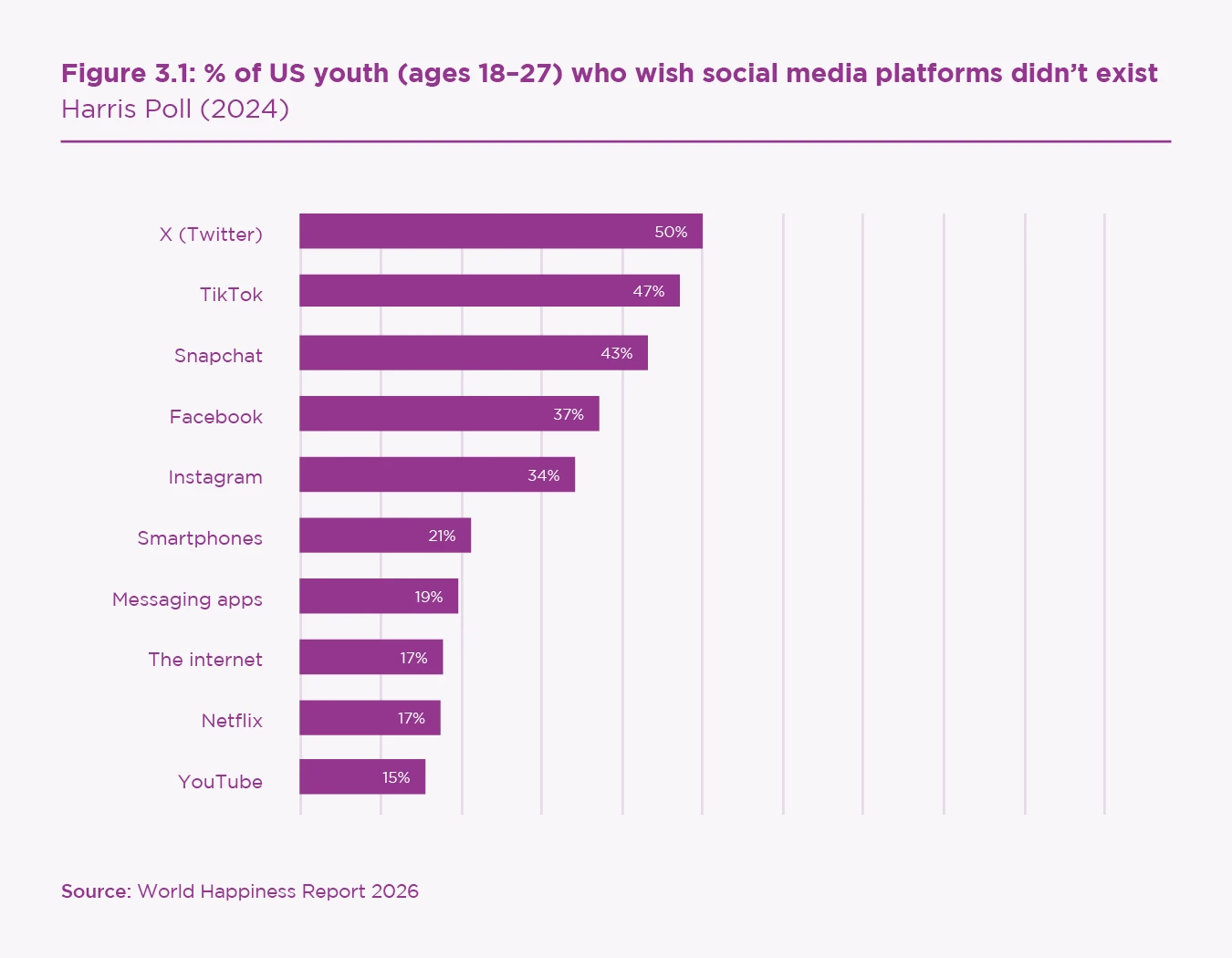
A more revealing test is to ask young people whether, in retrospect, they wish these products had never been invented. In a US survey of Gen Z adults (ages 18 to 27), that we conducted with the Harris Poll,[21] regret was low for products such as YouTube (15%), Netflix (17%), and messaging apps (19%), but much higher for social media platforms: 34% wished Instagram had never been created, 43% said the same about Snapchat, and nearly half expressed regret about TikTok (47%) and X (50%). In other words, one-third to one-half of young adults wish that some of the platforms they use for five or more hours each day had never existed.[22]
We are not the only ones to find this high level of regret. A 2023 study led by Leonardo Bursztyn found that 58% of US college students would prefer a world without Instagram and 57% without TikTok. Even among active users, one-third of TikTok users and over half of Instagram users said the same.[23] The researchers also asked how much money they would have to pay participants to give up TikTok or Instagram for a month. The answer? $59 and $47, respectively. But when asked how much it would take if most others on their campus also gave up the apps, the average answer dropped below zero. In other words, the participants were willing to pay the researchers to help them and their peers get off social media. You can read more about this study and the concept of ‘product traps’ in Chapter 6.
In the UK, a nationally representative survey conducted by More in Common in 2025 found that 62% of young people (ages 16 to 24) believe social media does more harm than good for those under 16, rising to 66% among Gen Z women. 55% said life would be better if social media were banned for under-16s, compared to 22% who said it would be worse.[24] A different survey, by BSI, the UK’s national standards body, finds similarly grim assessments in 2025 from young people in the UK (ages 16 to 21) about their online lives.[25]
Australian survey data show similar patterns, with young people identifying social media as a leading contributor to declining youth mental health.[26] In sum, when the apparent victims are surveyed, they positively identify social media as the perpetrator. There is little gratitude[27] and a lot of regret expressed toward these companies and their products,[28] at least across three English-speaking countries. More work is needed in other countries, but other chapters in this report analyse the global data we have so far.
Exhibit B: Internal surveys from social media companies show that Gen Z perceives high levels of harm
In October 2021, Facebook whistleblower Frances Haugen released thousands of internal documents and screenshots revealing that the company was well aware of the many harms its platforms were causing teens.[29] We will cover what Facebook/Meta’s leaders and employees said in a later exhibit. For now, we will focus on the surveys they conducted or commissioned about the experiences of their young users.
Among the most widely cited of these findings is an internal study – covering Brazil, India, Indonesia, Japan, Türkiye, and the United States – showing that one in three teen girls said Instagram made their body image issues worse (while 22% said it improved their body image).[30] Meta researchers also analysed qualitative data (i.e., what the teens said in their own words). From the report they submitted to Meta: “Teens blame Instagram for increases in the rate of anxiety and depression […] This reaction was unprompted and consistent across all groups.”[31]
A separate internal survey of 50,590 Instagram users across 10 countries – Australia, Brazil, France, Germany, India, Japan, Mexico, Republic of Korea, the UK, and the US – found that more than one-third of teen girls (37%) reported often or always seeing posts that made them feel worse about their bodies, compared to 26% of users overall.[32]
Two years after the release of the Facebook Files, another whistleblower, Arturo Béjar, came forward with internal research he had led at Instagram.[33] His study of more than 200,000 Instagram users, known as the Bad Experiences and Encounters Framework Survey, offered a snapshot of what teens were facing on the platform.[34] The picture was alarming. Among Instagram users aged 13 to 15, 13% reported receiving unwanted sexual advances – in the past week alone. That same percentage had seen violent, bloody, or disturbing images during the same time frame, and 28% reported witnessing bullying on the platform.
Additional internal research from other platforms – including Snapchat and TikTok[35] – reveals similarly troubling patterns. In a 2024 court filing by the Nebraska Attorney General, evidence drawn from TikTok’s own internal studies showed that:
Users found that overuse of TikTok caused “negative emotions”, “interfered with [users’] obligations and productivity”, and led to “negative impacts […] on their lives”, including “lost sleep, missed deadlines, poor school performance, running late, etc.” It reported that “many participants described their use of TikTok disturbing their sleep, which limited their productivity and performance the following day”, and that “[e]very participant indicated that time management on TikTok was especially difficult compared to other social media platforms”.
Across the board, these internal user surveys and related documents reveal that the companies know that millions of their young users perceive a great deal of harm to themselves and their peers from the ordinary use of these products.
In a courtroom, it is powerful when a victim points to the defendant and says “he did it”. The exhibits we highlighted – surveys of adolescents from independent organisations like Pew as well as the social media companies themselves – make it clear that Gen Z is pointing to social media platforms as the perpetrator.
Of course, the victim could be mistaken or could be lying, so direct positive identification is strengthened when corroborated by eyewitness testimony. The same logic applies here, so let’s move to our second line of evidence and call a variety of witnesses to the stand.
Evidence Line Two: What the witnesses say
One of the most striking patterns we encountered in our research and conversations is that in every group of adults that works closely with young people – parents, teachers, school counsellors, doctors, coaches, therapists, and more – many tell us they’ve seen firsthand a dramatic shift in kids’ mental health beginning in the 2010s, well before the arrival of COVID-19. Their testimony corroborates the claims made by so many members of Gen Z.
Internal user surveys and related documents reveal that the companies know that millions of their young users perceive a great deal of harm to themselves and their peers from the ordinary use of these products.
Exhibit C: Parents fear social media and perceive harm
Parents are on the front lines. They know their children intimately. They watch closely as new experiences, relationships, and technologies shape their children’s development. When something changes, parents are often the first to notice and to care.
When it comes to social media, most parents are deeply concerned about its impact on their children’s wellbeing. They’re not just reacting to headlines or stories about a crime committed far away, as in media-driven panics over comic books in the 1950s. Rather, parents are observing changes in their children’s behaviour, moods, sleep, and self-esteem after they give their children touchscreen devices and social media accounts. Parents see how these products and platforms are affecting their kids’ daily lives. In survey after survey, they corroborate the claims made by members of Gen Z in Evidence Line One.
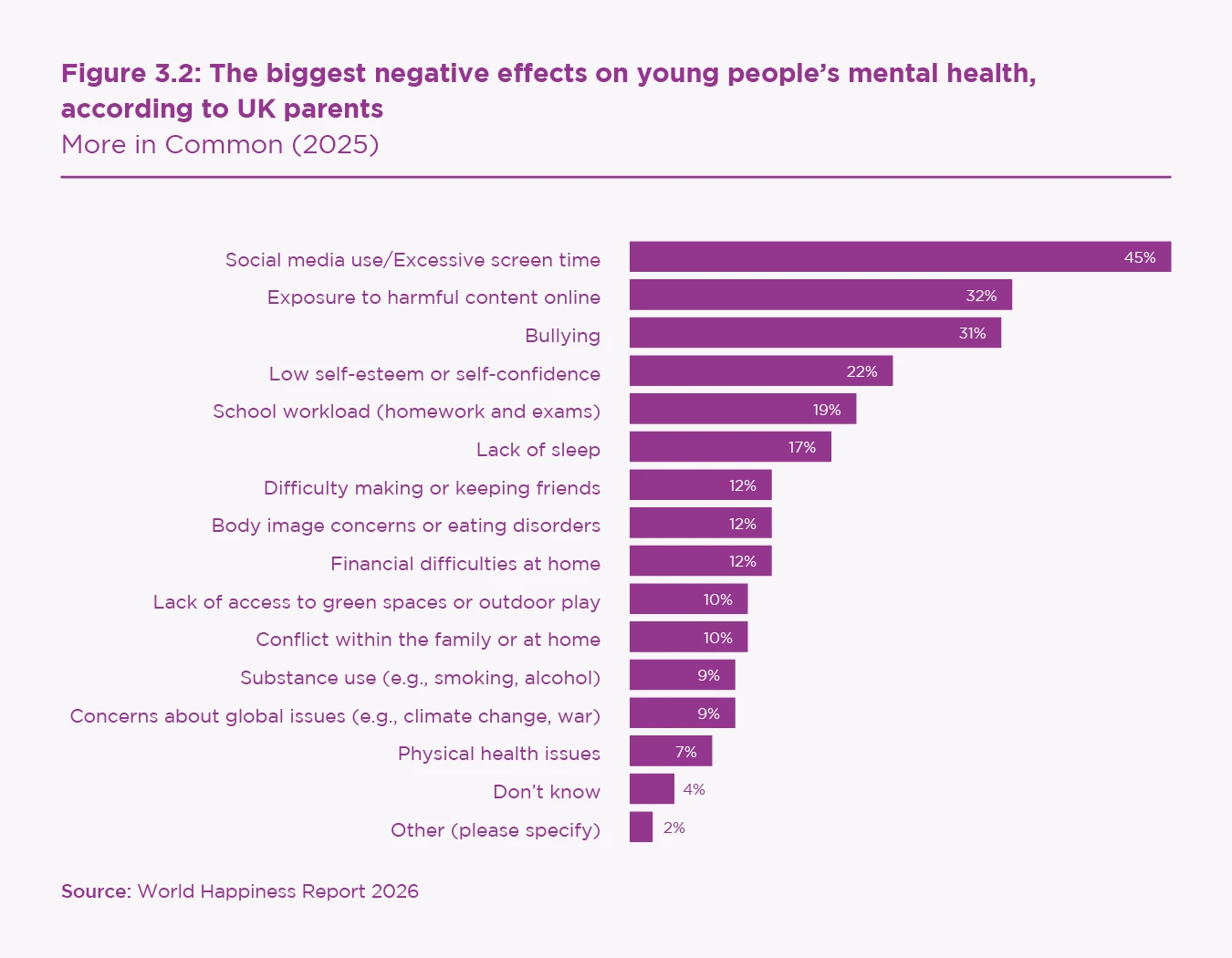
A 2025 Pew survey of US teens and their parents found that 44% of parents identified social media as the single most negative influence on teen mental health, ahead of “technology generally”.[36] Similarly, the 2025 UK survey by More in Common (discussed in Exhibit A) asked parents to identify what most negatively affects their own children’s mental health. The top response was “social media use/excessive screen time”, followed by concerns closely linked to digital technology, including exposure to harmful online content, bullying, low self-esteem, and lack of sleep (see Figure 3.2 below).
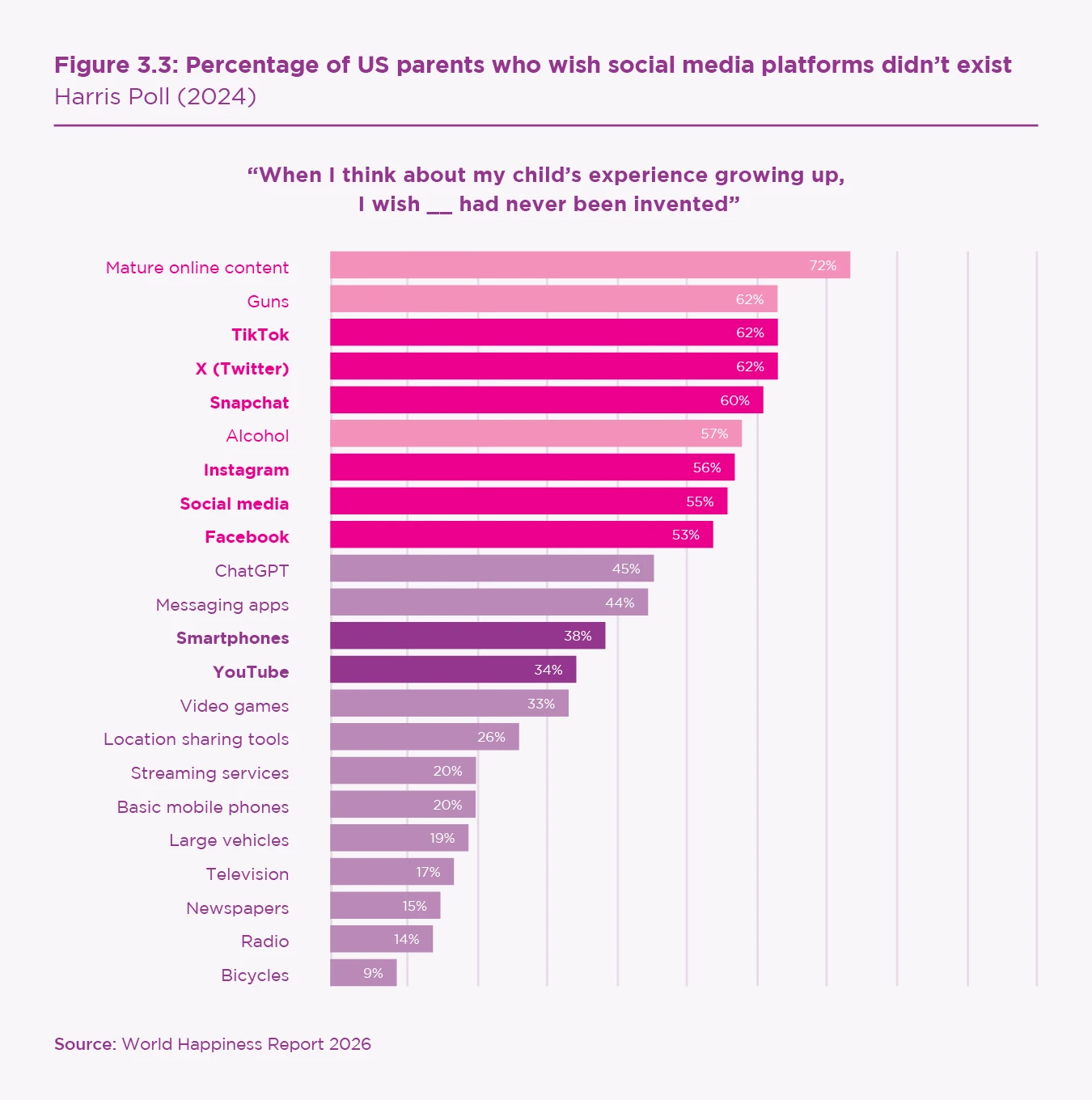
In our own research with the Harris Poll, we surveyed 1,013 US parents to gauge regret, as we did with Gen Z (see Exhibit A).[37] Specifically, we asked parents to reflect on the role of various products in their children’s lives by considering the sentence: “When I think about my child’s experience growing up, I wish ____ had never been invented.” Their responses are shown in Figure 3.3.
Not surprisingly, few parents expressed regret about bicycles (9%), even though many children have been injured riding one. Bicycles are viewed as positive tools for growth and independence, despite their risks. In contrast, most parents see products like alcohol, guns, and pornography as clearly harmful in the context of childhood development.
So where do digital media products fall on this spectrum? Are they more like bicycles or guns?
For some items, like smartphones and YouTube, there was ambivalence: about one-third of parents said they wished these had never been invented, but the majority did not. But for social media platforms, especially Facebook, Instagram, TikTok, and X, the results were far more stark. A majority of parents said they wished social media had never been created. For TikTok and X, 62% of parents expressed regret – higher than for alcohol and equal to guns.
It’s not just parents in Anglophone countries who are worried.[38] An Ipsos survey of parents with school-age children, conducted in 30 countries, found that mental health was the top concern, far ahead of physical health.[39] The survey also found that majorities in all 30 countries favoured banning everyone under the age of 14 from having a social media account, although concerns about social media were generally higher in developed Western nations than in developing nations.
Parents are not unanimous, but increasingly, and across many nations, they are expressing their beliefs that smartphones and social media are harming their children.
Exhibit D: Educators perceive harms to education and mental health
Another group of adults with a front-row view of what is happening to young people are the teachers and school administrators who see them every school day. These adults witness firsthand how students behave, focus, interact, and learn. Many have been around long enough to witness how students have changed since 2010. So what do they see? Do they view social media as a relatively benign tool for social connection, or as something more harmful?
In recent years, several important surveys have explored exactly this question. These studies span different countries and school roles.
One 2024 study conducted by the television network NBC surveyed 559 US elementary and secondary school principals about the impact of smartphones and social media on their students.[40] Just 1.3% believed that concerns about these technologies were “overblown”. In contrast, 42.2% said they firmly believe that smartphones and social media are “major causes of deteriorating student mental health”. When asked about the effects of smartphones on their own student bodies, large majorities said that they see these harmful effects: distraction and tiredness; depression, anxiety, and loneliness; as well as student conflicts and bullying. Few said they saw evidence of benefits, such as improving students’ work (3.4%) or improving their mental health (5.6%).
What about the teachers themselves? A 2024 survey of 2,889 US educators – members of the National Education Association – asked participants to rate how much various factors contribute to student mental health challenges in their schools.[41]
The top concern was “lack of parental involvement and communication” (92%). But just below that were two factors that point directly to technology: 84% of educators said that “social media use” contributes to student mental health issues, and 81% said the same for “cell phone or personal device use after school hours”.
Beyond mental health, US educators overwhelmingly agree that social media and smartphones are a major source of distraction that interferes with learning. In a recent Pew survey, 72% of US high school teachers said that cell phone distraction is a major problem in their classrooms.[42] Another survey of 595 US educators from EdWeek Research Center found that approximately nine out of ten believe social media harms students’ communication skills, their treatment of others, and girls’ mental health.[43]
We find similar concerns among teachers in other Western countries, including England,[44] Spain,[45] and France.[46] One survey of teachers (80% of sample), school leaders, and parents across the European Union found that 54% believe that mobile phone use negatively affects the overall school environment, 56% reporting a negative impact on social interactions and wellbeing, and 71% reporting that it worsens students’ ability to focus.[47] Taken together, these findings show that the belief that social media and smartphones are harming students’ education and mental health is not isolated or fringe. It is the dominant perception among educators across many Western nations. They stand in the witness box, point to social media platforms, and say: “They did it”.
The belief that social media and smartphones are harming students’ education and mental health is not isolated or fringe. It is the dominant perception among educators across many Western nations.
Exhibit E: Clinicians perceive harm to mental health (according to Meta)
A third group with deep insight into young people’s lives are mental health clinicians. They work closely with young people, observe their problems firsthand, are trained to identify and treat their distress, and see how those challenges change over time. So what do they report about social media’s impact on their clients?
While there is limited research available on the views of clinicians, Meta itself conducted a mixed-methods study of more than 1,000 psychiatrists, psychologists, therapists, and social workers to answer this question.[48] According to findings disclosed in court documents from a Multi-District Litigation brought by US school districts, 81% of clinicians said social media exacerbates anxiety disorders in their patients, 78% said it worsens depressive disorders, and 85% agreed that social media can be addictive. In other words, Meta itself found that clinicians believe that social media platforms are causing harm to adolescents.
We close our discussion of Evidence Line Two with an observation about the witnesses. No group or occupational category that works closely with children has come forth to say that social media is, overall, beneficial for adolescent mental health. No group or professional body has stepped forward as a character witness to say that the defendants are benefactors to young people, or that they are not the sort of companies that would knowingly harm young people.
As we will show in Evidence Line Three, they are very much the sort of companies that knowingly harm young people.

Evidence Line Three: What company documents and insiders reveal
Executives and some employees at TikTok, Snap, and Meta know (or seem to believe) that they are causing widespread harm to adolescents on their platforms. Quotations and statistics revealed through whistleblowers, lawsuits, and leaked documents and studies from inside the major social media companies make this clear.[49] We’ve compiled and organised such quotes and statistics – including direct quotes, internal slide decks, and stories of teens harmed.[50] Journalists such as Jeff Horwitz at The Wall Street Journal and Reuters have also reported extensively on the matter.[51] We also created a website, MetasInternalResearch.org, which compiles all of the publicly available information about dozens of internal research projects carried out by Meta and brought out by whistleblowers, or in the process of discovery during legal proceedings.
Below we highlight just a few of the most revealing internal quotations and statistics. These are admissions from company insiders and external consultants hired to offer advice.
Exhibit F: TikTok knows or believes that it is harming children at an industrial scale
In our essay “TikTok Is Harming Children at an Industrial Scale”,[52] we collected direct quotations from TikTok employees and executives, drawn from the briefs of two court cases, and posted online by the Attorneys General of Kentucky and Nebraska.[53] Here are just a few of the most incriminating quotations. The text in boldface comes directly from company employees and internal memos. The normal text around it was supplied by attorneys to frame the quotes.
“Compulsive usage correlates with a slew of negative mental health effects like loss of analytical skills, memory formation, contextual thinking, conversational depth, empathy, and increased anxiety”, in addition to “interfer[ing] with essential personal responsibilities like sufficient sleep, work/school responsibilities, and connecting with loved ones.”
—TikTank Report, an internal TikTok research group[54]
“The product in itself has baked into it compulsive use.”
—TikTok executive
“The reason kids watch TikTok is because the algo[rithm] is really good […] But I think we need to be cognizant of what it might mean for other opportunities. And when I say other opportunities, I literally mean sleep, and eating, and moving around the room, and looking at somebody in the eyes.”
—TikTok executive[55]
Internal documents highlight the fact that minor users are “particularly sensitive to reinforcement in the form of social award”, have “minimal ability to self-regulate effectively”, and “do not have executive function to control their screen time”.
—TikTok internal document[56]
The full list of quotations is much longer.[57] The evidence is clear: TikTok employees know they are harming millions of children.
Executives and some employees at TikTok, Snap, and Meta know (or seem to believe) that they are causing widespread harm to adolescents on their platforms. Quotations and statistics revealed through whistleblowers, lawsuits, and leaked documents and studies from inside the major social media companies make this clear.
Exhibit G: Snap Inc. knows or believes that it is harming children at an industrial scale
Our second essay in this series was “Snapchat Is Harming Children at an Industrial Scale”.[58] As we did for TikTok, we drew quotations from a legal brief that was posted online, in this case by the Attorney General of New Mexico.[59] The results are just as incriminating. One of the most widespread of the serious direct harms on Snapchat is sextortion, which causes great distress to its victims and sometimes leads directly to suicide as an escape from deep shame.[60] As of 2022, Snap was internally aware that they receive:
“[A]round 10,000 user reports of sextortion each month,” and “that 10k monthly reports likely represents a small fraction of this abuse as this is an embarrassing issue that is not easy to categorize in reporting.”
—Snap Trust and Safety Team Member[61]
One year later, in March of 2023, an employee stated “God I’m so pissed that we’re over-run by this sextortion shit right now. We’ve been twiddling our thumbs and wrung our hands all f…ing year.”
—Snap employee[62]
It’s not just sextortion; Snap’s design makes it an excellent platform for cyberbullying, which is also a common cause of death by suicide:
In a February 2022 ‘In-App Reporting Research’ deck by Snap’s consultant, Snap found, “cyberbullying, both anonymous and from known contacts, was a commonly cited problem [among users] […] Disappearing messages can embolden bullies to harass people with less fear of consequence.”
—Internal research deck from Snap consultant[63]
Because Snapchat is a way by which anonymous adults can easily reach young people once they connect with any young person (via the “quick add” or “find friends” feature), it is a vector for the sale of many illegal and dangerous products:
An undated internal Snap presentation acknowledged that Snap had a “problem” with drugs and guns; that dealers are using Snapchat’s “sharing mechanisms” “to reach teens on Snapchat they would never encounter in real life” and that “some teens have even died as result of buying drugs that they found through Snapchat”.
—Snap internal presentation[64]
While quotations about depression and anxiety do not seem to be as common at Snapchat as they are at Instagram and TikTok, the evidence that Snapchat’s design facilitates a variety of very dangerous encounters is strong, and these direct harms can cause anxiety and exacerbate mental illness. Snap employees know they are harming millions of young people, and they know that these harms are directly linked to specific product design choices that they made.
Exhibit H: Meta knows or believes that it is harming children at an industrial scale
In September 2021, whistleblower Frances Haugen brought out thousands of pages of internal Facebook reports, memos, and emails. The Wall Street Journal published these revelations in a series of articles titled The Facebook Files.[65] Below we draw quotations from those documents, as well as from disclosures by Arturo Béjar,[66] another whistleblower from Meta, and from New Mexico v. Meta and Northern District of California v. Meta, two major ongoing lawsuits.[67]
[…] [A]n internal Meta email to Adam Mosseri stated “[o]ur overall goal remains total teen time spent […] with some specific efforts (Instagram) taking on tighter focused goals like U.S. teen total time spent.” Another 2018 email stated Meta’s focus succinctly: “Short summary is ‘the young ones are the best ones.’ You want to bring people to your service young and early.”
—Internal Meta email[68]
Facebook’s founding President, Sean Parker, in 2017: The thought process that went into building these applications, Facebook being the first of them […] was all about: “How do we consume as much of your time and conscious attention as possible?” “And that means that we need to sort of give you a little dopamine hit every once in a while, because someone liked or commented on a photo or a post or whatever. And that’s going to get you to contribute more content, and that’s going to get you […] more likes and comments." "It’s a social-validation feedback loop […] exactly the kind of thing that a hacker like myself would come up with, because you’re exploiting a vulnerability in human psychology.” "The inventors, creators – it’s me, it’s Mark [Zuckerberg], it’s Kevin Systrom on Instagram, it’s all of these people – understood this consciously. And we did it anyway.”
—Facebook founding president[69]
“There are reasons to worry about self-control and use of our products” and presenting a “quick rundown of evidence” – including “[a]n experiment [which] found that a 1-month break from Facebook improved self-reported wellbeing.” In response, another senior data scientist at Meta (who also holds a PhD in neuroscience, and taught a university course on addiction) warned: “It seems clear from what’s presented here that some of our users are addicted to our products. And I worry that driving sessions incentivizes us to make our product more addictive, without providing much more value. How to keep someone returning over and over to the same behavior each day? Intermittent rewards are most effective (think slot machines) reinforcing behaviors that become especially hard to extinguish – even when they provide little reward, or cease providing reward at all.”
—A member of Meta’s core data science team and a senior data scientist at Meta[70]
“Oh my gosh yall IG is a drug […] We’re basically pushers […] We are causing Reward Deficit Disorder bc people are binging on IG so much they can’t feel reward anymore […] like their reward tolerance is so high […] I know Adam [Mosseri] doesn’t want to hear it — he freaked out when I talked about dopamine in my teen fundamentals leads review but its undeniable! Its biological and psychological […] the top down directives drive it all towards making sure people keep coming back for more. That would be fine if its productive but most of the time it isn’t […] the majority is just mindless scrolling and ads.”
—A chat between two UX Meta researchers[71]
Meta employees know they are harming millions of children and adolescents. They know this from their own research. As Sean Parker said, they knew what they were doing, and they did it anyway.
We have now examined the first three lines of evidence. Let us pause for a moment to evaluate the case so far. We have shown that:
- The victims identify the defendants as having harmed them (Exhibits A and B).
- Multiple witnesses who had a clear view of the scene agree (Exhibits C, D, and E).
- The defendants themselves talked and wrote extensively about the many ways that their products were harming adolescents (Exhibits F, G, and H).
We believe that these eight exhibits, comprising three distinct lines of evidence, are sufficient in themselves to answer the product safety question. The answer is: no, social media platforms are not safe for children and adolescents. Even the people who run them say so, in private, which may explain why many tech executives place very severe restrictions on their own children’s exposure to smartphones and social media.[72]
Let us now turn from the three lines of “testimony” to the four lines of academic research that are at issue in academic debates over social media and adolescent mental health: cross-sectional studies, longitudinal studies, randomised controlled trials (RCTs), and natural experiments.
Our goal is not to provide a comprehensive review of the academic literature, but rather to explain the four main kinds of studies that researchers are debating, and to show that, within each line, there are many studies showing compelling evidence of harm. We also show that the studies most often cited as failing to show risk or harm do, in fact, show risk or harm when the analysis is “unblended” or when other problems are fixed.
Evidence Line Four: Cross-sectional studies
The most common type of study surveys hundreds or thousands of young people (often college students) about their daily social media use (self-reported in hours per day) and their mental health (also self-reported). Researchers who conduct these cross-sectional studies are trying to determine if there is an association between social media use and adolescent mental health outcomes. Cross-sectional studies do not establish causal relationships on their own, but they are a first step in public health and epidemiological research. If heavy users of social media are much worse off than light users (after controlling for relevant factors), then there is more reason to suspect a causal relationship than if there had been no association, or a reverse association.
These cross-sectional (or correlational) studies now number in the thousands, but researchers differ on how to interpret the findings. Most studies find statistically significant associations; heavy users of social media are nearly always found to be in worse mental health than light users or non-users.[73] But some researchers interpret the associations as being "too small to warrant policy change”[74] while others (including us) interpret the associations as being much more worrisome, and comparable in size to other public health risks for which societies take action. Which camp is correct?
Exhibit I: Cross-sectional studies show that heavy users have elevated risk of depression
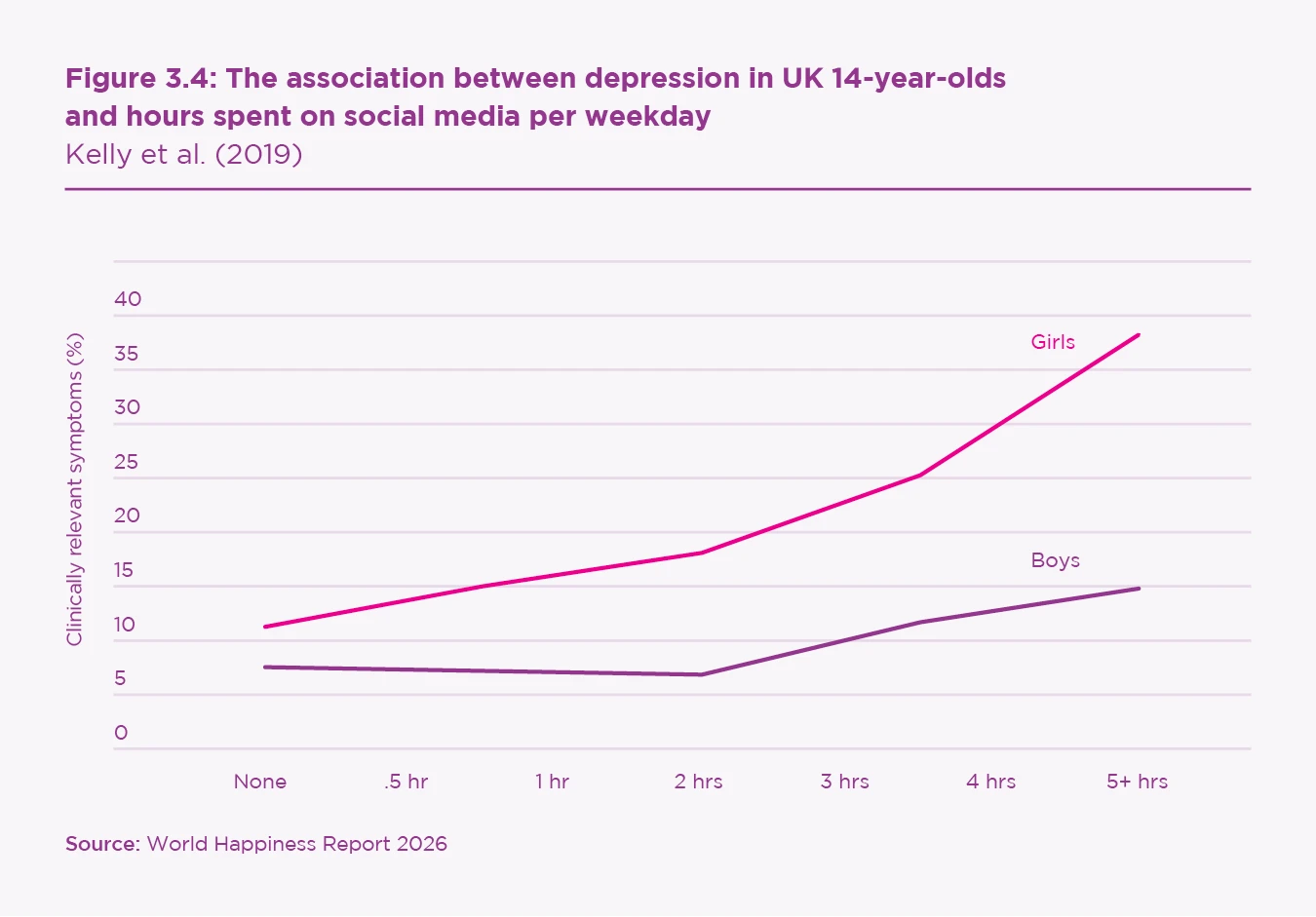
One of the most careful studies to date analysed data from 10,904 14-year-olds in the UK Millennium Cohort Study.[75] The authors found that adolescents who spent five or more hours per day on social media were about two times more likely to meet criteria for depression than those who used it for less than one hour per day (see Figure 3.4 below). In this study, heavy social media users (five or more hours per day) constituted roughly one-fourth of 14-year-old girls and 10% of boys.
Additional studies reinforce these findings.[76] A 2022 meta-analysis found that the odds of depression increased by about 13% for every additional hour per day of social media use (OR = 1.13).[77] Given that the average adolescent now spends roughly five hours per day on social media in the US (4.4 hours for boys, and 5.3 for girls),[78] this translates into a very large cumulative risk. Using these numbers, we can extrapolate that even average daily use is associated with over a 50% increase in the risk of depression compared with little or no use – with even larger effects among girls.[79]
In this same UK Millennium Cohort Study dataset, the risk elevation of heavy social media use for depression among girls (RR = 2.65 between those who spend more than five hours a day and those who spend less than one) is comparable to that of sleep deprivation (sleeping less than seven hours per night, RR = 2.45) and victimisation by online harassment (RR = 2.56).[80] The risk elevation from heavy social media use is greater than the risk elevation from poverty (RR = 1.22) for adolescent depression.[81]
These elevated risk findings were central to the US Surgeon General’s warnings in 2023 and 2024.[82] Citing studies which documented that high levels of social media use predicted double the future risk of depression among adolescents,[83] the Surgeon General cautioned that heavy and problematic use of social media poses “profound risk” to youth mental health.
Yet, some researchers do not account for these findings and argue that there is little or no association between social media use and adolescent mental health. They tend to cite a few influential studies to make their case. In the section below, we show that even these studies, when analysed correctly, reveal risks to adolescent mental health.
Exhibit J: Studies that report null findings actually yield significant associations when examining adolescent girls, heavy social media use, and internalising disorders
Many of the most-cited “null” findings focus on broad wellbeing scales that dilute the primary outcomes of concern – anxiety and depression in adolescents. One of the most influential reviews that critics use to dismiss the harms of social media was conducted by Jeff Hancock and colleagues in 2022.[84] Their meta-analysis of 226 studies was prominently cited in the National Academies of Sciences report Social Media and Adolescent Mental Health, which Mark Zuckerberg cited for exoneration in front of the US Senate.[85]
The headline claim in their abstract was that “social media use is not associated with an aggregated measure of well-being” (r = 0.01). Here, the aggregated wellbeing outcome blended together questions about anxiety and depression with eudaimonic and hedonic wellbeing as well as social wellbeing, which is not a mental wellbeing outcome.
Yet, Hancock and colleagues themselves found that when the aggregated wellbeing measure is unblended and narrowed down to measures of internalising disorders, the correlations are much larger: r = 0.18 for anxiety, and r = 0.13 for depression.[86]
In another study widely cited by researchers in the “too small” camp,[87] a re-analysis found much larger associations.[88] When the three large datasets in that study were “unblended” so that associations between social media use (not all digital media) and internalising disorders (not a broad measure of many diverse outcomes) were calculated for girls (not all teens), the associations were, once again, much larger.
These examples show why apparent “null” findings should not be taken at face value. Blending populations, technologies, and outcomes can often suppress the associations at the centre of the debate about social media’s effects on adolescent mental health.[89] Once these studies analyse the core hypothesis that heavy social media use is causing internalising disorders in adolescent girls, social media’s exonerating evidence ends up pointing in the same direction as Exhibit I: adolescents who are heavy social media users are at substantially elevated risk for depression, especially girls.
Blending populations, technologies, and outcomes can often suppress the associations at the centre of the debate about social media’s effects on adolescent mental health.
Evidence Line Five: Longitudinal studies
The longitudinal literature on social media and mental health allows researchers to follow individuals over time and can help clarify whether social media use predicts subsequent changes in mental health, whether poor mental health predicts subsequent social media use, or some combination of the two. The available longitudinal studies present clear and consistent evidence that social media use predicts later depression, as we’ll see in Exhibits K and L.
Exhibit K: Social media use at Time 1 predicts depression at Time 2
Overall, recent high-quality work provides support for the hypothesis that heavier use of social media predicts later increases in depressive symptoms[90] – especially when the focus is on time spent on social media and depressive outcomes in adolescent populations. Bidirectional effects have also been documented, with some evidence that declining wellbeing predicts subsequent increases in social media use, particularly in studies that rely on broader definitions of use, wider age ranges, or broad measures of wellbeing.
The strongest evidence comes from recent large-scale cohort studies. An analysis of a sample of 6,595 US adolescents, ages 12–15, found that heavy social media use predicted later increases in internalising symptoms.[91] Using the longitudinal Adolescent Brain Cognitive Development (ABCD) dataset, findings showed that increases in social media use predicted subsequent increases in depression.[92] Meanwhile, other researchers using the ABCD dataset showed that earlier internalising disorders failed to predict subsequent social media use.[93] A study which focused on “screen time” extended this to younger children, documenting bidirectional relationships: heavier use of screens predicted later depression, and depression symptoms also predicted greater subsequent use.[94] Together, these studies suggest that while reverse pathways are sometimes found, the forward relationship from social media use to depressive symptoms is robust, particularly for adolescents.
However, some researchers claim that the literature shows that poor mental health at Time 1 predicts later social media use, but not the other way around. For example, psychologist Candice Odgers wrote in Nature:
When associations over time are found, they suggest not that social-media use predicts or causes depression, but that young people who already have mental-health problems use such platforms more often or in different ways from their healthy peers.[95]
But the three studies Odgers cited do not in fact support her “reverse predictability only” claim.[96]
In sum, most of the recent high-quality longitudinal studies indicate that heavier social media use at one moment in time predicts later depression, especially for adolescent girls.[97]
Together, these studies suggest that while reverse pathways are sometimes found, the forward relationship from social media use to depressive symptoms is robust, particularly for adolescents.
Evidence Line Six: Randomised controlled trials of time reduction
We now turn to the major body of experimental research: social media time reduction experiments. These experiments randomly assign a portion of the participants to reduce or abstain from social media for a set period of time and then measure changes in their mental health outcomes, compared to a control group that made no change.[98]
The pattern of results is surprisingly consistent: sustained reduction in time on social media tends to improve mental health, particularly depression. As with correlational studies, disputes in the field often arise from how data are analysed and, especially, from the problem of blending together heterogeneous interventions, outcomes, and populations. Likewise, effects that appear small on a statistical scale can translate into meaningful improvements when considered across large populations.
Exhibit L: Experiments show that social media reduction leads to reduced depression
Among the most rigorous meta-analyses to date, researchers synthesised 32 randomised controlled trials of social media reduction experiments (5,544 participants, 91 effect sizes).[99] The analysis found that restricting social media produced consistent improvements in mental health and wellbeing outcomes, with pooled significant effects of:[100]
- Depression: Hedges’ g = 0.19 (roughly 19% of one standard deviation)[101]
- Anxiety: Hedges’ g = 0.28
- Wellbeing: Hedges’ g = 0.22
In fact, among the 16 experiments that provided a clear measure of depression, 14 found reductions in depression, and among the 10 that offered a clear measure of anxiety, 8 found reductions.[102]
One especially important study[103] examined the effects of social media reduction among already distressed young people – a group of particular clinical concern. The researchers recruited 220 distressed US youth, ages 17–25, and randomly assigned them to either (a) reduce social media use to one hour per day for three weeks, or (b) continue their usual use. Compared to the control group, those who reduced their use showed significant decreases in depression, anxiety, and fear of missing out (FOMO), along with improved sleep. These benefits were observed for both men and women.
Exhibit M: Studies that report no improvement from social media reduction actually do reveal benefits to depression when unblended
The first widely discussed meta-analysis of social media reduction experiments was conducted by psychologist Chris Ferguson, who analysed 27 studies and reported an average effect size of d = 0.088 with a confidence interval that included zero (−0.018, 0.197). He concluded that these findings “undermine causal claims […] that reductions in social media time would improve adolescent mental health” (p. 205). However, this conclusion rests on major conceptual and methodological flaws.[104] Most notably, the analysis pooled together highly heterogeneous studies that varied widely in duration, design, and outcomes. The analysis also included several studies that did not examine reductions in social media use, and thus cannot be used to assess the effects of social media reduction.
By blending highly heterogeneous studies and outcomes, Ferguson’s analysis obscured how short-term abstinence experiments (one or two days) often induce withdrawal-like responses (e.g., irritability, craving, and worse mood), whereas longer reductions (a week or more) usually improve mental health. Reanalysing Ferguson’s dataset, researchers found that interventions lasting under one week worsened mental health (d = −0.175), while those lasting longer than one week improved it (d = 0.156).[105] Additionally, when the studies that included clinical outcomes like anxiety and depression were isolated from studies that used broad, blended, composite wellbeing measures, effects were substantially larger: a study found d = 0.22 (using Ferguson’s own dataset) for experiments measuring symptoms of internalising disorders,[106] and another study reported (as noted above) robust pooled improvements (anxiety: g = 0.28; depression: g = 0.19).[107]
Taken together, these analyses show that when studies are unblended and properly analysed, they confirm that a sustained reduction in social media use (a week or longer) does in fact improve adolescent mental health – especially for anxiety and depression.
Exhibit N: Meta’s own RCT shows that social media reduction leads to multiple mental health benefits
In November 2025, documents obtained via discovery in a lawsuit brought by US school districts against Meta and other platforms revealed that Meta had run its own reduction experiment in 2020, with Nielsen (the media measurement company).[108] The project, code-named Project Mercury, asked a randomly selected group of users to deactivate their Facebook accounts for one week. According to Meta’s own summary, “people who stopped using Facebook for a week reported lower feelings of depression, anxiety, loneliness, and social comparison.”
An internal researcher noted, “the Nielsen study does show causal impact on social comparison”, adding an unhappy-face emoji. Another staffer reportedly warned that burying such results would put the company in the same position as the tobacco industry “doing research and knowing cigs were bad and then keeping that info to themselves.”
Internal documents show that Meta subsequently called off further work and dismissed the findings as being “tainted” by the “existing media narrative” around the company. Yet the core fact is that Meta’s own experiment found that sustained abstention from their product led to improvements in user mental health.[109]
All four studies reach a similar conclusion: the spread of high-speed internet and social media platforms worsened mental health. The harms were most pronounced among young people and disproportionately affected women and adolescent girls.
Evidence Line Seven: Natural experiments
One type of study rarely addressed in the debate over social media and mental health is the natural experiment, which is a research design that attempts to estimate causal effects without true random assignment.
Exhibit O: The evidence from natural experiments points to harm
The most common natural experiments examine the rollout of high-speed internet during the late 2000s and early 2010s. These studies leverage variation in broadband expansion to estimate its causal impact on mental health in the newly connected region. This approach provides population-level insights that are not possible in short-term lab experiments. These studies rely on the assumption that the rollout of high-speed internet greatly increased access and time spent on social media platforms (which seems reasonable given that it was very slow to load photos and videos before high-speed internet).
Researchers[110] have examined four such studies in Germany,[111] Italy,[112] Spain,[113] and the US.[114] Across diverse contexts and datasets, including national health surveys, hospital admission records, and suicide statistics, all four studies reach a similar conclusion: the spread of high-speed internet and social media platforms worsened mental health. The harms were most pronounced among young people and disproportionately affected women and adolescent girls. Documented outcomes include declines in self-reported mental health in Germany, increases in hospital-diagnosed mental disorders in Italy, rising adolescent mental health diagnoses (especially among girls) in Spain, and higher suicide rates in the US, as well as increased depression symptoms among US college students. Similar conclusions were drawn in another recent review of these studies.[115]
Three further studies augment this body of evidence. The first found negative effects of the arrival of high-speed internet in England on adolescent wellbeing.[116] These effects were strongest among heavy users (>5 hours per day) and were associated with social networking site use in particular. The second found similar results looking at suicidal conduct among teens from 2009 to 2019 in the wake of broadband introduction in the US.[117] The impacts of broadband were associated with cyberbullying and body dissatisfaction for girls, and with decreases in sleep for boys. The third exploited a difference-in-differences design based on Facebook’s staged rollout to US colleges and universities between 2004 and 2006.[118] They found that whenever Facebook arrived on campus, symptoms of mental illness soon increased.[119] Chapter 8 in this report also estimates that increased internet use reduced wellbeing on average in over 30 European countries from 2016–2024, with strong negative effects among Gen Z but near-zero or positive effects for older adults.
We have only found one study that points in the opposite direction.[120] It found improved aggregate wellbeing, reduction in suicides, and improved physical and mental health from broadband expansion in the US from 2000–2008.[121] The authors themselves interpret these gains as stemming mainly from improved local economic conditions (lower unemployment, reduced poverty, more business activity) rather than from changes in internet or social media use itself.
Summary of the evidence on the product safety question
We have now presented 15 exhibits organised into seven separate and independent lines of evidence. First, we presented three lines of “testimony” from the groups that had the clearest view of the effects of social media: Gen Z (Line One); parents, teachers, school administrators and clinicians (Line Two); and employees and consultants working for the major social media platforms (Line Three).
Next, we presented four lines of academic research showing that heavy users of social media suffer from substantially elevated risks of depression (Line Four); social media use at Time 1 predicts depression at Time 2 (Line Five); reducing time on social media causes improvements to mental health (Line Six); and, when high-speed internet entered into communities and regions, mental health outcomes got worse soon afterward, especially for girls and women (Line Seven). These findings converge on the conclusion that when adolescents use social media for several hours every day, it causes their mental health to suffer (on average).
What do you think, readers? Is social media probably safe for children and teens, or probably not? Do you think that more research is needed before we can answer that question?
Of course, it is important to hear the arguments on the other side. You should hear from researchers who take a more positive view of social media, or who take issue with our work. We urge you to read the main essay cited by journalists as a rebuttal of our work – Candice Odgers’ review in Nature.[122] We also recommend reading a new evidence review led by Amy Orben.[123] But after presenting our seven lines of evidence, including RCTs, natural experiments, and many quotes from social media employees stating directly that their products are causing harm to adolescents at a massive scale, we believe that the preponderance of the evidence points to a clear answer to the product safety question: no, social media platforms are not safe for children and adolescents.
Now let us turn, at last, to the historical trends question.
If carried out at scale, we predict that the widespread reduction of social media use by adolescents would cause substantial improvements in population-level measures of wellbeing and mental health.
Harm to millions is change at the population level
As we noted in the introduction, the product safety question is easier to answer than the historical trends question, which we formulated like this: “Was the spread of social media in the early 2010s (as smartphones were widely adopted) a major contributing cause of the big increases in adolescent depression, anxiety, and self-harm that began in many Western countries soon afterward?”
While our seven lines of evidence do not prove that social media was a major cause of those population-level changes, which are still with us today, they make it much more plausible. Conversely, had the preponderance of the evidence shown that social media was safe for adolescents at the individual level, that would have made it less plausible that social media caused those big increases at the population level.
In this section, we present an estimate of the scale of direct harm, as well as an estimate of the scope of harm to mental health based purely on the size of the effect in the social media reduction experiments. For illustration purposes, we calculate the damage to adolescents in the United States, which, in 2023, had a population of approximately 43 million young people within the US Census age band of 10 to 19. If we assume that 90% of them use at least one social media platform,[124] that gives us about 39 million teens.[125] How many of those 39 million may have been harmed by social media usage in ways that might have affected their mental health?

Direct harms to millions
Addiction and problematic use: Rates of addiction and problematic use often fall around 10%.[126] Facebook itself determined that 12.5% of its users were engaging in compulsive use of social media that affected their sleep, work, parenting, or relationships, and they found that teens have even less self-control than adults.[127] So, if we assume that 10% of all adolescents suffer from problematic use of at least one platform, that gives us just under four million in the US alone.
Sleep deprivation: According to Pew’s 2025 Teens, Social Media, and Mental Health report,[128] 45% of US teens (17.5 million) report that social media hurts the amount of sleep that they get. Given the widely acknowledged harmful effects of sleep deprivation on mental illness, this effect alone could account for substantial changes at the population level.
Sextortion: Snapchat was getting 10,000 reports of sextortion from its own users each month in 2022, which would be 120,000 cases per year.[129] One employee noted that this was likely just the “tip of the iceberg”, meaning that most cases were not reported. Sextortion happens on many other platforms too, so the total number of victims per year could be well over a million.[130]
Sexual harassment: Meta whistleblower Arturo Béjar conducted a global study while working for Instagram.[131] He found that 13% of Instagram users, ages 13 to 15, self-reported having received unwanted sexual advances via the platform within the previous seven days. If the US is on par with this global average, 13% of 39 million is 5.7 million adolescents in any given week. Béjar explained that if “looked at over time, it is likely the largest-scale sexual harassment of teens to have ever happened, and one that clearly calls for action.”[132]
We could go on. We could bring in the millions of teens cyberbullied each year,[133] and the millions of vulnerable teens who are fed self-harm content by the platforms’ algorithms every week.[134] We could quantify the number of additional drug overdose deaths caused by the easy access to drugs on social media platforms.[135]
Our point is that the direct harms from social media are not just occasional events or freak accidents that are happening to a few hundred adolescents each year. It would be bad policy to remove consumer products from the market every time one child finds an unusual way to get hurt by it. But there are so many different kinds of harm happening to adolescents who use social media for several hours every day that the number of victims likely exceeds ten million each year in the United States alone. This estimate is consistent with the Pew finding that 25% of girls (and 14% of boys) in the US believe that social media is harming their mental health.[136]
Given the scale of these harms, we believe it is plausible and likely that the introduction of smartphones with chronically available social media caused a substantial portion of the decrease in adolescent mental health and wellbeing that has been documented in the English-speaking countries and Western Europe (see Chapter 2 of this report), and more broadly across the Western world in other datasets.[137]
Indirect harms to millions
Shifting to social media’s indirect harms, we can use the effect sizes from the social media reduction experiments (Evidence Line Six) to estimate how a widespread reduction in social media use would affect a population’s wellbeing and mental health.
As noted in Exhibit L, research has reported an average effect of roughly g = 0.22 (about one-fifth of a standard deviation) for “wellbeing” outcomes in sustained social media reduction studies.[138] The “wellbeing” outcome is often measured by the Warwick–Edinburgh Mental Wellbeing Scale (WEMWBS), which is normally distributed in national samples with a mean near 51 and a standard deviation near seven. On this scale, scores below 41 have been used as an indicator of probable clinical depression.[139]
Using these parameters, we can estimate that a plausible population impact of social media reduction for just two weeks by young adults would be a decline in the prevalence of clinical depression by roughly one-third, and a plausible impact of a consequent return to regular social media use would be the rise in the prevalence of clinical depression by one-half (see the online appendix for details).
As a point of comparison, others estimate that the increased risk of depression and anxiety attributable to childhood maltreatment corresponds to effects of d = 0.22 and d = 0.25, respectively.[140] The fact that something as simple as a week or two of social media reduction produces improvements of a similar magnitude suggests to us that the relevant effect sizes are not “too small” to warrant policy change.
If carried out at scale, we predict that the widespread reduction of social media use by adolescents would cause substantial improvements in population-level measures of wellbeing and mental health.[141]
Once nearly everyone was on these platforms, everyone was stuck in a collective action trap… any individual who quit might find herself even worse off because she would lose her online connections.
Group-level effects make population effects even larger
The cross-sectional, longitudinal, and experimental lines of evidence that we reviewed all examine the effects of social media and its associations with mental illness at the individual level, usually by measuring or manipulating the number of hours per day that each individual spends on social media. But when social media reconfigured teen social networks in the early 2010s, it had large group-level or emergent effects. Time spent with friends decreased rapidly, well before COVID-19,[142] and when teens are spending less time together then eye contact, physical touch, food-sharing, and other ancient human bonding mechanisms become rarer too, even for the minority who did not open accounts. Teens just aren’t hanging out in person as much.
Once nearly everyone was on these platforms, everyone was stuck in a collective action trap. Even if the platforms were harming 100% of the adolescents who used them, any individual who quit might find herself even worse off because she would lose her online connections and might have difficulty finding ways to replace them offline.
The 2023 study led by Leonardo Bursztyn that we discussed in Exhibit A gives us a vivid illustration of the collective-action trap.[143] College students said they’d have to be paid to quit social media, as individuals. But when the researchers asked them their price for quitting if most other students were also quitting, the students said they’d be willing to pay the researchers to make that happen.
These group-level effects change so many aspects of daily social interaction, for so many adolescents, that they could turn out to be much larger than the individual-level effects found in studies that ask individuals to decrease social media usage for one week. See Chapter 6 of this report for a more detailed discussion.
Sensitive period effects make population effects even larger
A key theme of The Anxious Generation was that puberty is a sensitive period during which habits of attention, emotion, and social interaction will guide the rapidly changing brain in ways that could yield permanent effects. Neurons that fire together, wire together, and this is especially true during the years of heightened neural plasticity known as puberty.
One study specifically examined whether the associations of social media use and poor mental health varied by age. Researchers[144] found that there did seem to be sensitive periods – age ranges within which hours-per-day measures showed higher correlations with measures of poor mental health. For girls, that period was ages 11 to 13. For boys, who hit puberty a bit later, it was ages 14 to 15. This is a good reason for nations to set minimum ages for opening social media accounts no lower than 16.
If radical changes in social and cognitive environments during puberty can lead to large and possibly lasting changes to an adolescent’s brain and personality, then any effect sizes computed from brief reduction experiments using college students could be vast underestimates of the harms caused by heavy social media use over several years during puberty.
We believe that the preponderance of the evidence points to a clear answer to the product safety question: no, social media platforms are not safe for children and adolescents.
Conclusion
The academic debate over whether social media is harming adolescents has been complicated by the occasional confusion of two different questions: the product safety question and the historical trends question. Social media executives have deflected questions about product safety by asserting there is insufficient evidence to answer the historical trends question with certainty.[145] But as we have shown, there is now plenty of evidence to answer the product safety question. The preponderance of the evidence points to this conclusion: social media is not safe for adolescents. The seven independent lines of evidence we presented show, collectively, that the major social media platforms (such as Instagram, Snapchat, and TikTok) are causing substantial harm to the mental health of adolescents, especially girls.
Admittedly, it is more difficult to prove causality for historical population-level changes in adolescent mental health trends. However, while answering the product safety question, we have shown that the scale of harm from the ordinary use of these dangerous consumer products is so great, and affects such a large percentage of their users, that it justifies as highly plausible the following answer to the historical trends question: the sudden introduction of always-available social media, made possible by the spread of smartphones in the early 2010s, was a substantial contributor to the sharp increases in mental illness observed in many Western nations, and beyond, in the 2010s.[146]
Academic debates over media effects often take decades to resolve. We expect that this one will continue for many years. But parents and policymakers cannot wait for resolution; they must make decisions now, based on the preponderance of the evidence.
We believe that the evidence is now sufficient to justify the sort of action that the Australian government took in 2025 when it raised the age for opening or maintaining a social media account to 16. Just as the recent international trend of removing smartphones from schools is beginning to produce educational benefits,[147] the research we have reviewed suggests that removing social media from early adolescence is likely to produce mental health benefits.
Countries around the world ran a giant uncontrolled experiment on their own children in the 2010s by giving them smartphones and social media accounts. The available evidence suggests that the experiment has harmed them. It is time to call it off.
References
Abrahamsson, S. (2024). Smartphone Bans, Student Outcomes and Mental Health. SSRN Electronic Journal. https://doi.org/10.2139/ssrn.4735240
Anderson, M. (2018, September 27). A majority of teens have experienced some form of cyberbullying. Pew Research Center. https://www.pewresearch.org/internet/2018/09/27/a-majority-of-teens-have-experienced-some-form-of-cyberbullying/
ANP. (2025, May 21). Dutch kids, teens in favor of age limit for social media: UNICEF. NL Times. https://nltimes.nl/2025/05/21/dutch-kids-teens-favor-age-limit-social-media-unicef
Arenas-Arroyo, E., Fernandez-Kranz, D., & Nollenberger, N. (2025). High speed internet and the widening gender gap in adolescent mental health: Evidence from Spanish hospital records. Journal of Health Economics, 102, 103014. https://doi.org/10.1016/j.jhealeco.2025.103014
Bay, W. (2017, September 17). Teens and parents in Japan and US agree - mobile devices are an ever-present distraction. USC Annenberg. https://annenberg.usc.edu/news/expert-view/teens-and-parents-japan-and-us-agree-mobile-devices-are-ever-present-distraction
Beauchere, J. (2023, June 21). Two-thirds of Gen Z targeted for online “sextortion” – New Snap research. WeProtect. https://www.weprotect.org/blog/two-thirds-of-gen-z-targeted-for-online-sextortion-new-snap-research/
Béjar, A. (2024, May 6). How to reduce the sexual solicitation of teens on Instagram. After
Babel. https://www.afterbabel.com/p/make-social-media-safe-for-teens
Bergman, M. (2026). Snapchat fentanyl lawsuit: January 2026 update. Social Media Victims Law Center. https://socialmediavictims.org/snapchat-lawsuit/fentanyl/
Big Tech and the Online Child Sexual Exploitation Crisis: U.S. Senate Committee on the Judiciary, 118th Cong. (2024)(Testimony of Mark Zuckerberg). https://www.congress.gov/event/118th-congress/senate-event/LC74366/text
Bitkom. (2025). Parents, their children and social media: the difficult balance between freedom and control. Bitkom. https://www.bitkom.org/Presse/Presseinformation/Eltern-Kinder-Social-Media-Balance-Freiheit-Kontrolle
Blanchflower, D. G., Bryson, A., & Xu, X. (2024). The declining mental health of the young and the global disappearance of the hump shape in age in unhappiness (Working Paper No. 32337). National Bureau of Economic Research. https://doi.org/10.3386/w32337
Boer, M., van den Eijnden, R. J. J. M., Boniel-Nissim, M., Wong, S.-L., Inchley, J. C., Badura, P., Craig, W. M., Gobina, I., Kleszczewska, D., Klanšček, H. J., & Stevens, G. W. J. M. (2020). Adolescents’ intense and problematic social media use and their well-being in 29 countries. Journal of Adolescent Health, 66(6, Supplement), S89–S99. https://doi.org/10.1016/j.jadohealth.2020.02.014
Bowles, N. (2018, October 26). A dark consensus about screens and kids begins to emerge in Silicon Valley. The New York Times. https://www.nytimes.com/2018/10/26/style/phones-children-silicon-valley.html
Braghieri, L., Levy, R., & Makarin, A. (2022). Social media and mental health. American Economic Review, 112(11), 3660–3693. https://doi.org/10.1257/aer.20211218
Brown, A. (2024). The bad science behind Jonathan Haidt’s call to regulate social media. Reason. https://reason.com/video/2024/04/02/the-bad-science-behind-jonathan-haidts-anti-social-media-crusade/
Burnell, K., Meter, D. J., Andrade, F. C., Slocum, A. N., & George, M. J. (2025). The effects of social media restriction: Meta-analytic evidence from randomized controlled trials. SSM - Mental Health, 7, 100459. https://doi.org/10.1016/j.ssmmh.2025.100459
Bursztyn, L., Handel, B., Jiménez-Durán, R., & Roth, C. (2023). When Product Markets Become Collective Traps: The Case of Social Media. SSRN Electronic Journal. https://doi.org/10.2139/ssrn.4597079
Cheng, Q., Panayiotou, M., Finserås, T. R., Andersen, A. I. O., & Humphrey, N. (2025). How do social media use, gaming frequency, and internalizing symptoms predict each other over time in early-to-middle adolescence? Journal of Public Health, fdaf150. https://doi.org/10.1093/pubmed/fdaf150
Churchill, B. F., & Johnson, K. R. (2026). Broadband internet access and adolescent mental health in the U.S. (Working Paper No. 34614). National Bureau of Economic Research. https://doi.org/10.3386/w34614
Coe, E., Doy, A., Enomoto, K., & Healy, C. (2023, April 28). Gen Z mental health: The impact of tech and social media*. McKinsey Health Institute.* https://www.mckinsey.com/mhi/our-insights/gen-z-mental-health-the-impact-of-tech-and-social-media
Committee on the Impact of Social Media on Adolescent Health, Board on Population Health and Public Health Practice, Health and Medicine Division, & National Academies of Sciences, Engineering, and Medicine. (2024). Social Media and Adolescent Health (S. Galea, G. J. Buckley, & A. Wojtowicz, Eds; p. 27396). National Academies Press. https://doi.org/10.17226/27396
Commonwealth of Kentucky, ex rel. Russell Coleman, Attorney General, v. TikTok, Inc., Bytedance Inc., Bytedance Ltd., TikTok Ltd., and TikTok LLC., No. 24-CI-00824 Circuit Court of Kentucky (2024) https://www.dropbox.com/scl/fi/sfxbtc79imdvm4nmnjcnz/tiktok.kentuckyAG.unredacted.complete.ANNOTATED-edited.pdf?rlkey=z74c83rziez1vd68ii8boepi8&e=3&st=k5gch683&dl=0
C.S. Mott Children’s Hospital. (2023). Mott Poll Report: Overuse of devices and social media top parent concerns. https://mottpoll.org/reports/overuse-devices-and-social-media-top-parent-concerns.
Davis, C. G., & Goldfield, G. S. (2025). Limiting social media use decreases depression, anxiety, and fear of missing out in youth with emotional distress: A randomized controlled trial. Psychology of Popular Media, 14(1), 1–11. https://doi.org/10.1037/ppm0000536
De Visé, D. (2023, June 7). Teens are spending less time than ever with friends. The Hill. https://thehill.com/blogs/blog-briefing-room/4037619-teens-are-spending-less-time-than-ever-with-friends/
Donati, D., Durante, R., Sobbrio, F., & Zejcirovic, D. (2022). Lost in the Net? Broadband Internet and Youth Mental Health. SSRN Electronic Journal. https://doi.org/10.2139/ssrn.3949645
European School Education Platform Editorial team (2025, June 5). Survey on using mobile phones in schools – Results. European School Education Platform. https://school-education.ec.europa.eu/en/discover/surveys/mobile-phones-schools
Faverio, M., Anderson, M., & Park, E. (2025, April 22). Teens, social media and mental health. Pew Research Center. https://www.pewresearch.org/internet/2025/04/22/teens-social-media-and-mental-health/.
Faverio, M., & Sidoti, O. (2024, December 12). Teens, social media and technology. Pew Research Center. https://www.pewresearch.org/internet/2024/12/12/teens-social-media-and-technology-2024/
FBI Memphis. (2024, January 23). Sextortion: A growing threat targeting minors. FBI. https://www.fbi.gov/contact-us/field-offices/nashville/news/sextortion-a-growing-threat-targeting-minors
Ferguson, C. J. (2025). Do social media experiments prove a link with mental health: A methodological and meta-analytic review. Psychology of Popular Media, 14(2), 201–206. https://doi.org/10.1037/ppm0000541
Fondation pour l’Enfance. (2024, February 1). Results of the 2nd barometer on the impact of digital technology on the development of young children. Fondation pour l’Enfance. https://www.fondation-enfance.org/2024/02/01/resultats-du-2eme-barometre-sur-limpact-du-numerique-sur-le-developpement-des-jeunes-enfants/
Fondation pour l’Enfance. (2025, January 29). The impact of digital practices on the development of young children: our 3rd barometer is out! Fondation pour l’Enfance. https://www.fondation-enfance.org/2025/01/29/enfance-et-numerique-3e-barometre-croise-parents-enseignants/
Fridman, L. (2022, February 26). Mark Zuckerberg: Meta, Facebook, Instagram, and the Metaverse | Lex Fridman Podcast #267 [Video]. YouTube. https://www.youtube.com/watch?v=5zOHSysMmH0
Fundación MAPFRE. (2025). State of mental health in the classroom. Fundacion MAPFRE. https://www.fundacionmapfre.org/publicaciones/todas/estado-salud-mental-aula/
Gerber, M. (2025, March 5). Parents are blaming Snapchat for their teens’ fentanyl deaths. Will an L.A. lawsuit shape the future of social media? Los Angeles Times. https://www.latimes.com/business/story/2025-03-05/snap-lawsuit-fentanyl-death-teens
Golin, M. (2022). The effect of broadband Internet on the gender gap in mental health: Evidence from Germany. Health Economics, 31(S2), 6–21. https://doi.org/10.1002/hec.4570
Greb, N., & Rausch, Z. (2025). Kelly RR calculations [Unpublished spreadsheet]. New York University. https://docs.google.com/spreadsheets/d/1NPWce_FHjqnE-8MdqYqWa6S-TJI5AjbbvpuG-82cPoY/view?gid=0#gid=0
Grummitt, L., Baldwin, J. R., Lafoa’i, J., Keyes, K. M., & Barrett, E. L. (2024). Burden of mental disorders and suicide attributable to childhood maltreatment. JAMA Psychiatry, 81(8), 782–788. https://doi.org/10.1001/jamapsychiatry.2024.0804
Grund, T. U., Krüger, H., & Pascu, I. (2025). Social media use and adolescent depressive symptoms: The moderating roles of gender and parental monitoring. International Journal of Mental Health and Addiction. https://doi.org/10.1007/s11469-025-01566-3
Grund, B. A., & Luciana, M. (2025). Prospective predictors of adolescent screen time and problematic screen use. JAACAP Open, 3(4), 1259–1269. https://doi.org/10.1016/j.jaacop.2025.06.007
Haidt, J. (2024). The Anxious Generation. Penguin Random House.
Haidt, J., & Johnson, W. (2024, September 17). Gen Z has regrets. The New York Times. https://www.nytimes.com/2024/09/17/opinion/social-media-smartphones-harm-regret.html
Haidt, J., Johnson, W., & Rausch, Z. (2025, June 18). We don’t have to give in to smartphones. The New York Times. https://www.nytimes.com/2025/06/18/opinion/parents-smartphones-tiktok-facebook.html
Haidt, J., & Rausch, Z. (2025a, January 9). TikTok is harming children at an industrial scale. After Babel. https://www.afterbabel.com/p/industrial-scale-harm-tiktok
Haidt, J., & Rausch, Z. (2025b, April 16). Snapchat is harming children at an industrial scale. After Babel. https://www.afterbabel.com/p/industrial-scale-snapchat
Haidt, J., & Rausch, Z. (2025c, May 22). New study finds most experts share concerns about the effects of smartphones and social media on adolescent mental health. After Babel. https://www.afterbabel.com/p/social-media-consensus-paper
Haidt, J., Rausch, Z., & Aslam, A. (2025a). Population estimates for industrial scale harm post [Unpublished manuscript]. New York University. https://docs.google.com/document/d/1m4bBKfhbNqCeSUsLtPmqTZ_EDykVHUh0C2p27sJjpuo/edit?usp=drive_web&ouid=109151487798577830451
Haidt, J., Rausch, Z., & Aslam, A. (2025b). Population estimates for Snapchat users [Unpublished manuscript]. New York University. https://docs.google.com/document/d/1dnCPs5kGeba0Jy2fLCiUvSuCaM-TNyeOpIM-NAlIDtA/edit?tab=t.0#heading=h.xx90722q27p2
Haidt, J., Rausch, Z., & Aslam, A. (n.d.). Social media industrial scale harms: Statistics [Unpublished manuscript]. New York University. https://docs.google.com/document/d/1wZ-sKSiVdCOkoY4yoyIj9YXUwBDWhOig3Keb3sFDO50/edit?tab=t.0
Hancock, J., Liu, S. X., Luo, M., & Mieczkowski, H. (2022). Psychological Well-Being and Social Media Use: A Meta-Analysis of Associations between Social Media Use and Depression, Anxiety, Loneliness, Eudaimonic, Hedonic and Social Well-Being. SSRN Electronic Journal. https://doi.org/10.2139/ssrn.4053961
Hatfield, J. (2024, June 12). 72% of U.S. high school teachers say cellphone distraction is a major problem in the classroom. Pew Research Center. https://www.pewresearch.org/short-reads/2024/06/12/72-percent-of-us-high-school-teachers-say-cellphone-distraction-is-a-major-problem-in-the-classroom/
headspace & Brunton, C. (2018). headspace National Youth Mental Health Survey 2018. headspace National Youth Mental Health Foundation. https://headspace.org.au/assets/headspace-National-Youth-Mental-Health-Survey-2018.pdf
Heffer, T., Good, M., Daly, O., MacDonell, E., & Willoughby, T. (2019). The longitudinal association between social-media use and depressive symptoms among adolescents and young adults: An empirical reply to Twenge et al. (2018). Clinical Psychological Science, 7(3), 462–470. https://doi.org/10.1177/2167702618812727
Helliwell, J. F., Layard, R., Sachs, J. D., De Neve, J.-E., Aknin, L. B., & Wang, S. (Eds.). (2024). World Happiness Report 2024. University of Oxford: Wellbeing Research Centre.
Horwitz, J. (2025, November 24). Meta buried ‘causal’ evidence of social media harm, U.S. court filings allege. Reuters. https://www.reuters.com/sustainability/boards-policy-regulation/meta-buried-causal-evidence-social-media-harm-us-court-filings-allege-2025-11-23/
In Re Social Media Adolescent Addiction/Personal Injury Products Liability Litigation, MDL No. 3047, Case No. 4:22-md-03047-YGR (N.D. Cal. Nov. 21, 2025). United States District Court for the Northern District of California. https://www.lieffcabraser.com/pdf/2025-11-21-Brief-dckt-2480_0.pdf
Ipsos. (2025). Ipsos Education Monitor 2025: A 30-Country Ipsos global advisor survey. Ipsos. https://www.ipsos.com/sites/default/files/ct/news/documents/2025-08/Education_Monitor_2025%20%281%29.pdf
Jane Doe v. Roblox Corporation & Discord Inc., No. 4:25-cv-03520-YGR, Doc. 1-1, at 31, Superior Court of California. https://storage.courtlistener.com/recap/gov.uscourts.cand.448351/gov.uscourts.cand.448351.1.1_1.pdf https://www.scribd.com/document/853520971/New-lawsuit-accuses-Roblox-of-enabling-sexual-exploitation-via-Polygon
Johnson, K., & Persico, C. (2024). Broadband Internet Access, Economic Growth, and Wellbeing (No. W32517; p. w32517). National Bureau of Economic Research. https://doi.org/10.3386/w32517
Kannan, V. D., & Veazie, P. J. (2023). US trends in social isolation, social engagement, and companionship ⎯ nationally and by age, sex, race/ethnicity, family income, and work hours, 2003-2020. SSM - Population Health, 21, 101331. https://doi.org/10.1016/j.ssmph.2022.101331
Kelly, Y., Zilanawala, A., Booker, C., & Sacker, A. (2019). Social media use and adolescent mental health: Findings from the UK Millennium Cohort Study. eClinicalMedicine. https://doi.org/10.1016/j.eclinm.2018.12.005
Kyung, N., Lim, S., & Lee, B. (2021). Digital self-harm: an empirical analysis of the effects of broadband adoption on suicide. Internet Research, 31(4), 1444-1462. https://doi.org/10.1108/INTR-04-2020-0171
Lebedikova, M., Tkaczyk, M., Mylek, V., & Smahel, D. (2024, May 14). Do smartphones really cause mental illness among adolescents? Ten problems with Jonathan Haidt’s book. The London School of Economics and Political Science. https://blogs.lse.ac.uk/parenting4digitalfuture/2024/05/15/haidt/
Lemahieu, L., Vander Zwalmen, Y., Mennes, M., Koster, E. H. W., Vanden Abeele, M. M. P., & Poels, K. (2025). The effects of social media abstinence on affective well-being and life satisfaction: A systematic review and meta-analysis. Scientific Reports, 15(1), 7581. https://doi.org/10.1038/s41598-025-90984-3
Lembke, A. (2021). Dopamine Nation: Finding balance in the age of indulgence. Penguin Random House.
LINK NKY Staff. (2024, October 9). Kentucky attorney general, 12 states sue TikTok. LINK NKY. https://linknky.com/news/2024/10/09/tiktok-lawsuit-kentucky-attorney-general/
Liu, M., Kamper-DeMarco, K.E., Zhang, J., Xiao, J., Dong, D., & Xue, P. (2022, April 24). Time spent on social media and risk of depression in adolescents: A dose-response meta-analysis. International Journal of Environmental Research and Public Health. https://doi.org/10.3390/ijerph19095164
Marquez, J., Taylor, L., Boyle, L., Zhou, Wanying, De Neve, J.-E. (2024). Child and Adolescent Well-Being: Global Trends, Challenges and Opportunities (Version v1.0). World Happiness Report. University of Oxford. https://doi.org/10.18724/WHR-91B0-EK06
McDool, E., Powell, P., Roberts, J., & Taylor, K. (2020). The internet and children’s psychological wellbeing. Journal of Health Economics, 69, 102274. https://doi.org/10.1016/j.jhealeco.2019.102274
McGorry, P. D., Mei, C., Dalal, N., Alvarez-Jimenez, M., Blakemore, S.-J., Browne, V., Dooley, B., Hickie, I. B., Jones, P. B., McDaid, D., Mihalopoulos, C., Wood, S. J., El Azzouzi, F. A., Fazio, J., Gow, E., Hanjabam, S., Hayes, A., Morris, A., Pang, E., … Killackey, E. (2024). The Lancet Psychiatry commission on youth mental health. The Lancet Psychiatry, 11(9), 731–774. https://doi.org/10.1016/S2215-0366(24)00163-9
McClean, A., & Lebwohl, J. (2025, October 6). Does social media use at one time predict teen
depression at a later time? After Babel.
https://www.afterbabel.com/p/social-media-debate-longitudinal
McClean, A., Rausch, Z., & Haidt, J. (2025). The Effect of Broadband Access on Mental Health: A Review of Instrumental Variable Studies. SSRN. https://doi.org/10.2139/ssrn.5188105
Meta. (2021). Hard life moments - Mental health deep dive. https://about.fb.com/wp-content/uploads/2021/09/Instagram-Teen-Annotated-Research-Deck-1.pdf
Meta Internal Research. (n.d.). metasinternalresearch.org.
More in Common. (2025). Public attitudes to smartphones, social media, and online safety. More in Common. https://www.moreincommon.org.uk/media/flrnzo5x/public-attitudes-to-smartphones-social-media-and-online-safety-1.pdf
Murthy, V. (2024, June 17). Surgeon General: Why I’m calling for a warning label on social
media platforms. The New York Times.
https://www.nytimes.com/2024/06/17/opinion/social-media-health-warning.html
Nagata, J. M., Otmar, C. D., Shim, J., Balasubramanian, P., Cheng, C. M., Li, E. J., Al-Shoaibi, A. A. A., Shao, I. Y., Ganson, K. T., Testa, A., Kiss, O., He, J., & Baker, F. C. (2025). Social media use and depressive symptoms during early adolescence. JAMA Network Open, 8(5), e2511704. https://doi.org/10.1001/jamanetworkopen.2025.11704
National Education Association. (2024, August 12). Impact of social media and personal devices on mental health. National Education Association. https://www.nea.org/resource-library/impact-social-media-and-personal-devices-mental-health
NBC New York Staff. (2024, July 29). Generation Text: See the full NBC survey results as principals reveal concern about phones in schools. NBC. https://www.nbcnewyork.com/news/local/generation-text-see-the-full-nbc-survey-results-as-principals-reveal-concern-about-phones-in-schools/5645963/
Nguyen, L., Walters, J., Paul, S., Monreal Ijurco, S., Rainey, G. E., Parekh, N., Blair, G., & Darrah, M. (2025). Feeds, feelings, and focus: A systematic review and meta-analysis examining the cognitive and mental health correlates of short-form video use. Psychological Bulletin, 151(9), 1125–1146. https://doi.org/10.1037/bul0000498
Nilsson, A. H., Eichstaedt, J. C., Lomas, T., Schwartz, A., & Kjell, O. (2024). The Cantril Ladder elicits thoughts about power and wealth. Scientific Reports, 14(1), 2642. https://doi.org/10.1038/s41598-024-52939-y
O’Day, E. B., & Heimberg, R. G. (2021). Social media use, social anxiety, and loneliness: A systematic review. Computers in Human Behavior Reports, 3, 100070. https://doi.org/10.1016/j.chbr.2021.100070
Odgers, C.L. (2024, March 29). The great rewiring: is social media really behind an epidemic of teenage mental illness? Nature. https://www.nature.com/articles/d41586-024-00902-2
Orben, A. (2020). Teenagers, screens and social media: A narrative review of reviews and key studies. Social Psychiatry and Psychiatric Epidemiology, 55(4), 407–414. https://doi.org/10.1007/s00127-019-01825-4
Orben, A., Purba, A.K., Fokas, I., Gunschera, L.J., Yap, Z.Y., Davidson, B., Davis, O.S.P., Ellis, D.A., Goodyear, V., Haworth, C.M.A., Hollis, C., Joinson, A., Katikireddi, S.V., Livingstone, S., Panayiotou, M., Przybylski, A.K., Townsend, E., & Zendle, D. (2025). Feasibility Study of Methods and Data to Understand the Impact of Smartphones and Social Media on Children and Young People, London: UK Department for Science, Innovation and Technology. https://assets.publishing.service.gov.uk/media/696e0b46bbcea094189e2366/impact-smartphones-social_media-children-study.pdf
Orben, A., & Przybylski, A. K. (2019). The association between adolescent well-being and digital
technology use. Nature Human Behaviour, 3(2), 173–182.
https://doi.org/10.1038/s41562-018-0506-1
Orben, A., Przybylski, A. K., Blakemore, S.-J., & Kievit, R. A. (2022). Windows of developmental sensitivity to social media. Nature Communications, 13(1), 1649. https://doi.org/10.1038/s41467-022-29296-3
Ozkok, Z., Rosborough, J., & Malloy, B. (2026) Internet use, social media, and wellbeing: the role of trust, social connections, and emotional bonds. In World Happiness Report 2026 (Chapter 8). University of Oxford: Wellbeing Research Centre.
Pew Research Center. (2025, July 10). Teens and social media fact sheet. Pew Research Center. https://www.pewresearch.org/internet/fact-sheet/teens-and-social-media-fact-sheet/
Prothero, A., & Harwin, A. (2024, March 28). Educators say social media hurts their colleagues’ social skills. Their own? Not as much. EducationWeek. https://www.edweek.org/teaching-learning/educators-say-social-media-hurts-their-colleagues-social-skills-their-own-not-as-much/2024/03
Pugno, M. (2025). Does social media harm young people’s well-being? A suggestion from economic research. Academia Mental Health and Well-Being, 2(1). https://doi.org/10.20935/MHealthWellB7581
Puukko, K., Hietajärvi, L., Maksniemi, E., Alho, K., & Salmela-Aro, K. (2020). Social media use and depressive symptoms—A longitudinal study from early to late adolescence. International Journal of Environmental Research and Public Health, 17(16), 5921. https://doi.org/10.3390/ijerph17165921
Rausch, Z., & Haidt, J. (2023a). The teen mental health crisis is international, part 1: The Anglosphere. After Babel. https://www.afterbabel.com/p/international-mental-illness-part-one
Rausch, Z., & Haidt, J. (2023b). The teen mental illness epidemic is international, part 2: The Nordic nations. After Babel. https://www.afterbabel.com/p/international-mental-illness-part-two
Rausch, Z., & Haidt, J. (2025). Why Ferguson’s Meta-Analysis Should Not Be Used to Inform Debates on Social Media’s Impact on Adolescent Depression and Anxiety: A Commentary. SSRN. https://doi.org/10.2139/ssrn.5224958
Reuters. (n.d.). Jeff Horwitz. Reuters. https://www.reuters.com/authors/jeff-horwitz/
Riehm, K. E., Feder, K. A., Tormohlen, K. N., Crum, R. M., Young, A. S., Green, K. M., Pacek, L. R., La Flair, L. N., & Mojtabai, R. (2019). Associations between time spent using social media and internalizing and externalizing problems among U.S. youth. JAMA Psychiatry, 76(12), 1266–1273. https://doi.org/10.1001/jamapsychiatry.2019.2325
Rothwell, J. (2023, October 13). Teens spend average of 4.8 hours on social media per day. Gallup. https://news.gallup.com/poll/512576/teens-spend-average-hours-social-media-per-day.aspx
Schiffer, Z. (2024, April 11). Inside the debate over The Anxious Generation. Platformer. https://www.platformer.news/anxious-generation-jonathan-haidt-debate-critique/
Schrijvers, K., Cosma, A., Potrebny, T., Thorsteinsson, E., Catunda, C., Reiss, F., Hulbert, S., Kostičová, M., Melkumova, M., Bersia, M., Klanšček, H. J., Gaspar, T., & Dierckens, M. (2024). Three decades of adolescent health: Unveiling global trends across 41 countries in psychological and somatic complaints (1994–2022). International Journal of Public Health, 69, 1607774. https://doi.org/10.3389/ijph.2024.1607774
Sharma, A., & Vidal, C. (2023). A scoping literature review of the associations between highly visual social media use and eating disorders and disordered eating: A changing landscape. Journal of Eating Disorders, 11(1), 170. https://doi.org/10.1186/s40337-023-00898-6
Skiera, A. (2024, September 10). What Gen Z thinks about its social media and smartphone usage. The Harris Poll. https://theharrispoll.com/briefs/gen-z-social-media-smart-phones/
Sippel, B., Greb, N., Rausch, Z., & Haidt, J. (2025). A review of Meta Inc.’s internal research on social media and youth mental health [Unpublished manuscript]. New York University. https://docs.google.com/document/d/1fYTK–Wq_mLANQ7PEp12TTBsLRxywU1P_ketft6TUb0/
State of Nebraska ex rel. Hilgers v. TikTok Inc. et al., No. CI 24-1759 District Court Lancaster County (2024) https://www.dropbox.com/scl/fi/x0263qb6l6k680hd3omxb/tiktok.nebraska.redactions.ORGINAL.pdf?rlkey=y1au3kre23x7di1bry6gxgw7o&e=3&st=jou1z3xj&dl=0
State of New Mexico, ex rel. Raúl Torrez v. Meta Platforms, Inc., No. 1:23-cv-01115 District Court of New Mexico (2024) https://www.dropbox.com/scl/fi/1r0huee3tr403y1pu4isj/NewMexico.v.Meta.ORIGINAL.pdf
State of New Mexico ex rel. Raúl Torrez, Attorney General v. Snap Inc., No. D-101-CV-2024-02131 District Court of New Mexico (2024) https://nmdoj.gov/wp-content/uploads/2024-10-01-SNAP-NM-Amended-Complaint_Redacted.pdf
State of New Mexico ex rel. Torrez v. Meta Platforms, Inc., Instagram, LLC, Meta Payments, Inc., Meta Platforms Technologies, LLC, & Zuckerberg, No. 1:23-cv-01115-MIS-KK District Court of New Mexico (2024) https://storage.courtlistener.com/recap/gov.uscourts.nmd.496039/gov.uscourts.nmd.496039.36.2.pdf
Stein, D. (2024, September 5). Social media experiments and weighted averages. The Shores of Academia. https://shoresofacademia.substack.com/p/social-media-experiments-and-weighted
Steinberg, L. (1985). Adolescence (2025 Release). McGraw Hill.
Sungu, A., Choudhury, P. K., & Bjerre-Nielsen, A. (2025). Removing phones from classrooms improves academic performance (SSRN Scholarly Paper No. 5370727). Social Science Research Network. https://doi.org/10.2139/ssrn.5370727
The British Standards Institution. (2025). Supporting a safe and secure digital world for adolescents. https://www.bsigroup.com/en-GB/insights-and-media/insights/whitepapers/supporting-a-safe-and-secure-digital-world-for-adolescents
The Facebook Files. (2021, October 1). The Facebook Files. The Wall Street Journal. https://www.wsj.com/articles/the-facebook-files-11631713039
The Harris Poll. (2025, June 18). What parents think about their kids social media and smartphone usage. The Harris Poll. https://theharrispoll.com/briefs/what-parents-think-about-their-kids-social-media-and-smartphone-usage/
The Lancet Psychiatry. (2024). The Lancet Psychiatry commission on youth mental health – policy brief. https://www.thelancet.com/pb-assets/Lancet/stories/commissions/youth-mental-health/policy-1723555044810.pdf
The Wall Street Journal. (n.d.). Jeff Horwitz. The Wall Street Journal. https://www.wsj.com/news/author/jeff-horwitz
Thrul, J., Devkota, J., AlJuboori, D., Regan, T., Alomairah, S., & Vidal, C. (2025). Social media reduction or abstinence interventions are providing mental health benefits—Reanalysis of a published meta-analysis. Psychology of Popular Media, 14(2), 207–209. https://doi.org/10.1037/ppm0000574
Twenge, J. M. (2017). iGEN: Why today’s super-connected kids are growing up less rebellious, more tolerant, less happy-and completely unprepared for adulthood*: *(and what this means for the rest of us) (First Atria Paperback edition). Atria Paperback.
Twenge, J. M. (2025, December 15). A mind-blowing number of teens are spending 7+ hours a day on social media — And it’s even more for some groups of teens. Generation Tech. https://www.generationtechblog.com/p/the-mind-blowing-amount-of-time-teens
Twenge, J. (2026). Adolescent life satisfaction and social media use: gender differences in an international dataset. In World Happiness Report 2026 (Chapter 3). University of Oxford: Wellbeing Research Centre.
Twenge, J. M., Haidt, J., Blake, A. B., McAllister, C., Lemon, H., & Le Roy, A. (2021). Worldwide increases in adolescent loneliness. Journal of Adolescence, 93, 257–269. https://doi.org/10.1016/j.adolescence.2021.06.006
Twenge, J.M., Haidt, J., Lozano, J., & Cummins, K.M. (2022). Specification curve analysis shows that social media use is linked to poor mental health, especially among girls. Acta Psychologica. https://doi.org/10.1016/j.actpsy.2022.103512
University of Warwick. (2025). How it works. https://warwick.ac.uk/services/innovations/wemwbs/how/
UWE Bristol Media Relations Team (2025, September 29). Smartphone use hitting struggling pupils hardest, major study finds. UWE Bristol. https://www.uwe.ac.uk/news/smartphone-research-project
U.S. Department of Health and Human Services, Office of the Surgeon General. (2023). Social media and youth mental health: The U.S. Surgeon General’s Advisory. https://www.hhs.gov/surgeongeneral/reports-and-publications/youth-mental-health/social-media/index.html
Van Campenhout, C. (2025, July 4). Study finds smartphone bans in Dutch schools improved focus. Reuters. https://www.reuters.com/technology/study-finds-smartphone-bans-dutch-schools-improved-focus-2025-07-04/
Vasconcellos, R. P., Sanders, T., Lonsdale, C., Parker, P., Conigrave, J., Tang, S., del Pozo Cruz, B., Biddle, S. J. H., Taylor, R., Innes-Hughes, C., Salmela-Aro, K., Vasconcellos, D., Wilhite, K., Tremaine, E., Booker, B., & Noetel, M. (2025). Electronic screen use and children’s socioemotional problems: A systematic review and meta-analysis of longitudinal studies. Psychological Bulletin, 151(5), 513–543. https://doi.org/10.1037/bul0000468
Wells, G., Horwitz, J. & Seetharaman, D. (2021). Facebook knows Instagram is toxic for teen girls, company documents show. The Wall Street Journal. https://www.wsj.com/tech/personal-tech/facebook-knows-instagram-is-toxic-for-teen-girls-company-documents-show-11631620739
Woessmann, L., Wedel, K., Pfaehler, F., & Freundl, V. (2025, December 16). Strong public support to restrict social media for children in Germany. After Babel. https://www.afterbabel.com/p/strong-public-support-to-restrict
World Health Organization. (n.d.). Adolescent health.
https://www.who.int/health-topics/adolescent-health#tab=tab_1
Written Testimony of Arturo Béjar before the Subcommittee on Privacy,
Technology, and the Law, 118th Cong. (2023) (testimony of Arturo Béjar). https://www.judiciary.senate.gov/imo/media/doc/2023-11-07_-_testimony_-_bejar.pdf
Endnotes
Rothwell (2023). Note that Snapchat was not included in the survey options. ↩︎
See Evidence Line Three later in this essay. ↩︎
We note that there are additional indirect harms, such as stunted social development, interference with cognitive development, and declining educational outcomes that fall beyond the scope of this essay. See Nagata et al. (2025), and Nguyen et al. (2025). ↩︎
See Blanchflower et al. (2024); McGorry et al. (2024); Rausch and Haidt (2023a); Rausch and Haidt (2023b); Schrijvers et al. (2024); Twenge et al. (2021). ↩︎
See Table A1.2 in Marquez et al. (2024). See Chapter 3 Appendix in Helliwell et al. (2024). We note there is variation by sex. For boys, there were 33 statistically significant decreases, 13 statistically insignificant outcomes, and 1 statistically significant increase (Republic of Korea). For girls, there were 41 statistically significant decreases, 5 statistically insignificant outcomes, and 1 statistically significant increase (Greece). ↩︎
The difference between these two questions is important because they are often conflated. In his 2024 Senate testimony, Mark Zuckerberg told the US Senate that a report from the National Academies of Sciences “did not support the conclusion that social media causes changes in adolescent mental health at the population level.” That statement pertains to whether current evidence can explain historical shifts in aggregate rates (the historical trends question). This conclusion does not speak to whether present-day use of specific platforms elevates risk for individual teens (the product safety question). Indeed, that same report includes a long chapter (Chapter Four) documenting a variety of harms at the individual level. In other words: it is possible to conclude that “social media is unsafe for young people” even when the causes of past population trends remain uncertain. ↩︎
People’s beliefs about causation may not be reliable for cancer or other diseases that don’t become visible for many years after the events that caused them. People have much better insight into the foods that cause their allergic reactions. Social media is much more like allergies than like cancer in this regard. Like food allergies, some effects of social media show up within minutes, and people have many chances to observe the dose-response effect of their time on social media. This is why we consider these testimonials to be evidence of causation. ↩︎
We note that parents and legislators often use an even lower standard of proof: the precautionary principle, which says that when there is credible evidence that harm is possible, preventive action should be taken, especially when the costs of such action are low. ↩︎
See Haidt and Rausch (2025c) on the Consensus Study, which found strong agreement among a large group of experts that 25 out of 26 claims drawn from The Anxious Generation were “probably true”. ↩︎
Our most vocal critic is Candice Odgers. See her main essay: Odgers (2024). Or see Schiffer (2024) for an essay that interviews several critics. ↩︎
Pew says that Gen Z begins with the birth year 1997. Twenge (2017) said that “iGen” began with the birth year 1995. In The Anxious Generation, we split the difference and considered that 1996 was the first year. Of course the change in generations did not happen in a single year, but the mid to late 1990s seems to be the span of time in which it happened. ↩︎
The survey does not provide gender breakdowns for the experience of benefits. For teens in general, 4% report that social media improves their sleep, 19% report it improves their confidence, and 10% report it improves their mental health. Faverio et al. (2025). ↩︎
Gen Z men and women showed similar amounts of regret across platforms, besides TikTok. Men were significantly more likely to wish that TikTok was never invented (55% to 39%). See Skiera (2024). ↩︎
The British Standards Institution (2025). This study found that, “half (47%) of young people aged 16 to 21 would prefer to be young in a world without the internet, with 50% also saying a social media curfew would improve their lives.” ↩︎
We have been looking for writings by members of Gen Z that defend social media, or that claim that it has been good for their generation. Such writings are hard to find, while it is very easy to find essays by members of Gen Z that blame social media for personal or generational harm. ↩︎
See also Coe et al. (2023) McKinsey Health Institute’s 2022 Global Gen Z Survey of 42,000 people across 26 countries, although the key question about social media was actually about “technology and social media” so the regret numbers are lower, but they are consistently highest for Gen Z. ↩︎
Appearance-Based Social Comparison Study, December 2020, available at MetasInternalResearch.org ↩︎
State of New Mexico ex rel. Torrez v. Meta Platforms, Inc. (2024). ↩︎
The Harris Poll (2025). Also see Haidt et al. (2025) for a summary of findings. ↩︎
See country specific surveys in France (Fondation pour l’Enfance, 2024), Germany (Bitkom, 2025; Woessman et al., 2025), Netherlands (ANP, 2025), and Japan (Bay, 2017). ↩︎
European School Education Platform Editorial team (2025). ↩︎
Each had at least two years of experience post licensure and provided care for at least 30 patients in the past 30 months. ↩︎
Although Evidence Line Three focused on three major companies (TikTok, Snap, and Meta), they are not the only digital platforms at which the leadership is aware that their products pose significant risk of harm to minors. For example, a 2016 internal presentation from the YouTube Main App Team stated that they “aspire[d] to create an app that is […] addictive.” Another presentation revealed their goal to “increase habitual users” and “focus on making YouTube a daily habit.” (In Re Social Media Addiction Litig., 2024 ) Likewise, in litigation involving Roblox, one employee acknowledged: You’re supposed to make sure that your users are safe but the downside to that, if you’re limiting user engagement, it’s hurting our metrics. It’s hurting our active users, the time spent on the platform, and in a lot of cases leadership doesn’t want that. *(*See p. 31, paragraph 90 in Jane Doe v. Roblox Corp., 2025). ↩︎
We compiled the quotes and statistics in open-source Google Docs and translated them into essays published on After Babel. See Haidt et al. (n.d.); Haidt and Rausch (2025a); Haidt and Rausch (2025b). ↩︎
Link NKY (2024); State of Nebraska v. TikTok Inc. (2024). ↩︎
See p. 82, paragraph 213 in Commonwealth of Kentucky v. TikTok Inc. (2024). ↩︎
See p. 10, paragraph 19 in Commonwealth of Kentucky v. TikTok Inc. (2024). ↩︎
See p. 82, paragraph 216 in Commonwealth of Kentucky v. TikTok Inc. (2024). ↩︎
See pp. 59-60, paragraphs 132-134 in State of New Mexico v. Snap Inc. (2024). ↩︎
See p. 54, paragraph 117 in State of New Mexico v. Snap Inc. (2024). ↩︎
See p. 126, paragraph 317 in State of New Mexico v. Snap Inc. (2024). ↩︎
See p. 100, paragraph 242 in State of New Mexico v. Snap Inc. (2024). ↩︎
Written Testimony of Arturo Béjar before the Subcommittee on Privacy, Technology, and the Law (2023). ↩︎
State of New Mexico v. Meta Platforms, Inc. Doc. 36-1, (2024); In Re Social Media Addiction Litig. (2024). ↩︎
See p. 148, paragraph 296 in State of New Mexico v. Meta Platforms, Inc., Doc 36-1 (2024). ↩︎
See p. 151, paragraph 306 in State of New Mexico v. Meta Platforms, Inc., Doc 36-1 (2024). ↩︎
See p. 27 in In Re Social Media Addiction Litig. (2024). ↩︎
See p. 33 in In Re Social Media Addiction Litig. (2024). ↩︎
E.g., Bowles (2018). ↩︎
See the online appendix for conversions from OR to RR. ↩︎
Relative risks (RRs) were calculated as simple proportion ratios using depression prevalence data from Tables 1 and 2 of Kelly et al. (2019). Each RR represents the prevalence of depression in the exposed group divided by the prevalence in the reference group, comparing: social media use >5hours/day vs. <1hour/day; <7 hours of sleep vs. >7 hours of sleep; cyberbullying victims vs. not involved; and lowest economic quintile vs. highest economic quintile. Values >1.0 indicate increased depression risk. ↩︎
Murthy (2024); U.S. Department of Health and Human Services, Office of the Surgeon General (2023). ↩︎
Committee on the Impact of Social Media on Adolescent Health, Board on Population Health and Public Health Practice (2024). ↩︎
Also note that the study does not provide separate results for girls and boys, even though sex and gender-based factors play a widely known role in mental health risks. ↩︎
Twenge et al. (2022). For more details, see Underestimating digital media harm. Here, ‘wellbeing’ included outcomes such as “Restless, overactive, cannot stay still for long”; “Shares readily with other children (treats, toys, pencils, etc.)”; and “Generally obedient, usually does what adults request.” The ‘wellbeing’ measure was overwhelmed with outcomes unrelated to internalising symptoms. When Twenge et al. (2022) reanalysed the same dataset and code, restricting outcomes to internalising symptoms and focusing on girls’ social media use, the associations increased dramatically: median standardised betas were roughly –0.20 for girls (most between –0.25 and –0.15), compared to –0.04 for boys. ↩︎
For a much deeper analysis of “blending” and related problems in the cross-sectional studies, see Haidt and Rausch (2026). ↩︎
McLean and Lebwohl (2025). The three studies cited by Odgers as showing only reverse prediction do not actually show it: (1) Puukko et al. (2020) did not measure time spent on social media, focusing instead on more positive forms of digital communication including emailing and direct messaging on WhatsApp. (2) Hancock et al. (2022) blended social media with other screen use, they mixed age groups and outcomes, and they still found no evidence for reverse predictability (the distress → social media path was zero). (3) Heffer et al. (2019) offers a case for reverse predictability – but only for girls, and even that study also found evidence for the forward direction. In other words, it suggests a reciprocal relationship, which still implies that social media use at Time 1 contributes to harm at Time 2. ↩︎
A new longitudinal study was published when this report was in its final editing stage. Cheng et al. (2025) did not find that social media use at Time 1 predicted later internalising symptoms among boys and girls. We have requested access to data and code, but have been told it will take several months until they are publicly available. ↩︎
This work faces both conceptual and empirical challenges including issues of compliance (how many really reduced their use?), short intervention windows (reduction for one day versus multiple weeks), individuals reducing use while all of their peers remain online, misinterpretation of withdrawal effects, and varying definitions of “reduction”. ↩︎
These values are from “Table 2. Social media restriction effects by individual outcome, problematic cases removed.” ↩︎
Hedges’ g is a version of Cohen’s d that includes a small-sample correction. In practice, they are interpreted the same – for example, g = 0.20 is roughly equivalent to d = 0.20. The values we give here are from their analyses that exclude problematic studies. The corresponding rates for the full dataset (including all studies) was g = 0.22 (for depression) and g = 0.17 (for anxiety). ↩︎
See online appendix for details. ↩︎
Similarly, another recent meta-analysis by Lemahieu et al. (2025) reported no significant effects of social media abstinence on affective wellbeing or life satisfaction. This study focused narrowly on short-term abstinence interventions (most lasting about a week or less) and on mood-related outcomes such as positive affect and negative affect. They also included life satisfaction. In other words, the authors did not examine clinical outcomes like anxiety and depression, nor did they include longer-term reduction studies. Their null findings are therefore exactly what we would expect: when the analysis is limited to short-term abstinence studies that measure immediate mood states, there is little benefit to be expected. As other research on behavioral addictions shows, withdrawal from an addictive or habit-forming behaviour can temporarily worsen mood before longer-term benefits emerge (Lembke, 2021). ↩︎
Meta Internal Research (n.d.). We create a website that describes more than 20 other internal studies that Meta conducted, nearly all documenting various risks to young users via platform design. To learn more about Project Mercury, see metasinternalresearch.org. ↩︎
Although most of these natural experiments offer compelling evidence of population-level harm, they are not without limitations. First, most studies examine broadband internet access rather than social media use specifically. Meanwhile, the only study that examined a social media platform directly – Braghieri et al. (2022) – focused on Facebook’s rollout in 2004–2006, when the platform was text-based, desktop-only, and limited to college students. This environment differed substantially from today’s modern social media environment. ↩︎
Others include Lebedikova et al. (2024), and Brown (2024). ↩︎
We previously estimated the number of US teen users (ages 13 to 17) of TikTok and Snapchat. We estimated that in 2023 about 13.7 million teens in the US used TikTok, and about 12.7 million of these teens were daily users of TikTok. Additionally, we estimated that between 2019 and 2023, there were about 13 to 15 million US teens (ages 13 to 17) on Snapchat. We estimated that as of 2021, there were nearly 3 million 8 to 12-year-olds in the US on Snapchat. See Haidt et al. (2025a) for our TikTok estimates and Haidt et al. (2025b) for our Snapchat estimates. ↩︎
Written Testimony of Arturo Béjar before the Subcommittee on Privacy, Technology, and the Law (2023) ↩︎
Meta Internal Research (2025). Bad Experiences and Encounters Framework (BEEF) Survey (2021). This survey found that 10.8% of Instagram users aged 13-15 reported being a target of bullying in the last week. Also see Anderson (2018) where 59% of US teens report having been cyberbullied. ↩︎
Meta Internal Research (2025). Bad Experiences and Encounters Framework (BEEF) Survey (2021). This survey found that 8.4% of Instagram users aged 13–15 reported seeing someone harm themselves or threaten to harm themselves in the last week alone. ↩︎
See Schrijvers et al., (2024) on Europe; Twenge et al., (2021), which uses PISA internationally; Rausch and Haidt (2023a) on the Anglosphere; and Rausch and Haidt (2023b) on the Nordic Countries. ↩︎
Burnell’s Table 2 reports similar effects for internalising symptoms more directly tied to depression and anxiety: d = 0.19 for depression and d = 0.28 for anxiety. These results confirm that the wellbeing findings are not a fluke of measurement. The pattern is consistent across outcomes that matter most for adolescents. ↩︎
Kannan and Veazie (2023). See graph of teens’ weekly social outings data from Monitoring the Future, University of Michigan, graphed by Jean Twenge, as reproduced in De Visé (2023). ↩︎
Zuckerberg, Testimony before the US Senate in 2024. See Big Tech and the Online Child Sexual Exploitation Crisis (2024). ↩︎
Blanchflower et al. (2024); Rausch and Haidt (2023a); Rausch and Haidt (2023b); Schrijvers et al. (2024); The Lancet Psychiatry (2024); Twenge et al. (2021). ↩︎
Abrahamsson (2024); Sungu et al. (pre-print); Van Campenhout (2025). ↩︎