Social media, wasting time, and product traps
Acknowledgments
The author is grateful to Hunt Allcott, Leonardo Bursztyn, and Jonathan Haidt for valuable discussions. The author is also grateful to the other World Happiness Report authors for terrific discussions and superb suggestions and, for the same, to participants in a workshop at New York University, overseen by Haidt. The author is grateful, finally, for permission to draw on Sunstein, C. R. (2025). Do Social Media Platforms Increase Well-Being? Three Unresolved Puzzles, Theory and Society, 53(2), 331–341.

Key insights
Three empirical studies raise serious doubts about whether social media use makes people happy, with implications for valuation, choice, and wellbeing. The central conclusion is that many people use social media because other people use social media. If social media use were somehow reduced or even stopped, many people would be better off, and they are aware of that fact.
The first study finds that people are willing to pay far less to use social media platforms than they would demand to stop using them. The fact that people would pay little or nothing to use such platforms raises the possibility that many think they are wasting time when doing so.
The second study finds that people lose welfare from using Facebook. Even after experiencing a happier month without Facebook, however, they would demand a significant amount of money to stop using the platform for an additional month. The fact that people are more anxious and depressed when using Facebook provides strong cautionary notes about the idea that such use increases wellbeing.
The third (and, in important ways, the most revealing) study finds that while many young people would demand a significant amount of money to stop using Instagram and TikTok, they would also be willing to pay to eliminate those platforms from their community. Social media platforms impose a “negative non-user externality”, i.e., they impose a cost on people who do not use them.
A reasonable conclusion is that if social media platforms did not exist, many users would be better off.
A valuation problem
Do social media platforms increase wellbeing? Do they promote welfare? Do they make people happier? These questions can be addressed in many ways. My goal here is to approach them in light of three empirical studies, which in turn raise three puzzles. While I will be emphasising that the puzzles are indeed challenging to resolve, two clear conclusions emerge. First, social media platforms make many of their users more anxious and depressed. Second, many active social media users would prefer that the platforms they use did not exist. These conclusions strongly suggest that social media platforms reduce the happiness and impair the lives of many of their users – and that many of those users are entirely aware of that fact. That is a problem, but it is also an opportunity.
The first study[1] offers evidence, from a nationally representative sample in the United States, that people are willing to pay something for the use of social media platforms, and they would demand something in exchange for giving up use of those platforms. The puzzle is this: the amount they are willing to pay to use these platforms is far lower than the amount they would demand to give up using them. What accounts for this disparity? And which is a better indicator of the wellbeing effects of social media? I will suggest that, if we care about those effects, both measures have serious problems. I will also suggest that it is reasonable to speculate that some, or perhaps many, social media users think that they are wasting their time on these platforms, which helps explain why they are willing to pay little or nothing for the privilege.

Like the first study, the second study[2] finds, from a large sample of users recruited through Facebook display ads, that users would demand something significant to give up use of Facebook. But after randomising these users into two treatment groups (continuing users and deactivated non-users), the second study also finds that when people do give up use of that platform for a month, they are better off in every measured respect. They are happier, less anxious, more satisfied with their lives, and less depressed. Yet, after that month off (and this is the puzzle), people demand a significant amount to give up Facebook for an additional month. Why do people require a substantial sum of money not to suffer? Why do they ask for a substantial sum to feel less happy, more anxious, and less satisfied? Whatever the answers to these questions (and I shall offer some), the central finding remains: people who stop using Facebook are better off along multiple dimensions.
The third study[3] is the most important. Like the first two studies, the third finds, from a substantial sample of college students in the United States, that people would demand a substantial sum of money to give up use of social media platforms (in this case, Instagram and TikTok). In fact, the numbers are fairly close to those in the first two studies. The puzzle is this: if people are asked how much they would demand to give up use of those two platforms, contingent on others in their community also giving up use of those platforms, their answer flips. Many people would now be willing to pay real money to eliminate Instagram and TikTok from their lives. Why is this? Why would people demand money to give up use of a platform that they would also wish out of existence?
It seems to follow that social media platforms are reducing the welfare of many of their young users, who are entirely aware of that fact. The problem is simple: non-users suffer a loss of wellbeing. The existence of the two platforms (Instagram and TikTok) imposes an externality, in the form of negative utility, on those who decline to use the platform, and many people are entirely aware of that fact. Many users stay on the platform for just one reason: other people are on the platform. For that reason, they are essentially trapped. They would like to find a way out.
Many users stay on the platform for just one reason: other people are on the platform. For that reason, they are essentially trapped. They would like to find a way out.
Of willingness to pay and willingness to accept
In April 2018, I conducted a pilot experiment to obtain some answers to questions about the value of Facebook and the welfare effects of its use. Using Amazon’s Mechanical Turk, I asked 439 Facebook users to say how much their use of the platform is worth in monetary terms.[4] More specifically, I asked 215 Facebook users a simple question: “Suppose that you had to pay for the use of Facebook. How much would you be willing to pay, at most, per month?” At the same time, I asked 234 other Facebook users a different question: “Suppose that you are being offered money to stop using Facebook. How much would you have to be paid per month, at a minimum, to make it worth your while to stop using Facebook?”
The first question asks about willingness to pay (WTP), whereas the second focuses on willingness to accept payment (WTA). According to standard economic theory, the two questions should produce identical answers. The influential Coase Theorem, which helped produce a Nobel Prize for Ronald Coase, so suggests.[5] But behavioural economists have shown that, in important contexts, they do not.[6] In many experiments, WTA is about twice as much as WTP. This is evidence of the “endowment effect”: the allocation of the initial entitlement significantly affects people’s valuations; people place a higher value on goods that they own than they place on the same goods when they are in the hands of others.[7] The endowment effect occurs instantly; it is not a result of prolonged experience with goods. For example, people would pay less to buy a coffee mug or lottery ticket than they would demand to give up a coffee mug or a lottery ticket that they own.[8] The endowment effect is often said to be a product of “loss aversion”; people dislike losses more than they like equivalent gains. One issue for social media platforms is whether an endowment effect would be observed; another issue is its magnitude.
For the first question, the median answer was just $1 per month. The average was $7.38. Most strikingly, nearly half of the participants (46%) said that they would pay $0 for a month of Facebook use. In the context of WTP, valuation of Facebook was extremely low. Many users appear to think that it is worthless. They would pay little or nothing for it.
In the context of WTP, valuation of Facebook was extremely low. Many users appear to think that it is worthless. They would pay little or nothing for it.
For the second question, by contrast, the median answer was $59 per month. The average was $74.99.[9] In the context of WTA, Facebook has genuine value, and it is not small. It should be clear that the disparity between WTP and WTA observed here is unusually large. We might describe it as a “super endowment effect.” This is in contrast to the one-to-two ratio often observed in previous studies (and also in contrast, of course, to the “no endowment effect” observed for money tokens, for goods held for resale, and sometimes for goods with well-established economic values).
I followed this pilot survey with a larger one, involving a nationally representative sample of Americans. This larger survey also randomly divided people into two groups, asking the same two questions. But it focused not only on Facebook but on a wide assortment of social media platforms, and it included people who do not use those platforms. The results were broadly in line with those in the pilot survey, with some modest differences across platforms (see Tables 6.1 and 6.2).
| WTP to use ($ per month) | WTA to stop ($ per month) | |||
|---|---|---|---|---|
| Median | Mean | Median | Mean | |
| Pilot survey (n = 439) | 1 | 7.38 | 59.00 | 74.99 |
| Full survey (n = 828) | 5 | 16.70 | 98.50 | 98.80 |
| Current users | 5 | 17.58 | 99.00 | 95.54 |
| Non-users | 5 | 11.65 | N/A | N/A |
For the entire population, the median WTP for the use of Facebook was $5, with a mean of $16.70. The WTA numbers were much higher: $98.50 and $98.80. The figures were close for Facebook users: a median of $5 and a mean of $17.58 for WTP, and $99 and $95.54 for WTA. For non-users, the median WTP number was again $5, but the mean was much lower: $11.65. The obvious explanation is that many Facebook users would be willing to pay a large amount for use of the platform, driving up the mean. Not surprisingly, non-users do not show a high WTP, compressing the mean.
| WTP to use ($ per month) | WTA to stop ($ per month) | |||
|---|---|---|---|---|
| Median | Mean | Median | Mean | |
| 5 | 17.58 | 99 | 95.54 | |
| 5 | 21.67 | 100 | 102.60 | |
| 8 | 25.71 | 99 | 97.80 | |
| 5 | 20.97 | 100 | 102.92 | |
| 10 | 27.72 | 99 | 97.73 | |
| Snapchat | 5 | 24.92 | 100 | 106.20 |
| 10 | 34.90 | 100 | 101.16 | |
| X (Twitter) | 5 | 19.94 | 100 | 104.18 |
| YouTube | 5 | 17.27 | 88 | 90.78 |
The patterns are strikingly similar for all nine platforms in the survey. Most importantly, WTP is far lower than WTA, sometimes with a ratio (for the medians) of 1 to 20. I am unaware of any area in which the disparity between WTP and WTA is so high. The magnitude of the difference raises a serious puzzle, and it is the first of the three I shall be exploring.
At first glance, the central feature of this puzzle is the very low median for WTP, with many people saying they would be willing to pay nothing at all. Given the significant time that people spend on social media platforms, they certainly seem to have some value for users. Their use, sometimes extending to many hours per week, would seem to demonstrate a significant positive valuation. Is it even plausible to think that for a substantial percentage of users, the value is zero, or close to it?
An especially interesting possibility is that, for such people, social media is a good they willingly use, but also consider, on reflection, to be useless or valueless. Hence, they are willing to pay little or nothing for it. Using Facebook might be a way of spending time, perhaps as a result of habit or some kind of addiction, but people might think they would be better off, or as well off, doing something else instead. On this account, there are some goods – call them ‘Wasting Time Goods’ (WTG) – for which there is an interesting but explicable disparity between choices and valuation. People choose to use or consume WTG, but they would not be willing to pay much, if anything, to continue to do so.

WTG are real, important, and understudied. Importantly, some periods of wasting time might not be regretted; they might be a way of relaxing and recharging. People might well pay for such periods. But other such periods seem not only pointless but also some kind of loss. People would not pay for such periods. Social media may well count as a WTG, in the regretted sense, for some users. But I speculate that the low WTP numbers are not fully explicable in those terms. Another reason for those low numbers may well be expressive. They are in the nature of protest answers, reflecting a kind of indignation, and to that extent, not at all a reliable measure of the welfare benefits of using social media platforms.
In short: having had to pay nothing to use such platforms, people dislike the idea of a monthly fee. When people say they are willing to pay $0, or only slightly more, they were effectively announcing: “If you are going to start charging me, well, then, forget about it!” Something similar might be said about those who reported they would only pay a small monthly amount (say, $5 or $10). They might well have been registering their displeasure at the idea of suddenly having to buy something that has long been provided for free. Here, then, is a reason to think that the low median WTP does not offer adequate information about the wellbeing effects of using social media platforms.
There is a separate point, and it involves opportunity costs. The WTP question puts opportunity costs on the cognitive table, at least for many people, much of the time. When people are asked how much they are willing to pay for a good, they will often think about what else they could do with that money. The WTA question is different. When they demand a very high amount of money to give up a good that they own (coffee mugs, lottery tickets), they might not be focused on other potential uses of that money.[10] It follows that there is reason to doubt whether a high median WTA is sufficiently informative about the wellbeing effects of using a social media platform. These points suggest severe limitations to both WTP and WTA surveys as measures of the welfare effects of goods that have formerly been provided for free. We might want to distrust the resulting figures. If we are interested in the wellbeing effects of social media, what might be better?
Those who deactivated were happier, more satisfied with their lives, less anxious, and less depressed.
Demanding payment to be made worse off
The experiment in the previous section focused only on WTP and WTA; it did not investigate the effects of social media platforms on subjective experience. Hunt Allcott and collaborators sought to do that and, hence, to answer the question posed above.[11] They used a randomised experiment, designed to cast light on the consequences of social media use for people’s enjoyment of their lives. They recruited a sample of 2,743 Facebook users and elicited their WTA to deactivate for a month (interestingly, they did not ask for WTP). The median WTA was $100, and 61% of subjects had a WTA under $102. Of those, half were randomly assigned to a treatment group which was paid to deactivate for four weeks, and half were randomly assigned to a control group that stayed on the platform during that time. A central question was the effect of deactivation on subjective wellbeing.
The answer to that question was plain. Along every measured dimension, deactivation produced increases in wellbeing. Those who deactivated were happier, more satisfied with their lives, less anxious, and less depressed. The magnitude of the improvement was small but significant. The authors report that it was 25–40% of the standard improvement from group or individual therapy. It would be plausible to conclude that any economic demand to remain off social media should be very low. Indeed, it should be $0. People should want to stay off without any payment at all.
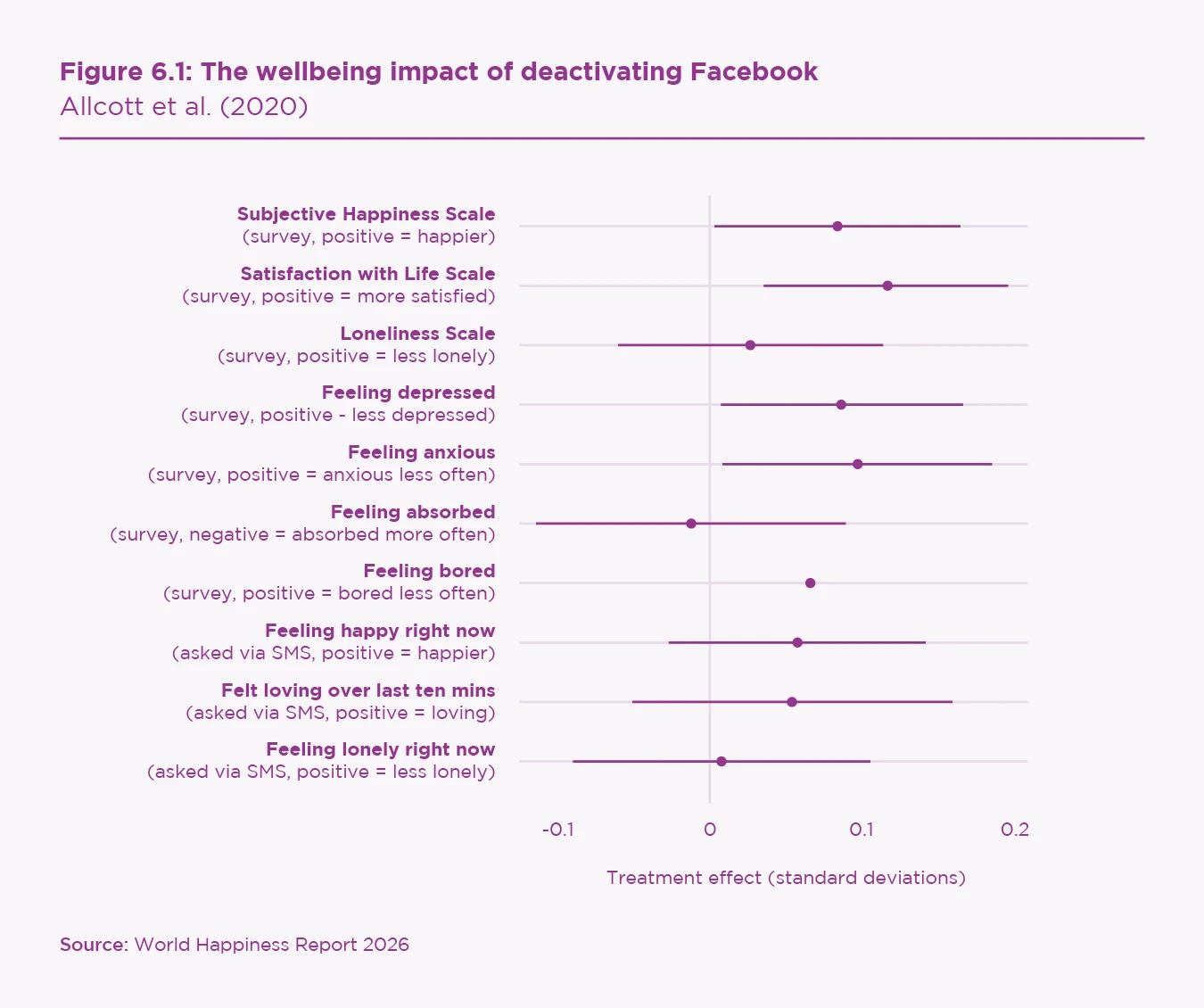
With that point in mind, Allcott and his colleagues asked another question, on which we should place a spotlight. Did people learn from their experience? How much? On the one hand, subjects who deactivated for a month did report a reduction, several weeks later, in their use of the Facebook app. In addition, people in the treatment group were more likely to delete the app from their phones. But, here is the second puzzle: in response to the question inquiring how much money they would demand for another month without Facebook, the median WTA, among those who deactivated, was about $86. That is a relatively modest reduction from the $100 median that they demanded before their month off.
On the basis of these findings, Allcott et al. conclude that “traditional consumer surplus measures,” based on WTA, “overstate the true welfare gains from social media.” The reason is that the $100 figure, representing that surplus, is higher than the $86 figure after learning. Even so, Allcott et al. conclude that “Facebook generates enormous flows of consumer surplus.” The reason is that if we multiply $86 by the total number of Facebook users in the US (about 250 million), we will find a very high monetary figure: $21.5 billion. Perhaps that figure is the monetised consumer surplus (I will raise doubts about that idea shortly).

But let us return to the puzzle, on which Allcott et al. do not linger. If deactivated Facebook users had an unusually good month, precisely because they deactivated, why should they demand $86 for another good month? Why would the median amount not be $10, or $5, or $0? Or why would they not be willing to pay something to install some kind of block?
As for the puzzle in the first study, we do not know, but we can speculate about two plausible answers. First, subjects may have anchored on the figure they previously suggested, with a median of $100, and adjusted downwards. If so, the $86 amount is a case study in the standard process of anchoring and adjustment;[12] it does not tell us much about welfare effects. Second, the improvement to their wellbeing may have been so novel and unexpected (and so relatively small) that it was not stored in memory, or sufficiently linked to their social media deactivation. Third, improvements in wellbeing may have been offset by awareness of the pervasiveness of usage. Though people are happier without Facebook, they might now be a bit unusual in their community, and they might have chosen to suffer (slightly) more to do what relevant others do. In that sense, they might be willing to conform, even at the expense of happiness or subjective experience.
Fourth, and perhaps most interestingly, people may obtain goods from Facebook usage that matter to them, but are not adequately captured in measures of subjective wellbeing, which is hardly the only thing that people care about.[13] For example, Allcott et al. find that the control group had significantly more political knowledge than the treatment group. Indeed, that is the only measured dimension along which those who deactivated were worse off than those who did not. Political knowledge might increase anxiety and depression; ignorance, as they say, is bliss. Even so, people might be willing to trade a little anxiety and sadness in return for political knowledge. There is also the associated question of connections with friends and family members. People might value those connections, even if they adversely affect wellbeing. The $86 figure might reflect this judgment: “I know that I am a little more anxious, and a little sadder, but it is worth it, to be connected with people I care about.”
Political knowledge might increase anxiety and depression; ignorance, as they say, is bliss. Even so, people might be willing to trade a little anxiety and sadness in return for political knowledge.
I emphasise that these explanations are speculative. We do not yet know why people would demand significant money to be deactivated from a social media platform after having experienced a month in which deactivation made their lives better along every measurement of subjective wellbeing. But we are about to get an important clue.
Bad goods
Both of the studies just described ask people about their valuation of social media platforms in their individual capacities. They did not test whether people’s valuations would change if they were asked about their willingness to accept money, or to pay money, to shut down a social media platform in a relevant community. That question might greatly matter. For example, people might be willing to pay something for a good if everyone else has that good, but might wish that no one had the good. Luxury goods might well fall in that category. Perhaps people buy them, contingent on their existence, in order to give the right social signals (or not give the wrong social signals); but perhaps they wish that those goods did not exist.[14] If there are goods that people buy but wish did not exist – because those goods make them less happy or otherwise worse off – we have a general problem, and it cries out for a solution.
Leonardo Bursztyn and collaborators explored this question in the context of social media platforms.[15] Recruiting hundreds of US college students, they found that, on average, participants would demand $59 to deactivate TikTok for a month and $47 to deactivate Instagram for the same period.[16] Those findings are broadly consistent with the two studies discussed earlier. Here again, we might conclude that the two platforms make people much better off and generate a massive consumer surplus. But in sharp contrast, Bursztyn et al. find that participants would be willing to pay $28 to have all members of their community (the relevant academic institution), including themselves, deactivate from TikTok for a month, and $10 to do the same for Instagram.[17] Almost two-thirds of the active TikTok users appear to lose welfare from the existence of the platform. The same is true for almost half of the active Instagram users. They wish that everyone in their community were off the platforms.

The central finding is that many people would demand significant money to stop using a product that they wish did not exist. Notably, there is heterogeneity on this count; some people believe that they gain from the existence of both platforms. But a very large number believe that they lose. On the basis of those findings, and with reference to qualitative evidence in which participants explained their choices, Bursztyn et al. urge that people sometimes find themselves in “product traps,” in which they buy goods for whose abolition they would also be willing to pay. In some cases, we have reason to think that people simultaneously benefit from having access to a good, contingent on its existence, and would benefit from eliminating that good, if only they could. Bursztyn et al. find strong evidence on behalf of this conclusion. In this light, the third puzzle is both the most paradoxical and the easiest to resolve: some people spend their time and resources on activities or goods that they do not like and might even deplore.
Bursztyn et al. urge that people sometimes find themselves in “product traps,” in which they buy goods for whose abolition they would also be willing to pay.
To see the structure of the problem, its underlying mechanisms, and its generality, consider a simple example. There is a party next Saturday night, and many of your friends will be there. You have two options: (1) attend the party, or (2) skip the party. Contingent on there being a party, you might choose (1). In fact, your preference might be both clear and strong. You might be willing to pay a great deal to attend the party. At the same time, you might prefer another option: (3) the party does not take place. You might wish, on reflection, that the party had not been arranged in the first place. Or you might hope that the party will be cancelled. Your preference ordering is: (3), (1), and (2).
Why is that an imaginable preference ordering? A general answer is “fear of missing out,” but that phrase can mean several things. It is often understood to mean that if you miss something, there is some probability that you will lose something of importance, which suggests you should prefer (1) to either (2) or (3). The question remains: why would you prefer (3) to (1), but (1) to (2)? One possibility is that if you do not attend the party, you will give a signal that you would prefer not to give. The signal might be that you do not like parties, that you do not like your friends, or that you do not like the host. The cost of giving any of those signals might seem very high. You might jeopardise or lose friendships, or compromise relationships. But if the party is cancelled, you can avoid an event that you prefer to avoid without giving the undesired signal.
Note that a crucial feature of your thinking is the social meaning of failing to attend the party. You might not intend the received meaning (you do like your friends; you do like your host), but you have little or no control over it. This, then, is a possible reason for the preference of (3) to (1), and (1) to (2): the unwanted signal that is given by refusing to go to the party.

There is another possibility. You might think that if the party happens, there will be opportunities for relationship-building. You might not care much about those opportunities; if you did, you would not want the party to be cancelled. Still, you might think that if other people take advantage of the opportunities and if you do not, you will be at a comparative disadvantage (this is one conception of “fear of missing out”). If the party is cancelled, you do not have to go, which is good (very good!), and you also will not be at a disadvantage, which is good (very good!) as well. You go to the party to avoid that disadvantage, but without the party, you would be better off.
In the context of social media use, the structure of the problem appears to be similar. Bursztyn et al. show that product traps exist whenever the value of relevant products stems in whole, or in large part, from the fact that people would lose out from non-use or non-consumption, on the assumption that other people are using or consuming those products. Significantly, product traps may exist even if there is no issue of addiction. Nor are such traps at all unusual. Sometimes they are deliberately engineered by savvy marketers. Sometimes they are a result of norms whose existence cannot be attributed to particular designers, and that might have emerged from invisible hand mechanisms. The key point is that many social media users wish the platform they use did not exist and would even be willing to pay to put it out of existence. This is strong evidence that they are losing welfare as a result of their free choices.
If users could coordinate and agree to stop using Instagram or TikTok, and if they could make the agreement binding, many of them would be better off.
Conclusion
People appear to be willing to pay very little for social media use. For a substantial number of users, the WTP is $0. Many people may well consider social media platforms to be ‘Wasting Time Goods’, which helps explain why they would pay little or nothing to use them.
Those who deactivate from Facebook for a month have a better month than they otherwise would. They are happier, more satisfied with their lives, less depressed, and less anxious. What is less clear, and what is a genuine puzzle, is why those who have enjoyed that good month demand a substantial sum of money to be deactivated for another month. For some people who make that demand, it is reasonable to speculate that Facebook provides a set of benefits, including political knowledge and personal connections, that do not translate into increases in subjective wellbeing. But it is also reasonable to speculate that people suffer from some kind of addiction, or do not want to miss out on interactions that involve their friends and neighbours.
That speculation has a clear connection with the most significant finding of the three discussed in this chapter: many US college students who would demand a considerable sum to deactivate from Instagram or TikTok for a month would also be willing to pay to deactivate from those platforms for a month, if (and only if) everyone else in their community deactivated as well. In this respect, social media platforms appear to be a good that many active users wish did not exist.
A major reason appears to be fear of missing out: the perceived social losses that particular users would incur if such platforms existed, but if those users were excluded. This is a negative externality imposed on non-users, a kind of product trap. If users could coordinate and agree to stop using Instagram or TikTok, and if they could make the agreement binding, many of them would be better off. They would be happier. Their lives would be better. They are keenly aware of those facts.
References
Allcott, H., Braghieri, L., Eichmeyer, S., & Gentzkow, M. (2020). The Welfare Effects of Social Media. American Economic Review, 110(3), 629–676. https://doi.org/10.1257/aer.20190658
Benjamin, D. J., Heffetz, O., Kimball, M. S., & Rees-Jones, A. (2012). What Do You Think Would Make You Happier? What Do You Think You Would Choose? American Economic Review, 102(5), 2083–2110. https://doi.org/10.1257/aer.102.5.2083
Bursztyn, L., Rao, G., Roth, C. P., & Yanagizawa-Drott, D. (2023). When Product Markets Become Collective Traps: The Case of Social Media (Working Paper No. 31771). National Bureau of Economic Research. https://doi.org/10.1257/aer.20231468
Coase, R. H. (1960). The Problem of Social Cost. The Journal of Law and Economics, 3, 1–44. https://doi.org/10.1086/674872
Ericson, K. M. M., & Fuster, A. (2014). The Endowment Effect. Annual Review of Economics, 6(1), 555–579. http://dx.doi.org/10.1146/annurev-economics-080213-041320
Frederick, S., Novemsky, N., Wang, J., Dhar, R., & Nowlis, S. (2009). Opportunity Cost Neglect. Journal of Consumer Research, 36(4), 553–561. https://doi.org/10.1086/599764
Frank, R. H. (1999). Luxury Fever: Why Money Fails to Satisfy in an Era of Excess. Free Press.
Kahneman, D. (1992). Reference Points, Anchors, Norms, and Mixed Feelings. Organizational Behavior and Human Decision Processes, 51(2), 296–312. https://doi.org/10.1016/0749-5978(92)90015-Y
Kahneman, D., Knetsch, J. L., & Thaler, R. H. (1990). Experimental tests of the endowment effect and the Coase theorem. Journal of Political Economy, 98(6), 1325–1348. http://dx.doi.org/10.1086/261737
Kogler, C., Kühberger, A., & Gilhofer, R. (2013). Real and hypothetical endowment effects when exchanging lottery tickets: Is regret a better explanation than loss aversion? Journal of Economic Psychology, 37, 42–53. https://doi.org/10.1016/j.joep.2013.05.001
Morewedge, C. K., & Giblin, C. E. (2015). Explanations of the Endowment Effect: an Integrative Review. Trends in Cognitive Sciences, 18(6), 339–348. https://doi.org/10.1016/j.tics.2015.04.004
Sharot, T., & Sunstein, C. R. (2024). Look Again: The Power of Noticing What Was Always There. One Signal Publishers.
Sunstein, C. R. (2020). Valuing Facebook. Behavioural Public Policy, 4(3), 370–397. http://dx.doi.org/10.2139/ssrn.3241348
Endnotes
Ericson and Fuster (2014); Kahneman et al. (1990); Morewedge and Giblin (2015). ↩︎
Ericson and Fuster (2014); Kahneman et al. (1990); Kogler et al. (2013); Morewedge and Giblin (2015). ↩︎
“We measure individual level WTA to deactivate one’s social media account for a period of four weeks, taking others’ social media consumption as given.” ↩︎
“We measure individual WTA conditional on all participating students being asked to deactivate their account in exchange for monetary compensation.” ↩︎